

Remembering the First Attempt
Cloud gaming’s first real push for mainstream attention came with enormous fanfare and, in retrospect, not nearly enough infrastructure to back it up. Early services promised console-quality gaming streamed to any screen, with no hardware purchase required beyond an internet connection. The pitch was compelling. The execution, for a large share of early adopters, was not. Input lag undermined fast-paced genres, video compression artifacts were distracting on anything beyond a modest connection, and server capacity struggled to keep pace with demand during peak hours, leading to queues and dropped sessions that did lasting damage to public perception of the category.
Several high-profile services shut down entirely within a few years of launch, and for a while it looked like cloud gaming might be remembered as a classic case of technology arriving before the infrastructure needed to support it properly. That verdict now looks premature. Quietly, and with considerably less fanfare than the first wave, cloud gaming has been rebuilding, and the underlying technology finally looks like it might be catching up to the original promise.
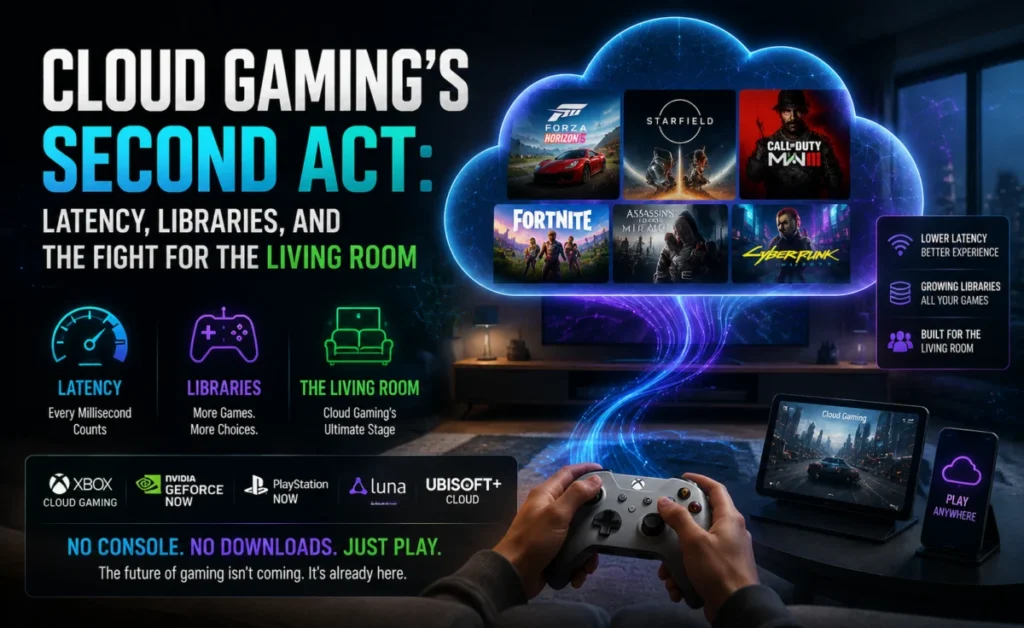
What Actually Changed
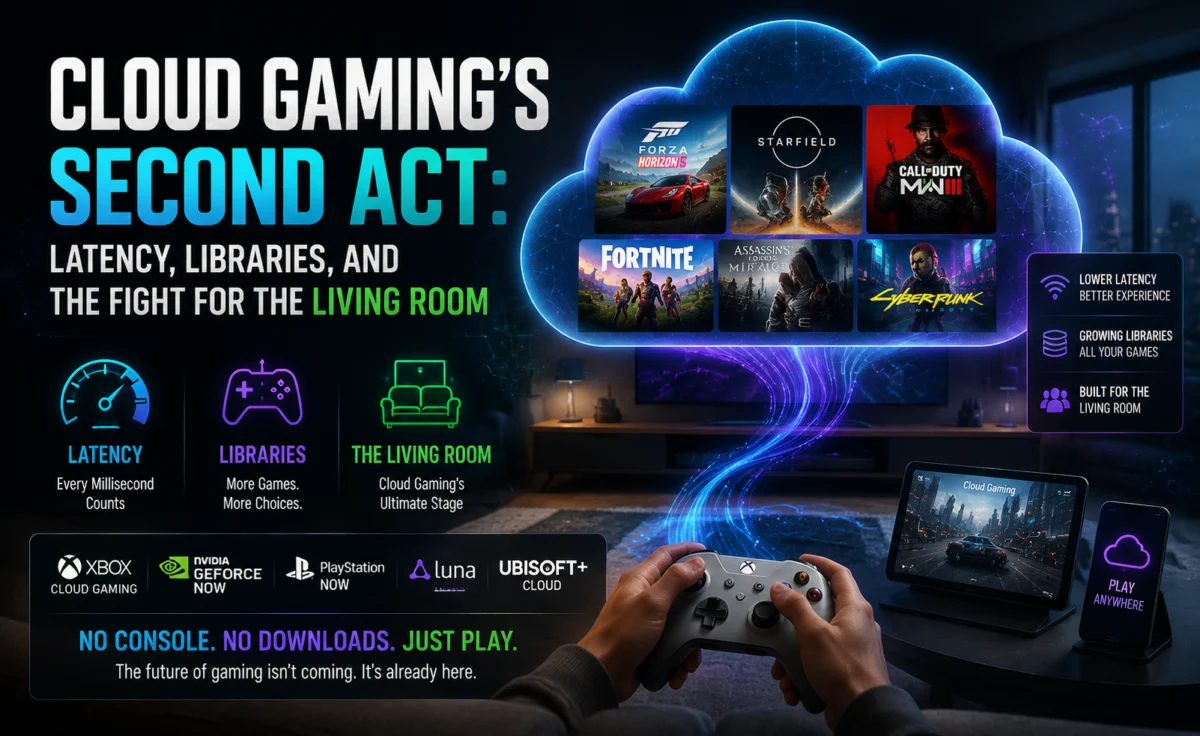
The single biggest factor behind cloud gaming’s improved performance is not any one dramatic breakthrough, but a steady accumulation of infrastructure investment that has genuinely paid off. Edge computing — placing server capacity physically closer to end users rather than relying on a handful of centralized data centers — has reduced round-trip latency in many markets to levels that are difficult to distinguish from local hardware for all but the most reaction-time-sensitive competitive genres.
Video compression has also improved substantially, with newer codecs able to deliver noticeably cleaner image quality at the same bitrate, which matters enormously for a technology that is fundamentally streaming a live video feed of gameplay rather than running code locally. Combined with more widespread high-speed broadband and improved home Wi-Fi standards, the practical experience of cloud gaming for a typical user in a well-served market has improved to the point where blind testing has, in several documented comparisons, shown players struggling to reliably distinguish a cloud stream from local hardware in non-competitive genres.
- Edge server expansion: physical proximity to data centers has reduced latency more than any single software optimization.
- Modern video codecs: better compression efficiency delivers cleaner images without requiring more bandwidth.
- Adaptive streaming logic: services now adjust resolution and bitrate dynamically and far more gracefully than early implementations.
- Broader broadband access: continued infrastructure investment in many regions has expanded the pool of users with a connection actually capable of good performance.
The Pitch Has Sharpened
Early cloud gaming marketing leaned heavily on the idea of replacing a console or gaming PC entirely, a promise that set expectations the technology of the time simply could not meet for a meaningful share of users. That framing has shifted noticeably. Rather than positioning cloud gaming as a wholesale replacement for local hardware, most current messaging frames it as an extension — a way to continue a save file on a phone during a commute, play a demanding title on an underpowered laptop, or try a game before committing to a full purchase or download.
This repositioning matters because it aligns the marketing with what the technology can currently deliver reliably, rather than what it might eventually deliver under ideal conditions. Players who approach cloud gaming with the expectation of a convenient supplement to their existing setup, rather than a total replacement for it, report considerably higher satisfaction than the early adopters who were sold, and disappointed by, the original all-or-nothing pitch.
“We spent the first generation trying to convince people to give up their console. We’re spending this generation trying to convince people to bring their save file with them,” said one platform executive describing the shift in strategy. “That’s a much easier sell, and honestly a much more honest one.”
Ownership and the Library Question
A persistent point of friction for cloud gaming has never been purely technical. A significant portion of skepticism toward the category stems from unresolved questions about ownership: what happens to a player’s library if a streaming service shuts down, changes its catalog, or restructures its subscription tiers? Unlike a physical disc or even a locally downloaded digital purchase, a cloud-streamed game that depends entirely on a remote service’s continued existence carries a form of risk that many players, having watched services shut down once already, remain understandably wary of.
Several services have attempted to address this directly by pairing cloud streaming access with actual digital ownership rights, so a title remains available to a subscriber through other means if the streaming component of the service is discontinued or a specific game leaves the streaming catalog. This hybrid approach — stream when convenient, retain access when not — appears to be emerging as something closer to an industry standard than the pure rental model several early services relied on, largely because it directly answers the trust deficit that damaged the category’s reputation the first time around.
Where Cloud Gaming Fits Now
Rather than displacing local hardware entirely, cloud gaming increasingly looks like it is settling into a specific, genuinely useful niche within a broader ecosystem rather than replacing that ecosystem outright. It works well as a bridge for players transitioning between hardware generations, as an accessibility tool for players whose disabilities make dedicated gaming hardware difficult to use, as a low-commitment trial mechanism for publishers wanting players to sample a game before buying, and as a genuine convenience layer for players who simply want continuity across multiple devices throughout their day.
This more modest, more specific positioning is arguably a healthier foundation for the category than the sweeping “cloud gaming will replace consoles” framing of the first wave. A technology solving a clearly defined problem for a clearly defined use case tends to build sustainable adoption more reliably than one promising to overturn an entire hardware ecosystem in one generation, and the current, quieter build-out of cloud gaming infrastructure looks considerably more likely to stick around for the long haul than its first, louder attempt at mainstream relevance.
Handheld Hardware Complicates the Picture
Ironically, one of the more interesting developments shaping cloud gaming’s second act has come from outside the streaming space entirely: a wave of increasingly capable dedicated handheld gaming devices that can run demanding titles locally, no streaming connection required. These devices complicate the original framing of cloud gaming as the primary path to portable, high-end gaming, since a growing share of that use case can now be served just as well, and more reliably, by local hardware that has become dramatically more power-efficient in a short span of time.
Rather than positioning this as a competitive threat, several cloud gaming providers have instead built native applications specifically for these handheld devices, treating them as just another screen in a broader multi-device strategy rather than a rival platform to be beaten. This pragmatic approach reflects a broader lesson the industry appears to have absorbed from the first cloud gaming wave: rather than betting everything on cloud streaming replacing local hardware outright, the more durable strategy has been to make cloud access available everywhere a player might want it, alongside local hardware rather than in opposition to it.
The Road Ahead
Remaining challenges are real but narrower in scope than the ones that plagued the first generation. Rural and underserved markets still lack the broadband infrastructure needed for a consistently good cloud gaming experience, competitive genres with extremely tight timing windows remain a difficult fit for any streaming-based approach regardless of latency improvements, and the ownership question, while improved, has not been fully resolved industry-wide.
None of these challenges look insurmountable in the way the fundamental latency and image quality problems of the first wave once did. Barring a major and unexpected setback, cloud gaming’s second act looks considerably more durable than its first, not because the technology has become perfect, but because both the infrastructure and the expectations surrounding it have finally grown up to meet each other somewhere in the middle.
What Publishers Actually Get Out of It
From a publisher’s perspective, cloud gaming has quietly become valuable for reasons that have little to do with subscriber counts or headline streaming quality. Frictionless trial access, where a player can sample a demanding game instantly without a lengthy download, has proven to be a genuinely effective conversion tool for turning casual interest into a purchase, particularly for large open-world titles whose download size alone can otherwise discourage an impulse trial. Several publishers have reported meaningfully higher conversion rates from cloud-based trials compared to traditional demo downloads, largely because removing the wait between curiosity and actually playing changes player behavior in ways that a slicker marketing trailer alone cannot replicate.
Cloud infrastructure has also opened up a secondary benefit that is rarely mentioned publicly: it gives publishers a controlled environment to test new hardware configurations, patch stability, and server load at a much smaller scale than a full public launch, since a cloud-hosted build can be adjusted centrally without requiring millions of individual client updates. For live-service titles in particular, this has become a quietly important part of how updates get validated before a wider rollout, folding cloud infrastructure into the development and testing pipeline in ways that have nothing to do with the player-facing streaming pitch at all.
About the Author