
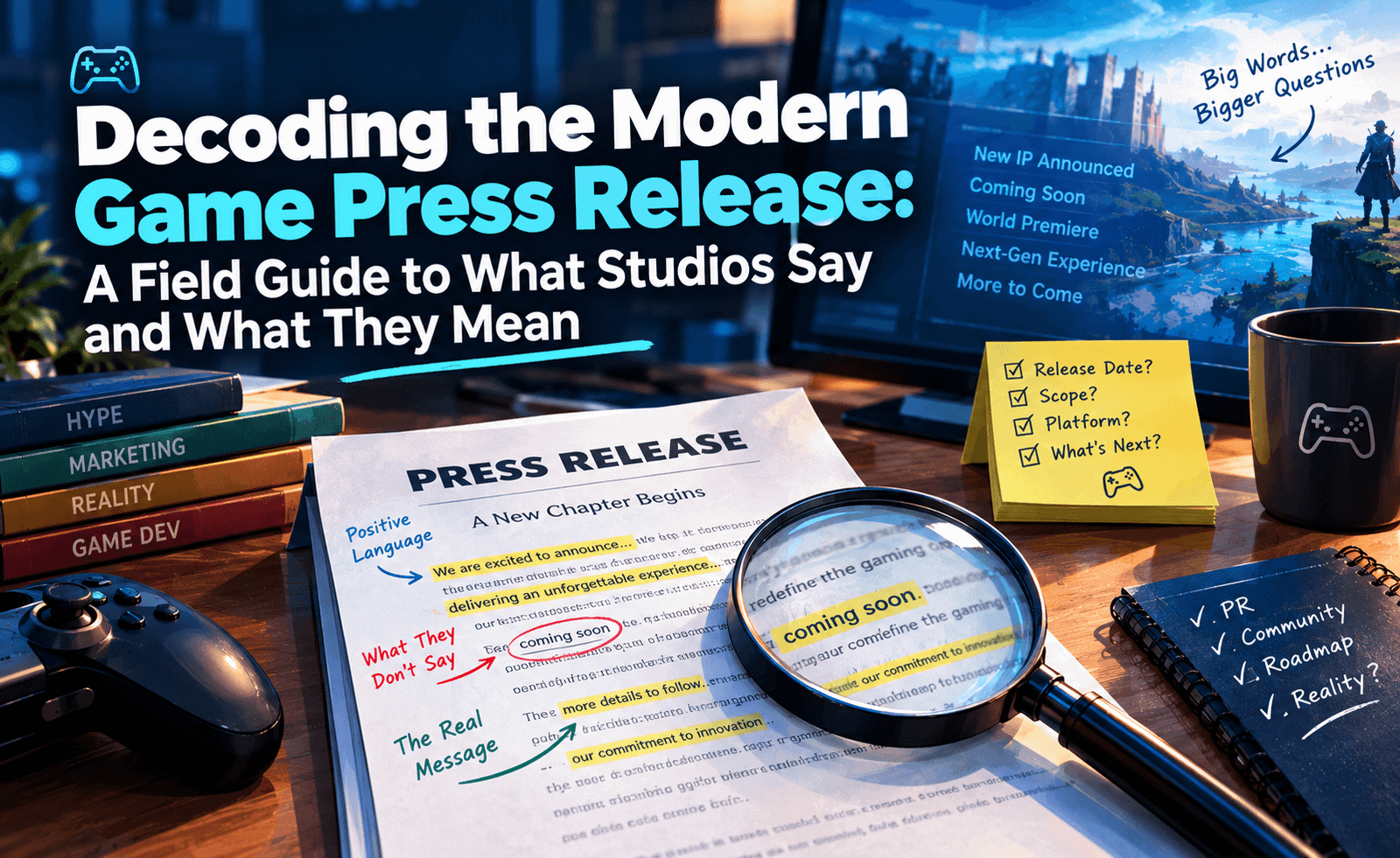
Decoding the Modern Game Press Release
Every game announcement is a small piece of theater. The press release is the script, the trailer is the set design, and the quotes from the studio head are the lines everyone has rehearsed. This week, the Depplo Team takes the script apart, line by line, so you can read it like an insider.
Key Takeaways
- A press release is built from a predictable skeleton: headline, hook, quote, feature list, availability, boilerplate.
- The most useful information often sits in the final third of the document, not the headline.
- Vague verbs such as “explore,” “reimagine,” and “elevate” usually signal that a feature is still in flux.
- Platform, pricing, and date language tells you more about a studio’s confidence than any adjective does.
1. Why the Press Release Still Matters
In an era of livestreamed showcases, cinematic reveals, and social posts that reach millions in minutes, it is tempting to declare the humble press release a relic. It is not. Behind nearly every announcement you see on social media sits a document that was drafted, argued over, legally reviewed, and approved by several departments. That document is the official record of what a company is willing to say in writing, and the wording is rarely accidental.
For players, understanding this matters because the press release is the source that journalists, creators, and community managers all draw from. When a headline on a news site uses a particular phrase, it very often traces back to a single sentence in a release. When a rumor gets “confirmed” or “walked back,” the change is usually visible as a difference between two versions of the same document. Learning to read these documents carefully is therefore a practical skill, one that helps you separate real commitments from marketing atmosphere.
It also matters for anyone who writes about games, whether professionally or as a hobby. Press releases are a starting point for coverage, not the finished product. A good writer knows how to extract the factual core, question the gaps, and add context the studio chose to leave out. That is exactly what this guide is designed to help you do.
2. The Skeleton: Six Parts of Almost Every Game Announcement
Although every studio has its own voice, most game press releases follow the same six-part structure. Once you can see it, you cannot unsee it.
Short, declarative, and built to be copied. It carries the single message the company most wants repeated.
Answers who, what, where, and when in about sixty words. If you read nothing else, read this.
Emotion and vision. This is where adjectives live, and where very little verifiable information does.
Bulleted or paragraph-style detail. The most concrete part, and the one worth screenshotting.
Platforms, regions, editions, and dates. Often compressed into a single line that carries enormous weight.
A paragraph about the company, plus legal notes and contact details. Dry, but surprisingly informative.
Let us walk through each part and look at what it can tell you.
The Headline
Headlines are engineered for reuse. A studio knows that many outlets will paste the title directly into their own post, so the wording is chosen to be neutral enough to survive that treatment and exciting enough to attract clicks. Pay attention to the verb. “Announces” is the safest and most common. “Reveals” implies something previously hidden. “Confirms” signals that the information was already circulating and the company is now putting its name on it. “Teases” is a deliberate promise that more will follow, and it often foreshadows a future announcement within weeks.
Pay attention to what is missing, too. If a headline mentions a title and a vague “new chapter” but no platform, you can reasonably assume that platform details are still being negotiated or that the company wants to avoid early comparisons between versions.
The Hook Paragraph
The hook paragraph is the densest part of the document. Professional writers are trained to put the most important facts here, because editors often trim from the bottom. In a well-crafted release, this paragraph will tell you the name of the game or update, the type of announcement, a rough timeframe, and the platforms. If any of those is absent, note it. Absence is data.
A useful exercise is to rewrite the hook paragraph in your own words using only concrete nouns and numbers. If you can fill in “what, when, where, and for how much,” the release is giving you a firm commitment. If you find yourself writing “a major update at some point soon on certain platforms,” you are looking at an announcement that is mostly about momentum rather than information.
The Executive Quote
Almost every release includes a quote from a creative director, studio head, or publisher executive. Quotes are rarely spontaneous. They are drafted by communications teams and approved by the speaker, which means they are an excellent window into the brand message the company wants to project. Words like “passion,” “community,” “vision,” and “journey” are signals of tone, not of content.
That said, quotes can reveal priorities. If a quote spends most of its length thanking players for feedback, the studio is probably positioning an update as a response to community concerns. If it emphasizes technology and scale, the update is probably about performance or new systems. Reading the quote for its emphasis, rather than its claims, is one of the more underrated techniques in games coverage.
The Feature Block
This is the section most players are really looking for, and it rewards careful reading. Look at how features are described. Concrete features use specific nouns: “three new maps,” “a revised matchmaking system,” “support for 120 frames per second on supported hardware.” Soft features use abstract language: “deeper progression,” “enhanced social experiences,” “a more dynamic world.”
Neither type is dishonest, but they tell you different things about development status. Concrete features are generally built, or close to it. Abstract features are often still being shaped, and the language is deliberately loose enough to survive changes. When a release leans heavily on abstractions, a thoughtful reader treats the feature list as a statement of intent rather than a guarantee.
Availability and Pricing
This is the shortest section and frequently the most important. Look for four things: platforms, regions, editions, and dates. Phrases such as “coming to additional platforms at a later date” are a flag that a platform is not guaranteed. “Available worldwide” is a firmer statement than “available in select regions.” A date given as a specific day is a commitment, while a date given as a season or a quarter is a target, and a date given as a year is a hope.
Pricing language deserves the same scrutiny. If a release mentions an “introductory price” or a “launch window discount,” it is telling you that the price will change. If it mentions editions but lists only one price, the other editions are still under discussion or are being held back for a separate announcement.
The Boilerplate
The final paragraph about the company looks like filler, but it can reveal the organizational context of the announcement. It tells you whether a studio is independent or owned by a larger publisher, how many titles it has shipped, and how it describes itself. Changes in boilerplate between releases are a quiet but reliable way to notice that a studio has changed ownership, shifted its focus, or rebranded.
“A press release is not a lie and not the whole truth. It is the version of the truth that survived a meeting.”
— The Depplo Team
3. The Press Decoder: Common Phrases and What They Usually Mean
Every industry develops its own dialect, and games communications is no exception. The table below is not a claim that studios are being deceptive. It is a reading aid. These phrases are normal, and in many cases they are the honest way to describe something that is still in progress. The point is to calibrate your expectations.
| Phrase | What it often signals |
|---|---|
| “Coming soon” | A date exists internally but has not been approved for release, or the date is still moving. |
| “In active development” | The feature exists in some form but is not final. Treat details as provisional. |
| “Reimagined” | Significant changes to something existing. Check whether the change is cosmetic or structural. |
| “Based on community feedback” | A response to criticism. Look for specifics about what changed and what did not. |
| “Details to be shared” | A future announcement is planned, often tied to an event or a marketing beat. |
| “Subject to change” | A legal and practical caveat. It does not mean the feature is at risk, but it means the studio wants flexibility. |
| “Early access” | The product is playable but unfinished, and the roadmap is as important as the current build. |
| “Limited time” | An urgency tactic. Check whether the end date is stated and whether the offer is likely to return. |
4. Reading Between the Lines Without Becoming Cynical
There is a risk in learning this kind of media literacy: it can turn into reflexive cynicism. Not every vague phrase is a warning sign, and not every studio is hiding something. Development is genuinely uncertain, and communications teams often have to describe work that is still evolving. A studio that overpromises specifics and then misses them tends to lose more trust than one that speaks in careful generalities and then delivers.
The healthiest approach is calibrated trust. Give a studio credit for clarity when it is clear, and notice patterns over time. If a team consistently announces features that ship roughly as described, you can reasonably extend more trust to its future announcements. If a team repeatedly uses firm language and then revises it, treat later statements with more caution. The history of a studio’s communication is as informative as any single release.
It helps to maintain a mental ledger with three columns: commitments, intentions, and atmosphere. Commitments are specific, verifiable statements, such as dates, prices, platforms, and named features. Intentions are goals the studio is working toward, such as “we plan to improve performance.” Atmosphere is everything else: the mood, the branding, the sense of excitement. A good release has all three, and a good reader keeps them separate.
5. A Practical Reading Workflow in Five Steps
If you cover games, run a community, or simply like to be well informed, the following workflow takes about five minutes per release and dramatically improves your understanding.
Step 1 — Highlight the nouns and numbers. Mark every date, price, platform, region, and named feature. Ignore adjectives for now.
Step 2 — Sort claims into the three columns. Commitments, intentions, atmosphere. Be strict about it.
Step 3 — List the gaps. What would a reasonable player want to know that the release does not say? Note each gap as a question.
Step 4 — Compare with the previous statement. Has anything changed since the last announcement? Differences are where the story is.
Step 5 — Decide what you will verify. Pick one or two commitments to follow up on, using official channels, store pages, or direct questions during community events.
This approach has an added benefit. When you can state precisely what a release does and does not say, your own writing and conversation become more credible. Instead of “the studio is being vague,” you can say “the release names a quarter for launch but gives no platform list,” which is more useful and harder to dispute.
6. How Embargoes and Timing Shape What You Read
Another layer worth understanding is timing. Many releases are distributed under embargo, meaning that journalists receive information in advance with an agreement not to publish before a specified time. The purpose is to let outlets prepare thorough coverage so that a wave of well-researched articles appears at once. The side effect is that the first hour of coverage after an embargo lifts tends to look suspiciously similar across sites, because everyone is working from the same materials.
The practical lesson is to wait. The most valuable coverage of an announcement often appears a day or two later, once writers have had time to ask follow-up questions, test builds, or speak with developers. If you want a quick overview, the first wave is fine. If you want analysis, patience pays off.
Timing also affects the content of the release. Announcements made just before a major event are often deliberately lighter, because the company is saving details for the stage. Announcements made on quiet days may be heavier, because the studio wants to avoid competing with larger news. Neither is good or bad, but both shape what you should expect to find in the text.
7. What Great Press Communication Looks Like
It is worth ending on a constructive note, because plenty of studios do this well. The best press communication has a few consistent qualities. It states what is known, what is not yet known, and when the next update will arrive. It uses plain language and avoids padding. It includes specific details that a reader can verify. It acknowledges previous statements when plans have changed, instead of silently rewriting history.
Players tend to respond very positively to this style of communication, even when the news itself is disappointing. A delay announced early, with a clear reason and a revised target, generates far less frustration than a delay discovered after the fact. Likewise, a candid roadmap that says “this feature is later than we hoped” earns more goodwill than a polished one that glosses over problems.
For studios reading this, the takeaway is simple: clarity is a feature. For players and writers, the takeaway is equally simple: read for what is concrete, note what is missing, and keep a running memory of how a studio has communicated in the past.
The Depplo Quick Checklist
Before you share or write about any announcement, ask yourself: Is there a date? Is there a platform list? Is there a price? Which features are named, and which are only described? What has changed since last time? If you can answer all five, you have read the release properly.
Final Thoughts
The press release will probably never be glamorous, but it remains one of the most information-rich documents in the games industry. Once you learn its structure, its vocabulary, and its habits, every announcement becomes easier to evaluate. You will spot the difference between a firm commitment and a hopeful intention. You will notice what a studio chooses to emphasize and what it leaves quiet. And you will be better equipped to join conversations about games with accuracy, nuance, and a healthy sense of curiosity.
At Depplo, we will keep bringing you press updates with this lens: what was said, what it likely means, and what is still unanswered. Bookmark this guide, share it with a friend who loves the industry, and the next time a big announcement lands, try the five-step workflow. You may be surprised by how much was hiding in plain sight.
Published by the Depplo Team · depplo.com/ · Category: Game Press Updates
About the Author