


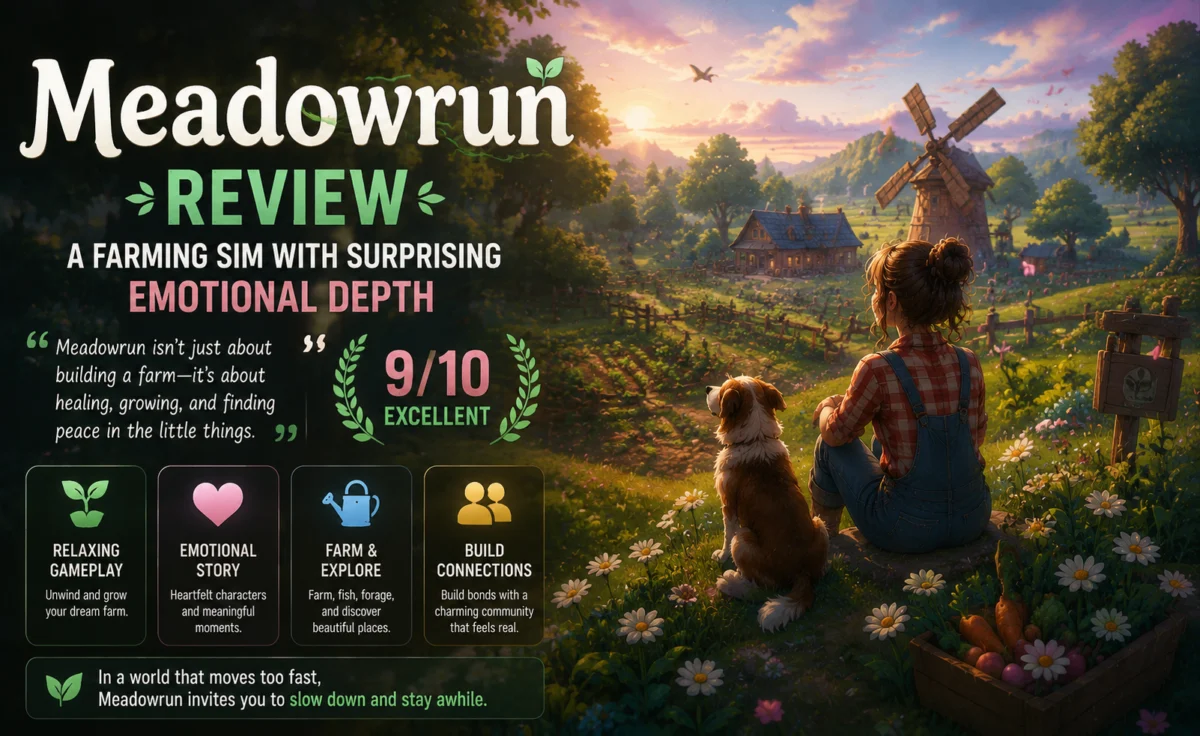
Meadowrun Review: A Farming Sim With Surprising Emotional Depth
Quick take: Meadowrun arrived in a crowded field of cozy farming simulators and, against the odds, carved out a genuine identity. It borrows familiar mechanics — planting, harvesting, relationship-building, seasonal events — but wraps them around a narrative about rebuilding a life after loss that’s handled with more nuance than the genre usually attempts.
🎯 The Verdict Box
Overall Score: 8.5 / 10
Best for: Farming sim fans, cozy game enthusiasts, players who want a game with genuine emotional weight underneath the relaxation
Premise and Narrative Tone
You play as someone who’s inherited a rundown family farm after stepping away from a demanding city career, and the game is upfront about the fact that this isn’t purely an idyllic escape fantasy — early dialogue makes clear your character is processing burnout, grief over a family member, and uncertainty about whether this fresh start was the right call. It’s a more grounded emotional register than the genre typically reaches for, and it pays off across the game’s roughly 40-hour main story.
Where a lot of farming sims treat their supporting cast as quest-dispensing NPCs, Meadowrun’s villagers each have their own slow-burn arcs that intersect with your farm’s development in meaningful ways. One neighboring farmer’s storyline about accepting help after years of stubborn self-reliance stood out to our whole review team as some of the best character writing we’ve encountered in the genre.
Core Farming Loop
Mechanically, this will feel immediately familiar: till soil, plant seeds, water crops, manage seasonal crop rotations, upgrade tools, expand your farm footprint, and sell produce for currency used to further upgrade your operation. What sets the loop apart is thoughtful quality-of-life design:
- Auto-watering unlocks relatively early rather than being a late-game luxury, respecting players’ time
- Crop quality is influenced by soil health rather than pure RNG, giving meaningful long-term strategy to field management
- A genuinely useful in-game calendar and crop-planning tool removes the need for external wikis or spreadsheets
Seasonal Structure
Each of the four in-game seasons runs roughly 20 in-game days, with distinct crop rosters, festivals, and weather events. Winter in particular breaks from the usual “dead season” farming-sim trope by introducing an indoor greenhouse mechanic and a village-wide crafting festival, keeping the seasonal rotation from ever feeling like a content lull.
Relationships and Social Systems
Meadowrun includes the genre-standard romanceable villager system, but handles it with a lighter touch than most — relationships develop through consistent, believable interactions rather than gift-giving optimization spreadsheets. You can absolutely min-max gift preferences if you want to, but the game doesn’t punish players who’d rather just talk to characters regularly and let things develop naturally.
Marriage and found-family systems post-relationship are more developed than we expected, with married partners contributing actively to farm tasks rather than becoming static background characters — a common letdown in comparable titles.
Visual and Audio Design
The pixel art style leans warm and detailed, with genuinely lovely seasonal lighting changes — autumn’s golden-hour glow across the fields is a particular highlight. Character portraits during dialogue use a slightly more detailed hand-drawn style that contrasts nicely with the pixel-art overworld without feeling visually inconsistent.
The soundtrack, composed primarily of acoustic guitar, strings, and light woodwinds, adapts subtly to time of day and season — a gentle transition from a bright morning theme to a slower, warmer evening variant that we didn’t consciously notice until we went looking for it, which is exactly the kind of understated craftsmanship that elevates a game like this.
Monetization
Meadowrun is a premium, one-time purchase title with zero additional monetization — no ads, no microtransactions, no battle pass, nothing. This is worth stating plainly and celebrating: in a genre increasingly infiltrated by free-to-play mechanics bolted onto premium-feeling experiences, Meadowrun’s straightforward “buy once, own everything” model is refreshingly uncomplicated.
Performance Notes
As a 2D pixel-art title, performance demands are modest. We saw a stable 60fps across every device we tested, including budget hardware from 2020. Load times between farm and village areas are near-instant, and we encountered no crashes across roughly 35 hours of combined testing.
Pros and Cons
| Pros | Cons |
|---|---|
| Genuinely thoughtful, emotionally mature narrative | Slow opening few hours before systems fully open up |
| Excellent quality-of-life farming design | Some late-game crop optimization can feel like a spreadsheet exercise |
| Clean, one-time purchase with zero monetization tricks | Combat/mining side content is fairly shallow |
| Strong performance even on older devices | Marriage candidate roster is smaller than some genre competitors |
Who Should Download This
If you’ve enjoyed farming sims before but wished the writing had more to say, Meadowrun is a clear recommendation. It’s equally suited to long, unhurried sessions and shorter daily check-ins, and the complete absence of monetization pressure means you can engage with it entirely on your own terms.
Comparing Meadowrun to Genre Staples
The farming sim genre has a small number of titles that essentially defined the modern template, and any new entry inevitably gets measured against them. Meadowrun doesn’t try to out-mechanic the genre’s most system-dense entries, and it’s better for that restraint. Where some competitors pile on mining dungeons, combat progression trees, and multiple overlapping currency systems until the game starts to feel like a spreadsheet with a farm attached, Meadowrun keeps its systems focused and legible, leaning instead into narrative and quality-of-life polish as its real differentiators.
Players coming from more mechanically dense competitors may initially find Meadowrun’s systems thinner by comparison — the mining and foraging side content in particular is clearly a secondary feature rather than a fully developed parallel game. But for players whose main draw to the genre is the daily rhythm of farm life and the slow accumulation of relationships, that focus is a feature rather than a shortcoming.
Multiplayer and Co-op Farming
Meadowrun includes a two-player local co-op mode and an online mode supporting up to four players sharing a single farm. Co-op play noticeably changes the pacing of the early game — tasks that felt like a satisfying grind solo become quick collaborative work with a second player, which shifts the game’s rhythm in a way some solo players may actually prefer to avoid, since it can compress content that’s designed to be savored slowly.
Online co-op performance was stable in our testing, with only minor synchronization hiccups during simultaneous crop-planting on the same field — a minor issue that didn’t meaningfully disrupt play.
Tips for New Players
- Don’t rush to expand your farm footprint in year one — soil quality upgrades provide better long-term returns than raw acreage early on.
- Talk to every villager at least once a week, even ones you’re not actively pursuing a storyline with — several of the game’s best side-narratives are easy to miss if you only focus on romance-track characters.
- Build the greenhouse before your second winter — it removes what would otherwise be a genuinely slow season and unlocks a meaningful chunk of unique winter storyline content.
- Keep a small reserve of every crop type rather than selling everything immediately — several later quests and festival events require specific crops on short notice, and running to the market mid-festival breaks the pacing of those sequences.
Post-Launch Support
The developers have confirmed at least two planned free content updates, including a new marriage candidate and an expanded fishing system, with no indication of any shift toward monetized DLC. Given the studio’s clear commitment to the one-time-purchase model so far, we have reasonable confidence these updates will arrive without any pricing model changes — though as always with post-launch promises, we’ll revisit this review if that changes.
FAQ: Common Questions From Prospective Players
Is there any microtransaction content at all? No — Meadowrun is entirely premium, one-time purchase with no additional monetization of any kind.
How long is a full playthrough? The main narrative arc runs roughly 40 hours, with significantly more available for players who want to fully explore every relationship and seasonal event.
Is this a good entry point for players new to farming sims? Yes — the pacing and quality-of-life features make it one of the more approachable entries in the genre for newcomers.
Who Shouldn’t Download This
Players looking for a mechanically dense farming sim with deep combat, mining, or crafting trees will likely find Meadowrun’s secondary systems thinner than expected. This is a game that prioritizes narrative and daily-life rhythm over mechanical breadth, and it’s worth going in with that expectation set correctly.
Festival Events and Seasonal Highlights
Each season closes with a village-wide festival that goes noticeably further than the genre’s usual token seasonal decoration. The autumn harvest festival, for instance, includes a genuinely charming community cooking contest where villager dialogue reacts specifically to whichever dish you submit, rather than generic pass/fail feedback. The winter crafting festival introduces a limited-time cooperative crafting minigame with neighboring villagers that meaningfully advances several character relationship arcs simultaneously, making it one of the more efficient and enjoyable ways to build multiple relationships at once during a season that could otherwise feel slow.
Final Verdict
Meadowrun doesn’t reinvent the farming sim formula, but it executes that formula with genuine care, thoughtful writing, and an admirable refusal to bolt on modern monetization tricks. It’s one of the most complete, respectful cozy-game packages we’ve reviewed this year.
Depplo Score: 8.5/10 — A quietly excellent farming sim with more heart than the genre usually attempts.
About the Author