

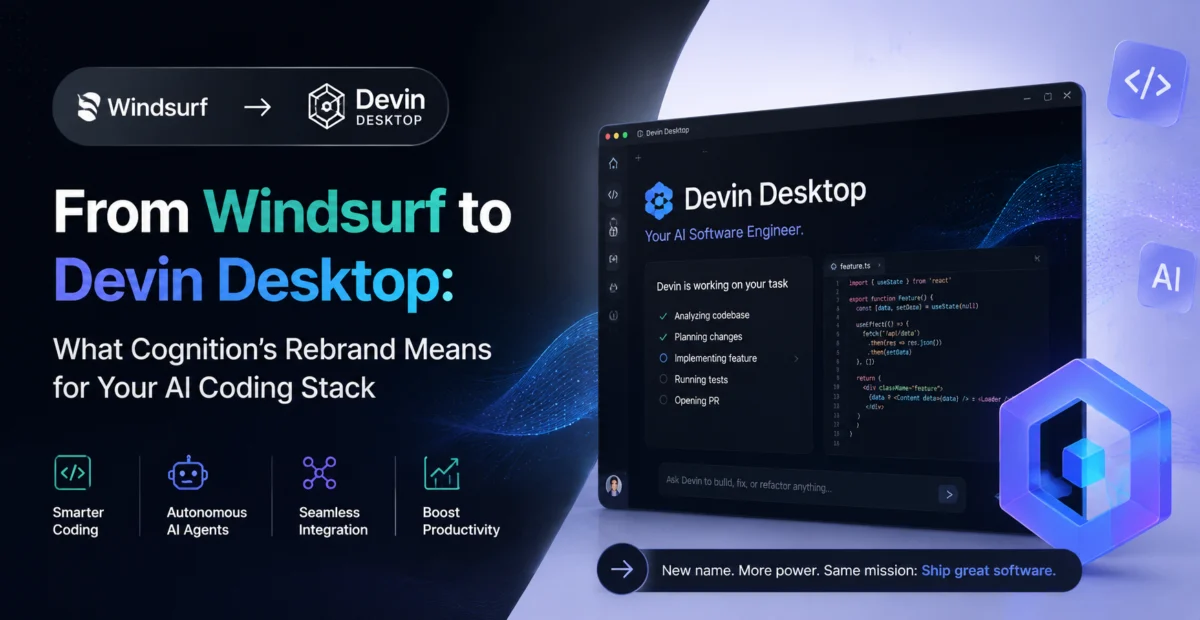
On June 2, 2026, Cognition — the company behind the autonomous engineer Devin — retired the Windsurf name entirely and relaunched the IDE as Devin Desktop. For anyone who adopted Windsurf over the past couple of years, or was evaluating it against Cursor and Copilot, that’s a bigger deal than a simple logo change. We tested the transition firsthand to explain what actually changed under the hood, what stayed the same, and whether it affects your buying decision today.
A Quick History, for Context
Windsurf began as Codeium’s answer to the AI-native editor category Cursor had opened up — a VS Code-pattern fork built around an agentic mode called Cascade, which could plan and execute multi-step coding tasks with diff previews at each stage. It built a loyal following, particularly among developers who found its free tier more generous than Cursor’s and its multi-line inline completions notably snappy. Then, in a sequence of moves that reshaped the competitive landscape, Cognition acquired Codeium, embedded its autonomous engineer Devin directly into the IDE via an April 2026 “Windsurf 2.0” release, added a Devin Terminal CLI shortly after, and finally dropped the Windsurf name altogether in favor of Devin Desktop on June 2, 2026.
What Devin Desktop Actually Is Now
The core editing experience will feel immediately familiar to anyone who used Windsurf — it’s still a VS Code-pattern IDE with Tab completions and an agentic layer. What’s changed is the depth and framing of that agentic layer. Devin Cloud — Cognition’s fully autonomous engineer, capable of taking on tasks with minimal supervision — now ships included with every self-serve plan rather than being a separate product. A new “Agent Command Center” has become the default surface for managing both local and cloud agents, tracking PRs, and organizing context, with “Spaces” letting related agents share context across a project.
The most consequential change, in our view, is a strategic shift toward openness: Devin Desktop now supports the Agent Client Protocol (ACP), meaning agents built by other companies — including OpenAI’s Codex, Anthropic’s Claude Agent, and open-source options like OpenCode — can run directly inside Devin Desktop’s interface, all managed through the same Kanban-style board. That’s a meaningfully different bet than Cursor’s more closed, in-house model approach, and it positions Devin Desktop less as “another AI editor” and more as a control surface for whichever agents you want to run.
Pricing: What Actually Moved
| Tier | Windsurf (pre-2026) | Devin Desktop (current) |
|---|---|---|
| Free | 50 prompt credits, 200 flow action credits | Similar free entry tier retained |
| Pro | $15/month | $20/month (raised March 2026, ahead of the rebrand) |
| Max | Not offered | New $200/month tier introduced |
| Teams | $30/user/month | $40/user/month |
The pricing realignment actually happened in stages before the name change itself — Pro moved from $15 to $20 in March, and Teams moved from $30 to $40/user around the same period — effectively bringing the product in line with where Cursor and Claude Code had already settled. By the time the Devin Desktop name landed in June, the product had already repriced itself out of the “budget AI editor” positioning it built its early reputation on.
What This Means If You’re Already a Windsurf User
Functionally, very little breaks. Projects, settings, and workflows carry over, and the core Cascade-style agentic editing experience is still there under a new name and a deeper feature set. The bigger adjustment is less technical than psychological: what you signed up for as a lightweight, budget-friendly AI IDE has become a more expensive, more ambitious platform explicitly built around Cognition’s autonomous-agent vision. If the reason you chose Windsurf originally was price, it’s worth re-evaluating now that Pro sits at the same $20 as Cursor.
If the reason you chose it was the Cascade agent experience specifically, that experience hasn’t gotten worse — if anything, the addition of Devin Cloud and ACP support has made the agentic side of the product noticeably more capable. The question is whether you want (and will actually use) that expanded scope, or whether you preferred the simpler, cheaper tool it used to be.
Stability: The Elephant in the Room
It would be dishonest to review this transition without addressing the uncertainty it’s created. An acquisition, a leadership shakeup that saw departures to Google, a full product rebrand, and two rounds of price increases within a matter of months is a lot of change for any team to absorb — and it shows up in how developers talk about the product. Compared to Cursor, which has stayed on a more predictable release and pricing cadence over the same period, Devin Desktop currently carries more uncertainty about long-term product direction. That’s not necessarily a reason to avoid it, but it’s a legitimate factor to weigh if stability matters more to your team than being on the newest architecture.
How Devin Desktop Compares Today
- Vs. Cursor: Similar price point ($20/month Pro on both), similar core concept (AI-native VS Code fork with an agent layer). Cursor currently has the larger community and a longer track record of stability; Devin Desktop has the more ambitious agent-orchestration vision with ACP support and included cloud agent access.
- Vs. Claude Code: Devin Desktop is IDE-based with supervised, stage-by-stage diff approval; Claude Code is terminal-based with deeper unsupervised autonomy. Different shapes of tool for different working styles.
- Vs. GitHub Copilot: Copilot remains the lower-cost, lower-friction, multi-IDE option; Devin Desktop asks you to adopt its editor outright in exchange for a considerably deeper agentic experience.
The Broader Pattern: Consolidation in the Agentic IDE Market
The Windsurf-to-Devin-Desktop transition isn’t happening in isolation — it’s part of a broader consolidation wave running through the AI coding tool market in 2026. As the major players race to differentiate on agentic depth rather than raw completion quality, acquisitions and rebrands have become a faster path to “instant” capability than building agent orchestration from scratch. Cognition’s move to fold Codeium’s editor and user base into its own Devin-branded autonomous-engineer vision is a textbook example: rather than building an IDE from zero to compete with Cursor, Cognition bought a mature one and retrofitted its own agent technology on top.
For buyers, this pattern is worth watching closely, because it changes how much weight you should put on a product’s current name and pricing when making a multi-year tooling decision. A tool’s identity in this category has proven, this year alone, to be far less stable than its underlying technology. The Cascade agent experience that made Windsurf popular didn’t disappear — it got absorbed into a larger, more ambitious platform. The lesson for teams evaluating any AI coding tool in 2026 is to weigh the underlying technical capability and the backing company’s trajectory at least as heavily as the current brand and price point, since both of the latter have proven to move quickly this year.
What to Watch Going Forward
A few open questions will determine whether the Devin Desktop bet pays off for Cognition, and they’re worth tracking if you’re considering adopting it: whether the ACP-based multi-agent orchestration model actually gets meaningful third-party adoption beyond Codex and Claude Agent, whether pricing stabilizes now that it’s aligned with the rest of the market, and whether the leadership departures to Google earlier in the year turn out to be an isolated event or the start of a larger talent drain. None of these are reasons to avoid the product today, but they’re reasonable factors to revisit in another two or three release cycles before betting a team’s entire workflow on it.
Practical Recommendations
If you’re currently on Windsurf and happy with it, there’s no urgent reason to leave — your workflow carries forward, and the added capabilities are additive rather than disruptive. If you’re evaluating AI coding tools fresh in mid-2026 and considering Devin Desktop specifically for its ACP-driven multi-agent flexibility, it’s worth a serious trial, particularly if you want a single interface for orchestrating agents from multiple providers rather than committing to one vendor’s stack. If stability and predictability matter more to you than being on the newest architecture, Cursor remains the safer bet at an identical price point today.
Depplo Verdict: The Windsurf-to-Devin-Desktop transition trades budget-friendly simplicity for a more ambitious, more expensive, multi-agent platform. The underlying technology got more capable; the pricing and brand stability got more uncertain. Whether that trade is worth it depends entirely on whether you actually need the expanded scope Cognition is building toward.
What We’d Tell a Friend
If a colleague asked us over coffee whether to bother with Devin Desktop today, our honest answer would depend entirely on why they were asking. Coming from Windsurf already, the advice is simple: keep using it, the product only got more capable, just budget for the higher price. Coming to the category fresh and torn between Devin Desktop and Cursor at the same $20 price point, we’d lean toward Cursor for most individual developers purely on the basis of maturity and community size — you’ll find more shared configs, more troubleshooting threads, and a more predictable roadmap. Where Devin Desktop genuinely pulls ahead is for a team that specifically wants to run agents from multiple vendors — Codex, Claude Agent, and others — through one shared interface instead of juggling separate tools; that’s a real, differentiated use case nothing else on the market currently serves as directly.
Final Thoughts
Rebrands are usually cosmetic. This one isn’t. Cognition used the Windsurf-to-Devin-Desktop transition to signal a real strategic shift — from “AI-assisted editor” to “control surface for autonomous agents from any provider” — and that shift is reflected in the pricing, the new tiers, and the ACP integration alike. It’s a bet worth watching closely over the next few release cycles, especially as Cursor, Copilot, and Claude Code all continue evolving their own agentic ambitions in response.
About the Author