

Depplo Chatbot Reviews
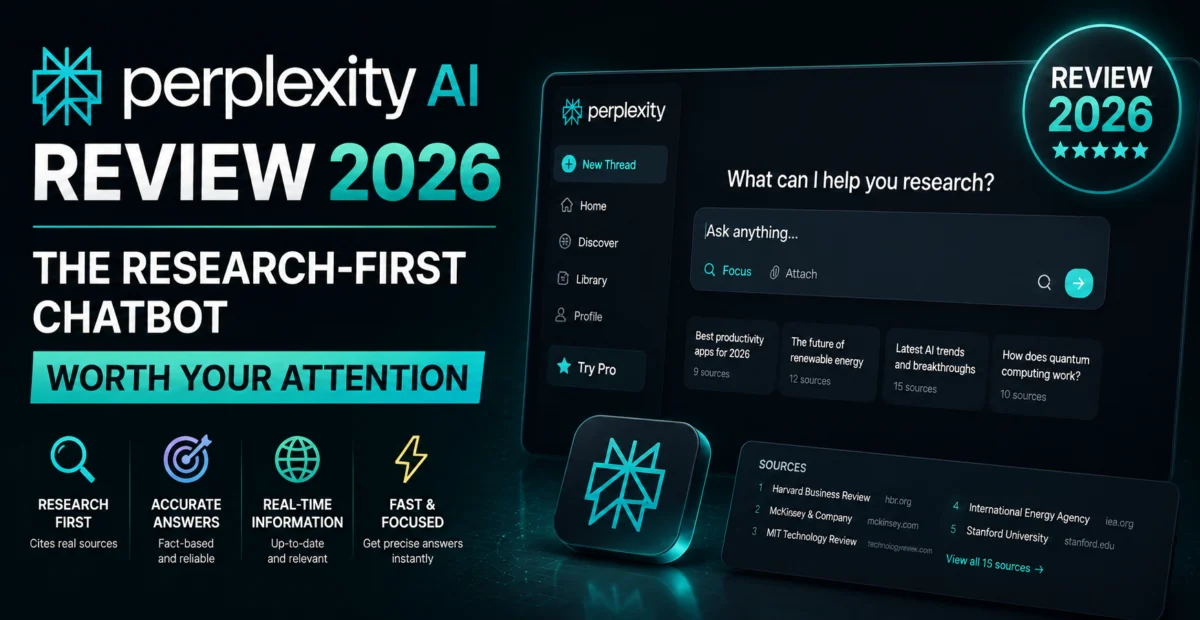
Perplexity AI Review 2026: The Research-First Chatbot Worth Your Attention
Evaluating source transparency, research tools, and real-world accuracy.
Bottom line: If your primary need is trustworthy, verifiable research answers rather than general-purpose chat, Perplexity is one of the strongest tools we’ve tested in this category.
📊 Quick Verdict at a Glance
| Best For | Research, fact-checking, current events |
| Free Tier | Yes, with a daily search cap |
| Source Citations | Visible and reliable |
| Focus Modes | Academic, news, and domain-specific filtering |
| Creative Writing | Not a core strength |
| Browser Extension | Available |
| Depplo Score | 4.3 / 5 |
💡 What Is Perplexity and Who Is It For?
Perplexity AI has built its reputation around a specific promise: answers you can actually trust, backed by visible, clickable sources. Rather than positioning itself as a general creative or coding assistant, Perplexity leans hard into being a research and search-replacement tool, and that focus shows clearly in how it’s designed.
The Depplo Team tested Perplexity primarily as a research companion — comparing it against traditional search, and against the browsing modes of other chatbots — to see whether its source-first approach genuinely produces more trustworthy answers.
It’s best suited to students, analysts, journalists, and anyone who regularly needs to answer a question and immediately verify where that answer came from, particularly in fields where getting a claim wrong carries real professional consequences.
💡 Conversational Quality and Personality
Perplexity’s conversational style is noticeably more utilitarian than some of its competitors — answers are typically structured, concise, and organized around a list of sources rather than a flowing narrative response. This isn’t necessarily a weakness; for research tasks, it’s often exactly what you want.
Follow-up questions are handled well within a research thread, with the model correctly narrowing or expanding its source search based on the conversation’s direction. It felt less suited to open-ended creative writing or casual chat, which doesn’t appear to be its core focus anyway.
The overall tone is efficient rather than personable — a reasonable trade-off given the product’s clear positioning as a research tool first.
💡 Accuracy, Reasoning, and Reliability
This is where Perplexity earns its reputation. Because nearly every factual claim is paired with a visible citation, verifying accuracy is fast and straightforward — a meaningful advantage over chatbots where you have to take the answer largely on faith. In our testing, source quality was generally strong, drawing from a mix of reputable news outlets, academic sources, and primary documentation.
On multi-step reasoning tasks unrelated to live research — complex coding problems or abstract logic puzzles — Perplexity performed adequately but wasn’t the standout performer compared to tools built specifically around deep reasoning. That’s consistent with its positioning: it’s optimized for finding and synthesizing information, not for creative problem-solving from first principles.
For time-sensitive queries — current events, recent product releases, ongoing news stories — it was consistently one of the fastest and most reliable tools in this review series.
💡 Features, Integrations, and Ecosystem
Perplexity’s research-focused features include the ability to build persistent research threads, generate structured reports from multiple sources, and filter searches to specific domains like academic papers or recent news. For anyone doing recurring research work, these organizational tools save real time compared to manually re-running searches.
A dedicated ‘Focus’ style mode lets users narrow the model’s search scope — for example restricting results to academic sources for a literature review, or to recent news for current-events tracking — which noticeably improved answer relevance in our testing.
Browser extensions and mobile apps extend the research workflow outside the main chat window, letting users summarize or fact-check content directly from a webpage they’re already reading.
💡 Pricing and Plans
Perplexity offers a functional free tier with a daily cap on its most advanced search modes, which is enough for occasional research needs. The paid tier significantly raises those limits and unlocks more powerful models for synthesis and reasoning, along with expanded file upload and analysis capabilities.
For students and professionals who research frequently, the paid tier’s higher limits are likely to be worth it; casual users will probably find the free tier sufficient.
💡 Privacy and Data Handling
Because Perplexity’s core function revolves around live web search, it’s worth understanding how your queries are logged and whether they’re used to improve the underlying models. The platform provides settings to manage search history and personalization, which we’d recommend reviewing if research topics are sensitive.
As always, treat any cloud-based research tool with the same caution you’d apply to a search engine: avoid including confidential or proprietary information directly in your queries, especially when researching topics tied to unreleased products or internal business decisions.
💡 Best Use Cases
Perplexity is an easy recommendation for research-heavy workflows: literature reviews, competitive analysis, journalism fact-checking, and general question-answering where source transparency matters. It’s also a strong replacement for traditional search when you want a synthesized answer rather than a list of links to sift through manually.
It’s less suited to open-ended creative writing, casual conversation, or deep autonomous coding projects, where other tools in this review series performed noticeably better.
⚖ How It Compares to Other Chatbots
Against ChatGPT and Claude, Perplexity trades general-purpose flexibility for sharper, more transparent research answers — it’s simply not trying to be a creative writing or coding companion in the same way. Against Gemini, both tools lean on live search, but Perplexity’s citation-first presentation makes source-checking faster and more explicit.
For teams that need both capabilities, our testers often paired Perplexity for the research and fact-finding stage of a project with a more general-purpose chatbot for the writing or coding stage that followed.
📝 Tips From Our Testing
Using Focus modes to restrict searches to academic or news sources meaningfully improved answer relevance compared to leaving the search scope general, especially for niche or technical topics. Starting a dedicated research thread per topic, rather than mixing unrelated questions into one long conversation, also kept source relevance noticeably higher.
For fact-checking existing content, the browser extension was the fastest workflow we tested — highlighting a claim on a webpage and asking for verification returned sourced context in seconds.
📌 Who Should Consider a Different Tool
If you need a strong creative writing partner or a deep coding collaborator, ChatGPT or Claude are better suited to those tasks than a research-first tool like Perplexity. If your research needs are casual and infrequent, the free tiers of more general-purpose assistants may cover your needs without a dedicated research subscription.
But for anyone who researches often and cares about being able to verify what they’re told, Perplexity’s focus is a genuine advantage rather than a limitation.
🧩 Real-World Testing Scenarios
We asked Perplexity to research recent developments in a fast-moving industry topic and compile a short briefing with sources. It returned a well-organized summary within seconds, citing a mix of news outlets and a primary press release, and correctly noted where two sources presented slightly different figures rather than silently picking one.
In a separate academic-focused test using the Focus mode restricted to scholarly sources, it surfaced relevant papers on a niche topic that a general web search buried several pages down, and summarized each paper’s core finding accurately enough to save real time during an initial literature scan. Both scenarios reflected the same underlying pattern: Perplexity performs best when a task genuinely benefits from live, verifiable information rather than pure creative generation.
Pros
- ✅ Fast, well-sourced answers with visible citations
- ✅ Excellent for current events and time-sensitive research
- ✅ Useful Focus modes for academic or news-specific searches
- ✅ Strong browser extension for on-page fact-checking
- ✅ Functional and generous free tier
Cons
- ❌ Less capable for creative writing and casual conversation
- ❌ Not a top performer on abstract, non-research reasoning tasks
- ❌ Advanced modes are capped daily on the free tier
❓ Frequently Asked Questions
Q: Does Perplexity replace a traditional search engine?
For many research tasks, yes — it synthesizes an answer with sources rather than returning a list of links, though a traditional search engine is still useful for pure browsing.
Q: Are Perplexity’s sources reliable?
In our testing, source quality was generally strong, drawing from reputable outlets and primary documentation, though every citation is worth a quick review as with any research tool.
Q: Is Perplexity good for coding?
It’s adequate but not a specialist tool for coding compared to dedicated coding-focused chatbots.
Q: How is Perplexity different from just using a search engine?
Rather than returning a list of links to click through manually, Perplexity synthesizes a direct answer while still showing the underlying sources, which typically saves time on straightforward informational questions while still allowing quick verification.
🏆 The Depplo Verdict
Perplexity succeeds by doing one thing exceptionally well rather than trying to be everything to everyone. For research-heavy users who value transparency and speed, it’s a genuinely excellent tool and one of the easiest recommendations in this review series.
Reviewed by the Depplo Team — independent AI software testing and analysis at depplo.com/.
About the Author