

From Gold Rush to Reckoning
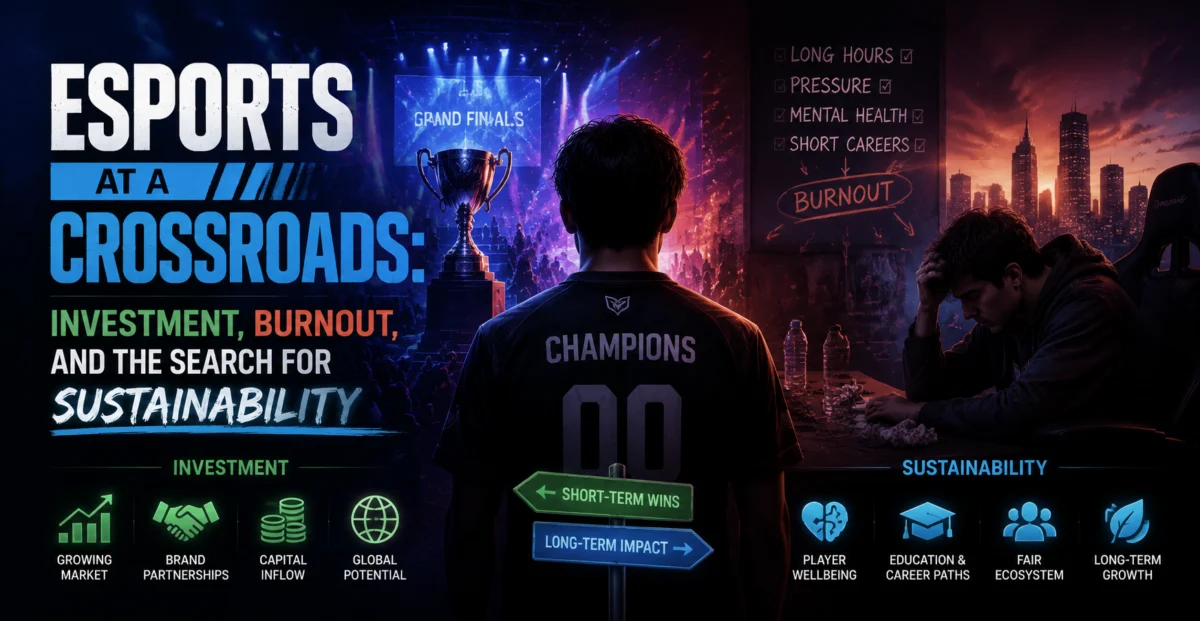
It is worth remembering how recently esports was treated as an unstoppable growth story. For much of the last decade, headlines focused almost exclusively on record-breaking prize pools, franchise slots selling for tens of millions of dollars, and venture capital flowing into organizations that, in many cases, had never turned a profit. That narrative has changed considerably. Several major organizations have folded or scaled back operations in the past two years, franchise leagues have quietly relaxed some of their rigid structural requirements, and conversations at industry conferences have shifted from “how big can this get” to “how do we make this last.”
None of this means esports is dying, despite the periodic wave of obituaries that circulates every time a prominent org shuts down. Viewership for major tournaments remains substantial, sponsorship deals continue to be signed, and a new generation of players and fans continues to enter the ecosystem. What has changed is the recognition that the previous decade’s growth was subsidized heavily by external investment chasing a speculative future, rather than organic revenue, and that subsidy is drying up.
The Franchise Model’s Growing Pains
Franchised leagues, modeled explicitly on traditional sports leagues like the NFL or NBA, were pitched to investors as a way to bring stability to an inherently volatile ecosystem. Buying a permanent slot, the logic went, meant an organization no longer had to worry about relegation or qualification, giving them the security to invest in facilities, staff, and long-term player development the way a traditional sports franchise would.
In practice, several of these leagues have struggled to deliver the return on investment that justified the original slot fees, some of which reportedly ran into eight figures. Local media rights, a cornerstone of traditional sports economics, have been slow to materialize at meaningful scale for most esports leagues, since global online viewership doesn’t map cleanly onto the regional broadcast model that generates the bulk of traditional sports revenue. Several publishers running franchised leagues have responded by revisiting fee structures, introducing promotion and relegation elements in some cases, or restructuring how revenue is shared between the league and its member organizations.
“The franchise model wasn’t wrong, it was just built for a revenue environment that hasn’t arrived yet, at least not on the original timeline,” said one team owner who has operated across multiple titles. “We’re now building for the revenue environment that actually exists.”
The Human Cost of the Boom-Bust Cycle
Behind the financial headlines is a workforce that has borne the brunt of the volatility. Player contracts in esports have historically offered far less security than their traditional sports counterparts, with shorter guaranteed terms, fewer structured benefits, and compensation heavily weighted toward prize winnings rather than salary. When organizations fold or scale back, players and support staff — coaches, analysts, content producers — are often the first to feel the impact, sometimes with little notice.
Mental health has become a increasingly prominent topic in competitive gaming discourse, and not only because of contract instability. Professional players in the most demanding titles often train for ten or more hours daily, face public scrutiny of every mistake in real time via chat and social media, and operate on career timelines that, for some titles, can be startlingly short before reflexes and reaction time begin to decline relative to a new generation of competitors. Several former professionals have spoken openly in recent interviews about burnout setting in well before their competitive careers naturally would have ended, and about the lack of structured support systems compared to traditional athletics, where sports psychology and post-career transition planning are far more established.
- Shorter competitive lifespans: many titles see peak individual performance in players’ late teens to mid-twenties.
- Limited post-career pathways: transitioning into coaching, casting, or content creation is possible but far from guaranteed.
- Inconsistent mental health infrastructure: support varies enormously between well-funded organizations and smaller, scrappier teams.
- Public scrutiny at scale: real-time chat and social commentary during matches creates pressure traditional athletes rarely face in the same immediate form.
Some organizations and player associations have begun addressing these gaps directly, introducing standardized minimum contract terms, mental health resources, and educational or career-transition programs. These efforts remain uneven across the industry, but their existence at all marks a shift from a purely growth-obsessed mindset toward one that at least acknowledges player welfare as part of building a sustainable ecosystem, rather than a cost center to be minimized.
Where the Money Is Actually Working
Not every corner of competitive gaming is struggling. Grassroots and semi-professional scenes, which never carried the inflated valuations of top-tier franchised leagues, have in some cases proven more resilient, because their cost structures were never built around the assumption of endless external investment. Community-organized tournaments, local competitive circuits, and lower-cost regional leagues continue to operate on modest but sustainable budgets, often driven by genuine community passion rather than venture funding.
Mobile esports has also emerged as a notably strong performer in several regions, benefiting from lower production costs, enormous existing player bases, and audiences that skew toward markets where mobile is the primary gaming platform rather than console or PC. Several mobile titles now run competitive circuits with viewership figures that rival or exceed some traditional PC and console esports, while operating on a fraction of the production budget, a combination that has attracted renewed sponsor interest even as spending elsewhere has cooled.
What Sustainability Might Actually Look Like
Industry observers increasingly converge on a similar set of recommendations when asked what a healthier esports ecosystem would require. Diversified revenue is at the top of nearly every list — reducing reliance on any single sponsor category, building direct-to-consumer revenue through merchandise and membership models, and developing media products, like behind-the-scenes documentary content, that can generate revenue independent of live tournament viewership.
There is also a growing push toward right-sizing expectations. Rather than every title’s competitive scene aspiring to NFL-scale franchise economics, several publishers and organizers now talk about building competitive ecosystems calibrated to the actual size and engagement level of a given game’s community, rather than a one-size-fits-all franchised league model borrowed wholesale from traditional sports.
A Maturing Industry, Not a Dying One
The current period is probably best understood not as the end of esports, but as its transition from an adolescent industry defined by speculative growth into a more mature one defined by sustainable, if less spectacular, economics. That transition is uncomfortable, and it has real costs for the players and organizations caught in the middle of it. But a competitive gaming ecosystem built on actual revenue rather than investor optimism is, by most measures, a healthier long-term foundation than the one it is replacing.
The organizations, leagues, and players who navigate this period successfully will likely be the ones who treat the current correction as a signal to build differently, rather than a temporary setback to wait out until the old growth patterns return. Based on the conversations happening across the industry right now, most serious operators seem to understand that those old patterns are not coming back — and increasingly, they don’t seem to want them to.
Broadcasters and the Attention Economy
Media rights are frequently cited as the missing piece that would finally make esports economics resemble traditional sports, but the picture is more complicated than a simple lack of broadcaster interest. Traditional sports broadcasting built its economics around scheduled linear viewing and appointment television, a model that competitive gaming’s core audience has largely never engaged with, having grown up instead on free, on-demand, ad-supported streaming platforms where the expectation of paying for access to live competitive content is far weaker than it is for traditional sports fans.
This has pushed several leagues and organizers to experiment with hybrid monetization instead of chasing a traditional broadcast deal as the primary revenue driver: in-stream purchases tied to live events, exclusive digital content bundled with streaming access, and direct fan engagement features like real-time voting on in-game outcomes that would be difficult to replicate on a traditional broadcast. These approaches remain smaller in absolute revenue terms than a major traditional sports broadcast deal, but they are growing steadily and, unlike a broadcast rights negotiation, they scale naturally with an esports audience that is already comfortable spending money inside a digital ecosystem.
Regional Scenes Tell a More Optimistic Story
Much of the doom-and-gloom narrative around esports economics has focused specifically on the top tier of Western franchised leagues, but that focus obscures a considerably more optimistic picture playing out in several other regions. Competitive gaming scenes in parts of Asia and Latin America, in particular, have continued to grow steadily, often built around slightly different economic models that were never as reliant on the franchise slot fees and venture funding that drove the boom-bust cycle described above.
These regional scenes tend to be more closely integrated with local telecom and mobile gaming ecosystems, generate revenue through models better suited to their specific audiences, and in several cases have continued attracting new sponsors and viewership even during the period when Western franchised leagues were contracting. Industry observers increasingly suggest that the future of competitive gaming’s economic model may end up looking less like a single global standard and more like a patchwork of regionally appropriate approaches, each calibrated to the media consumption habits and payment infrastructure of its own audience rather than a single template exported everywhere.
About the Author