

A Genre of Its Own
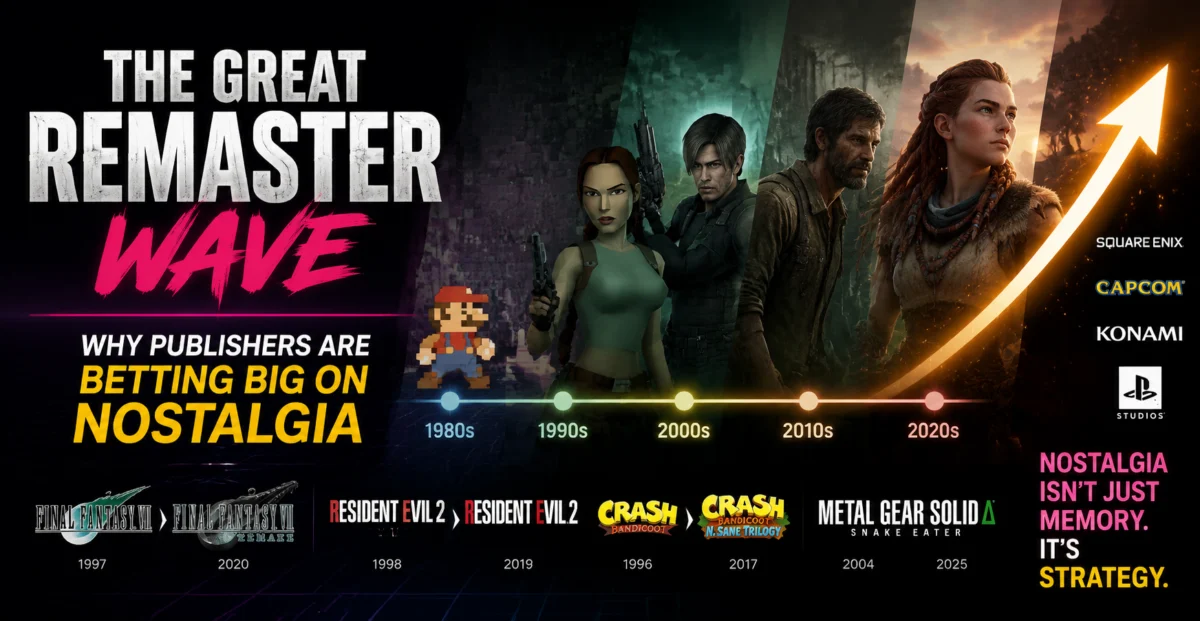
Somewhere between “new release” and “re-release,” the remaster has grown into something publishers now treat as its own product category, with its own budgets, its own marketing playbooks, and increasingly, its own dedicated internal teams. What used to be a stopgap between major releases — a way to keep a franchise visible during a quiet year — has become a strategy in its own right. This week’s release calendar alone includes several high-profile remasters spanning three different console generations, and industry analysts tracking sales charts note that remastered titles have occupied a growing share of the weekly top ten for over a year now.
The obvious explanation is nostalgia, and nostalgia is certainly part of it. But treating the remaster boom purely as an emotional play undersells what has actually changed. Remasters today are cheaper to produce relative to their potential audience than almost any other category of release, they carry built-in brand recognition that makes marketing spend go further, and — critically — the technical gap between “original release” and “modern expectations” has widened enough that even a relatively light-touch remaster can feel transformative to a new generation of players.
The Economics Behind the Curtain
Building a brand-new IP from scratch is one of the riskiest bets a publisher can make. Development costs for a large-scale original title now regularly stretch into nine figures, timelines run five years or longer, and there is no guarantee the finished product finds an audience. A remaster, by contrast, starts from a position of known demand. The publisher already knows how many people loved the original, has years of community sentiment to draw on, and can often reuse core assets, level geometry, and design documentation rather than starting from a blank page.
That doesn’t mean remasters are cheap in absolute terms. A genuine ground-up remake, rebuilding assets in a modern engine rather than simply upscaling textures, can cost a meaningful fraction of a new title’s budget. But the risk profile is fundamentally different. Where an original IP has to convince players it is worth their time from zero, a remaster only has to convince them the improvements are worth the price of admission on something they already love, which is a much smaller marketing hill to climb.
- Lower marketing cost per unit sold: existing brand awareness reduces the need for expensive discovery campaigns.
- Reusable design documentation: level layouts, pacing, and encounter design are already solved problems.
- Built-in review context: critics and players evaluate against a known baseline rather than an unknown quantity.
- Cross-generational appeal: parents introducing childhood favorites to kids has become a genuine, trackable sales segment.
Not All Remasters Are Created Equal
Players have grown noticeably more discerning, and the gap between a beloved remaster and a derided cash-grab has never been more publicly litigated in real time on social media and storefront review sections. The industry has, somewhat informally, settled into three tiers.
The first tier is the straight port: higher resolution, a stable frame rate, maybe some quality-of-life menu improvements, and little else. These releases are the cheapest to produce and the most likely to draw criticism for pricing, particularly when sold at a price point close to a new release. The second tier is the true remaster: rebuilt textures, updated lighting, sometimes reworked control schemes and accessibility options, while preserving the original’s level design, story, and structure untouched. This is currently the most common approach among the major publishers, and when done well, it tends to earn the most consistent critical praise, because it respects what made the original work while removing the friction that keeps modern players from experiencing it.
The third tier is the full remake — original assets rebuilt from scratch, sometimes with expanded content, restructured pacing, or entirely new systems layered on top of a familiar story. These are the most expensive and highest-risk projects, because they invite direct comparison to the original on every front, including the choices that differ from it. When a remake changes something fans consider sacred, the backlash can be loud and immediate. When it succeeds, however, it tends to produce the biggest commercial and critical wins of the category, precisely because it offers both nostalgia and genuine novelty in the same package.
“The projects that work are the ones where the team treats the original as a foundation to build on, not a museum piece to be preserved exactly as-is or a checkbox to tick off,” noted one producer whose studio has shipped several remaster projects over the past two console generations.
The Preservation Argument
There is a less cynical, less commercially driven reason remasters matter, and it is one that preservation advocates have been raising for years: a huge amount of gaming history is functionally inaccessible. Original hardware fails, physical media degrades, and digital storefronts for older platforms have shut down entirely, taking purchased libraries with them in some documented cases. A well-executed remaster is, in a very real sense, an act of preservation, moving a piece of interactive history onto hardware and storefronts people can actually access today.
This framing has started to shape how some studios approach the work. Rather than treating a remaster purely as a revenue opportunity, several teams have spoken publicly about wanting to make sure a specific game remains playable for a new generation before the knowledge and source materials needed to do so are lost entirely, as original development teams disperse and internal documentation ages out of relevance. It is a genuinely different motivation than chasing a nostalgia dollar, even if the two often point toward the same finished product.
Fatigue on the Horizon?
The obvious risk of any successful strategy is overuse, and there are early signs the remaster market may be approaching a saturation point in certain genres. Several franchises have now been remastered more than once within a single console generation, and player sentiment on forums and social platforms has begun to show visible fatigue with titles perceived as remasters of remasters, rather than a meaningful step forward.
Publishers seem aware of the risk. The more successful projects announced recently have leaned harder into genuine reinvention — new game modes, expanded multiplayer, meaningful accessibility overhauls, or substantial content additions that go beyond a visual refresh — specifically to avoid the perception of a lazy re-release. The message from the market appears to be that nostalgia alone is no longer sufficient; it has to be paired with a genuine reason for a returning fan, and an even stronger reason for a first-time player, to actually pick the game up.
What Comes Next
Expect the remaster category to keep growing in the short term, but expect the bar for what counts as a worthwhile remaster to keep rising alongside it. The easy wins — the most beloved, most requested titles from the last two decades — are increasingly already spoken for, which means publishers digging further into their back catalogs will need to work harder to make the case for titles with a smaller, more niche fanbase.
The long-term winners in this space are likely to be the studios that treat remaster work as a genuine craft discipline in its own right, staffed by people who understand both the technical challenge of updating decades-old code and the emotional weight of handling something a generation of players grew up with. Done carelessly, a remaster can feel like a cynical repackaging. Done well, it can introduce a genuine classic to an audience who would otherwise never have had the chance to play it, and that, more than any sales chart, is probably the strongest argument for why this wave shows no sign of slowing down.
Pricing Is Where the Goodwill Gets Tested
If there is a single issue that decides whether a remaster is remembered fondly or resentfully, it is pricing, and it is a topic that generates disproportionate discussion relative to almost any other aspect of a remaster’s release. Players broadly accept that meaningful visual and technical overhauls cost real money to produce and deserve a real price tag in return. What generates backlash, consistently and predictably, is a release perceived to charge close to full price for changes that feel cosmetic rather than substantive.
Several publishers have experimented with tiered approaches to defuse this tension: offering a lower-cost upgrade path for players who already own the original release, bundling a remaster with a season pass or expanded edition of the original content, or pricing based explicitly on the scope of the changes rather than the franchise’s overall brand strength. None of these approaches has become a universal standard yet, and pricing strategy remains one of the more contentious internal debates at publishers currently weighing a remaster of their own back catalog, precisely because getting it wrong can turn what should be a goodwill-generating release into a public relations problem instead.
The Modding and Fan Restoration Wildcard
One factor complicating the remaster calculus that rarely gets discussed in official announcements is the existence of unofficial fan-made restoration projects, which in some cases have already delivered many of the visual and technical improvements an official remaster promises, years ahead of any commercial release and entirely free. Dedicated fan communities have, for some beloved older titles, produced texture packs, widescreen patches, and performance fixes that rival what a commercial remaster team might deliver, built purely out of passion for the source material.
This creates an unusual dynamic for publishers deciding whether a given title is worth an official remaster: the existence of a passionate, technically capable fan community around an older game is simultaneously a strong signal of enduring demand and a potential source of competition for an official release trying to justify its price tag. Some publishers have leaned into this by hiring fan restoration modders directly onto official remaster teams, a practice that has become increasingly common and speaks to how seriously the industry now takes grassroots preservation work that, not so long ago, existed mostly in a legal and cultural gray area.
About the Author