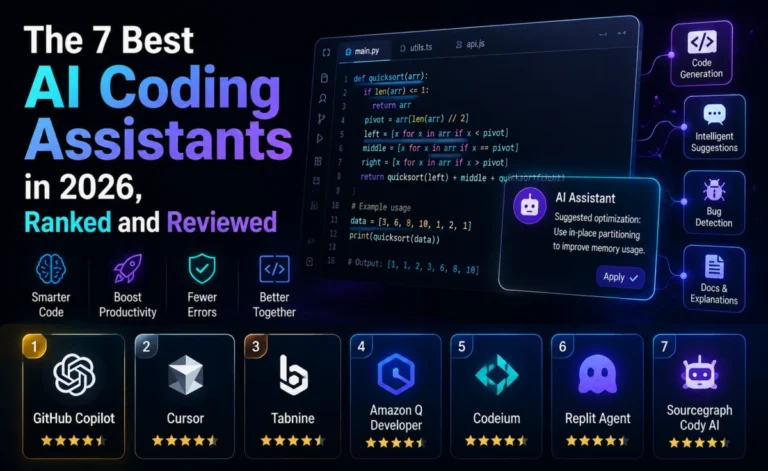


Seven tools now genuinely dominate the AI coding assistant conversation in 2026: GitHub Copilot, Cursor, Claude Code, Devin Desktop (formerly Windsurf), OpenAI Codex, Google Antigravity, and Amazon’s enterprise-focused Kiro. We tested all seven across the same core scenarios — inline completion quality, multi-file agentic work, pricing at both individual and team scale, and ecosystem fit — to produce this ranked breakdown.
How We Ranked These
Rather than crown one universal “best” tool, we scored each assistant across five practical dimensions that matter to a working developer: completion quality, agentic depth, model flexibility, pricing transparency, and ecosystem/IDE fit. A tool can rank highly overall while still being the wrong pick for a specific workflow — we call that out explicitly for each entry below.
1. Cursor — Best Overall for Agentic, Multi-File Work
Price: $20/month Pro · Best for: developers whose work is dominated by multi-file features and refactors
Cursor tops this list for the same reason it’s become the default recommendation across most of the developer conversations we tracked this year: its Composer 2.5 agent, codebase-wide indexing, and genuine multi-provider model flexibility combine into the highest practical ceiling of any tool we tested. It requires adopting its editor outright, and the price is double Copilot’s entry tier, but for teams whose daily work is agentic and cross-file, nothing else currently matches it end to end.
2. GitHub Copilot — Best Value and Best Ecosystem Fit
Price: $10/month Pro · Best for: teams on GitHub, multi-IDE environments, budget-conscious individuals
Copilot remains the easiest recommendation for the widest range of developers. Its autocomplete is still best-in-class for pure inline completion, it works across virtually every major IDE, and its new usage-based credit system (since June 1, 2026) makes costs transparent and controllable. Its agentic capabilities have expanded significantly this year, closing much of the gap with Cursor for scoped tasks — though large, cross-cutting refactors still favor Cursor. For most individual developers, this is the correct default.
3. Claude Code — Best for Deep, Autonomous Sessions
Price: Usage-based, roughly $5–$300/month depending on intensity, or bundled around $20/month at entry tier · Best for: large, well-scoped tasks handed off for autonomous execution
The only terminal-native agent on this list, and the most autonomous. Claude Code’s 200K-token context window and unsupervised agentic loop make it the strongest choice specifically for big, structurally complex jobs — large refactors, deep debugging across services, schema migrations. It has zero inline autocomplete by design, so it works best as a complement to another tool rather than a sole daily driver.
4. Devin Desktop (formerly Windsurf) — Best for Multi-Agent Orchestration
Price: $20/month Pro, up to $200/month Max · Best for: teams wanting to run agents from multiple vendors inside one control surface
Following Cognition’s acquisition of Codeium and the June 2026 rebrand, Devin Desktop has repositioned itself around Agent Client Protocol (ACP) support — letting Codex, Claude Agent, and other third-party agents run inside its interface alongside its own Devin Cloud engine. That’s a genuinely distinctive value proposition, but the rapid pace of pricing changes and leadership turnover this year introduces more uncertainty than the other tools on this list.
5. OpenAI Codex — Best for Teams Standardizing on OpenAI Models
Best for: organizations already invested in OpenAI’s model ecosystem
Codex has matured considerably alongside OpenAI’s newest model generation, and it holds up well as an agentic coding tool for teams that want tight integration with the rest of an OpenAI-centric stack. It’s a more natural fit for organizations with existing OpenAI infrastructure and API relationships than for developers shopping purely on coding-assistant merits alone.
6. Google Antigravity — Best for Teams Already Inside Google’s Cloud Ecosystem
Best for: teams building on Google Cloud and Gemini-family models
Google’s entrant brings solid agentic capability and, unsurprisingly, the smoothest experience for teams already building on Google Cloud infrastructure. It’s earned a place in serious head-to-head comparisons this year, though it remains a step behind Cursor and Claude Code specifically on raw agentic depth for very large, cross-cutting tasks.
7. Amazon Kiro — Best for Enterprise AWS Environments
Best for: large enterprises standardized on AWS
Kiro rounds out the list as the most enterprise-oriented option, with the deepest natural fit for organizations already running on AWS infrastructure. It’s less of a general recommendation for individual developers or smaller teams and more of a specialized fit for a specific kind of enterprise buyer.
What Changed Since Last Year’s Rankings
A few shifts are worth calling out for anyone who evaluated this category twelve months ago and hasn’t revisited it since. First, agentic capability has become table stakes rather than a differentiator — every tool on this list now offers some form of multi-file, multi-step task execution, whereas a year ago that was Cursor and Claude Code’s distinguishing feature almost alone. Second, pricing has compressed hard at the entry tier: nearly every serious competitor now sits at $10–$20/month for an individual Pro plan, which means the buying decision has genuinely shifted from “what can I afford” to “what actually fits my workflow” for most individual developers. Third, and most visibly, the Windsurf-to-Devin-Desktop transition reshuffled the competitive landscape in real time, folding a previously independent budget option into a more ambitious, more expensive multi-agent platform mid-year.
We’d also flag a quieter trend underneath all of this: model access itself has become less of a moat. A year ago, which frontier models a tool could access was a meaningful differentiator. Today, with Cursor, Devin Desktop, and increasingly Copilot all offering multi-provider routing, and with Claude Code and Codex representing the deliberately single-provider alternative, the real differentiation has moved to how well each tool orchestrates and applies those models — the agent architecture, the context management, the review workflow — rather than which raw models sit behind the curtain.
Side-by-Side Pricing Snapshot
| Tool | Entry price | Billing model |
|---|---|---|
| GitHub Copilot | $10/month | Usage-based credits since June 2026; unlimited completions |
| Cursor | $20/month | Included fast-request pool, BYOK supported |
| Claude Code | ~$20/month bundled or usage-based via API | Token-metered, scales with session intensity |
| Devin Desktop | $20/month, up to $200/month Max | Flat tiers plus included Devin Cloud access |
| OpenAI Codex | Varies by plan | Bundled with OpenAI platform access |
| Google Antigravity | Varies by plan | Bundled with Google Cloud / Gemini access |
| Amazon Kiro | Enterprise pricing | AWS-integrated billing |
Worth noting: 2026 has seen the market broadly commoditize around $20/month for a Pro-equivalent individual tier, with real cost differentiation only emerging at the heaviest usage levels — Claude Code’s top usage tier, Cursor’s Business seats, and Devin Desktop’s Max plan all diverge sharply once you’re running agents most of the working day.
How to Actually Choose
Rather than picking based on this ranking alone, match the tool to your actual task mix:
- Mostly single-file, incremental coding: GitHub Copilot.
- Mostly multi-file features and refactors, want a visual editor: Cursor.
- Large, structurally complex tasks you want to hand off entirely: Claude Code.
- Want to orchestrate agents from several vendors in one place: Devin Desktop.
- Already standardized on OpenAI, Google, or AWS infrastructure: Codex, Antigravity, or Kiro, respectively.
And, echoing a pattern we’ve now seen across dozens of engineering teams this year: don’t assume you need to pick exactly one. A common, genuinely productive combination is Copilot (or Cursor) for daily editor work paired with Claude Code for the handful of large, autonomous tasks each week that actually justify a deeper agent. The overlap in coverage is small enough that running two tools rarely feels redundant in practice.
Depplo Verdict: There is no single “best” AI coding assistant in 2026 — there’s a best tool for your specific mix of work. Cursor and Copilot cover the vast majority of day-to-day developer needs between them; Claude Code and Devin Desktop earn their place for teams that genuinely need deeper autonomy or multi-agent orchestration; Codex, Antigravity, and Kiro are the right calls specifically for teams already committed to their respective cloud ecosystems.
Common Mistakes We Saw Teams Make
A few patterns showed up repeatedly across the teams and individual developers we spoke with while researching this roundup, and they’re worth naming explicitly. The most common mistake is standardizing on a tool org-wide before anyone has actually run it against the team’s own repository for a real week of work — benchmark scores and other teams’ testimonials are useful signal, but they don’t account for your specific language mix, codebase size, or testing setup. The second most common mistake is treating an agent’s green test suite as equivalent to a human code review; every tool in this roundup, including the strongest ones, will occasionally produce code that passes tests while missing the actual intent of a request. The third is underestimating onboarding cost — the difference between a team that writes a proper rules file or CLAUDE.md-equivalent document and one that doesn’t is often larger than the difference between the tools themselves.
Final Thoughts
The AI coding assistant market has matured fast in 2026 — pricing has largely commoditized at the entry tier, and the real differentiation has shifted to agentic depth, model flexibility, and ecosystem fit rather than raw completion quality alone. That’s good news for developers: at $10–$20 a month, the entry cost of trying any of these tools is low relative to the time they can save, and switching between them carries less friction than it used to. Our honest advice, after testing all seven: trial two tools against your actual repository for a week before standardizing on anything. The right answer depends far more on your workflow than on any ranking — including this one.
About the Author