

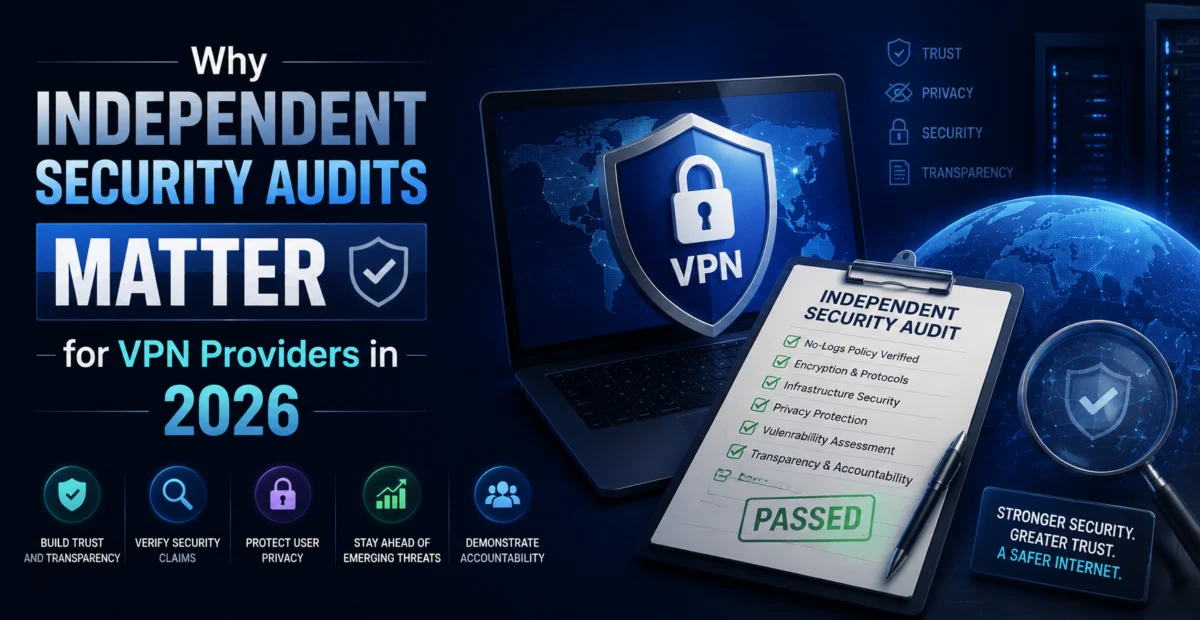
Every VPN provider says the same three things: we don’t log, we’re fast, and we’re secure. The problem is that all three claims live inside a black box you can’t personally inspect. You can’t see the server logs. You can’t see the source code running on a router in a data center you’ll never visit. You can’t watch someone try to break in. That’s exactly the gap an independent security audit is built to close — and in 2026, it has become the single most reliable signal separating providers that can back up their marketing from providers that are just good at writing marketing.
What a Security Audit Actually Is
Strip away the press-release language and a security audit is simple: a company that has nothing to gain from flattering the VPN pays a separate, specialized firm to try to find everything wrong with it. That firm gets access — source code, infrastructure diagrams, server configurations, sometimes live production systems — and it spends days or weeks trying to break, leak, or misconfigure its way through the product. At the end, it writes a report. The provider does not get to edit the findings. It can only choose whether to publish the report at all.
That last part matters more than people realize. A provider that commissions an audit and buries the results when they’re unflattering hasn’t actually given you anything. Publication, in full, is the difference between an audit and a marketing prop.
The Four Audits That Actually Get Commissioned
Not all audits test the same thing, and conflating them is where a lot of confusion starts.
| Audit Type | What It Actually Verifies |
|---|---|
| No-logs audit | Whether the infrastructure, server configs, and internal policies are consistent with a genuine no-logging setup at the time of review |
| Application penetration test | Whether the desktop, mobile, or browser-extension apps can be exploited, leak traffic, or be tricked into unsafe states |
| Source code review | Whether the actual implementation of encryption, key handling, and protocol logic matches what the provider claims |
| Infrastructure & network audit | Whether the servers themselves — the physical or virtual machines routing your traffic — are configured securely and resistant to compromise |
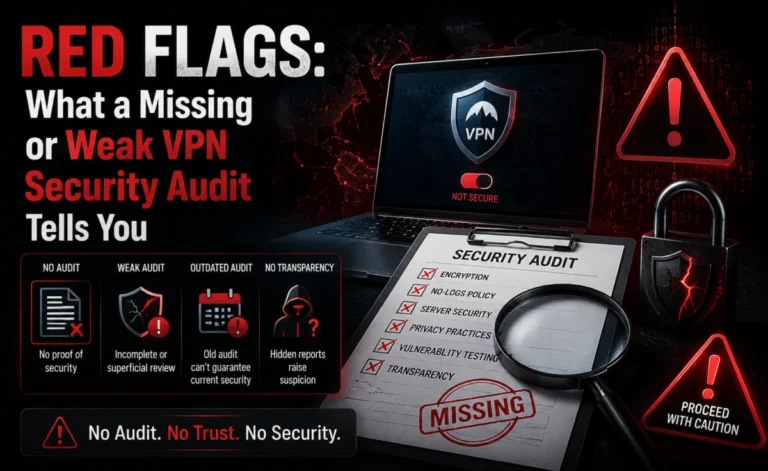
A provider that shouts “we’ve been audited!” without specifying which of these took place is telling you almost nothing. A no-logs audit says nothing about whether the Windows app has a DNS leak. A penetration test says nothing about whether the no-log policy is actually enforced on the backend. Precision in the claim is itself a signal of good faith.
Key takeaway: The question isn’t “have they been audited?” It’s “audited for what, by whom, and can I read it myself?”
Why Self-Reported Security Isn’t Enough
VPN providers are, structurally, asking you to trust a stranger with everything: your browsing destinations, your real IP address, sometimes your DNS queries, occasionally your unencrypted traffic if a connection ever drops without a kill switch. There is no way for an ordinary user to verify any of this by using the product. The app can look polished and still be leaking your DNS requests in the background. The privacy policy can promise “zero logs” while a support ticket system quietly retains IP addresses for months.
This is precisely the kind of asymmetry that independent audits exist to correct. An auditor with source-code access and root-level infrastructure visibility can catch what a user with a laptop and a stopwatch never will. The audit doesn’t replace your own testing — leak tests, kill-switch checks, latency benchmarks — but it covers the parts of the system you structurally cannot see.
Who Actually Performs These Audits
Reputable VPN audits are typically carried out by dedicated cybersecurity consultancies with a track record in penetration testing and infrastructure review, or by larger professional-services firms with a dedicated security-assurance practice. What matters isn’t necessarily brand recognition — it’s independence, a documented methodology, and a public report with a named engagement scope. A one-paragraph “certificate of trust” with a firm’s logo slapped on it and no methodology section is not an audit; it’s a badge.
What “Passing” an Audit Really Means — and Doesn’t
This is where most coverage of VPN audits goes wrong. An audit is not a permanent certification. It is a snapshot, bounded by:
- Time — the audit reflects the system as it existed during the engagement window, often a few weeks. Infrastructure changes constantly; a provider that adds new servers six months later hasn’t re-proven anything about them.
- Scope — auditors test what they’re asked to test. A no-logs audit of the backend says nothing about the Android app’s leak resistance unless that was explicitly in scope.
- Access — if the provider restricts what the auditor can see, the report will say so, and that limitation should be read as carefully as the findings themselves.
A single clean audit from years ago is a weaker signal than an unflattering-but-honest audit from last quarter with documented remediation. Providers that treat audits as an annual or semi-annual discipline, rather than a one-time PR event, are telling you something real about how they operate day to day.
Questions Worth Asking Before You Trust the Badge
- Is the full report public, or just a summary written by the provider’s own marketing team?
- What exact systems, apps, or claims were in scope?
- When was the audit conducted, and has anything materially changed since?
- Were findings remediated, and is there a follow-up or re-test on record?
- Is this a recurring practice, or a one-off event tied to a funding round or rebrand?
The Bigger Picture for 2026
As regulatory attention on data brokers and traffic interception intensifies globally, and as more users treat a VPN as basic infrastructure rather than a novelty tool, the bar for what counts as credible evidence keeps rising. Marketing copy alone no longer clears that bar. A specific, scoped, recently dated, and fully published audit report does. If a provider can’t produce one, that absence is itself informative — not proof of wrongdoing, but a gap in the evidence you’re entitled to ask about before handing over your traffic.
The Real Cost of Getting This Wrong
It’s worth being concrete about what’s actually at stake when a VPN’s security claims turn out to be hollow. This isn’t an abstract trust exercise — a provider with a genuine logging gap, a leaky kill switch, or a compromised update mechanism can expose exactly the information a user chose a VPN to protect: browsing history, real IP address, location, and in worse cases, unencrypted credentials passed over public Wi-Fi. Journalists, activists, and people in restrictive jurisdictions are the most visible examples of high-stakes use, but the underlying risk applies to anyone who assumed “VPN” was synonymous with “protected.” An audit doesn’t eliminate that risk, but it materially reduces the odds that a basic, discoverable flaw goes unnoticed until it’s exploited.
How Audits Fit Into a Broader Trust Stack
No single piece of evidence should carry the full weight of a trust decision, and independent audits are best understood as one layer in a larger stack rather than a final verdict on their own.
- Corporate transparency — clear, traceable ownership and a defined operating jurisdiction.
- Technical audits — the subject of this piece: independent, scoped, dated verification of infrastructure and applications.
- Operational history — how the provider has responded to past incidents, vulnerability disclosures, or legal requests.
- Community and researcher scrutiny — independent security researchers publishing findings outside of any paid engagement.
Providers that score well across all four layers are rare, but they’re the ones worth paying a premium for. A provider that scores well on marketing and poorly everywhere else is the pattern worth learning to recognize quickly.
How This Shapes the Way We Evaluate Providers on Depplo
When we review a VPN for the Security Audits section of this hub, we don’t stop at whether a badge exists on the pricing page. We look for the underlying report, check the scope against the marketing claim, confirm the date, and note whether remediation is documented. A provider that makes this easy to verify earns a materially different writeup than one that makes it hard — and that difference is exactly what this category of our reviews is built to surface for readers who don’t have time to read ninety-page PDFs themselves.
How the Audit Landscape Has Shifted Over the Past Few Years
It’s worth noting how much this category has matured. A decade ago, a single audit of a single component was treated as a landmark event worth a press cycle on its own. Today, the more sophisticated providers in the space run overlapping programs: a no-logs infrastructure review on one cadence, an application penetration test on another, and periodic cryptographic reviews tied to major protocol updates. That fragmentation can make comparing providers harder at a glance, but it also means the ceiling for what “good evidence” looks like has risen substantially. Providers that haven’t kept pace with that ceiling increasingly stand out by comparison, not because they’ve gotten worse, but because the baseline around them has moved.
A Practical Framework for Comparing Two Providers
When two VPNs both claim to be audited and you’re trying to decide between them, a simple side-by-side comparison of four data points usually resolves the ambiguity faster than reading either marketing page in full: how many distinct audit engagements each has published, how recent the most recent one is, how many components each covered, and whether either has a documented history of remediating findings rather than disputing them. This isn’t a perfect scoring system, but it converts a vague impression of “both seem trustworthy” into a concrete, evidence-based comparison you can actually defend if someone asks why you picked one over the other.
The providers worth paying for are increasingly the ones that treat scrutiny as a feature rather than a threat. Independent audits are how that difference becomes visible from the outside.
About the Author