

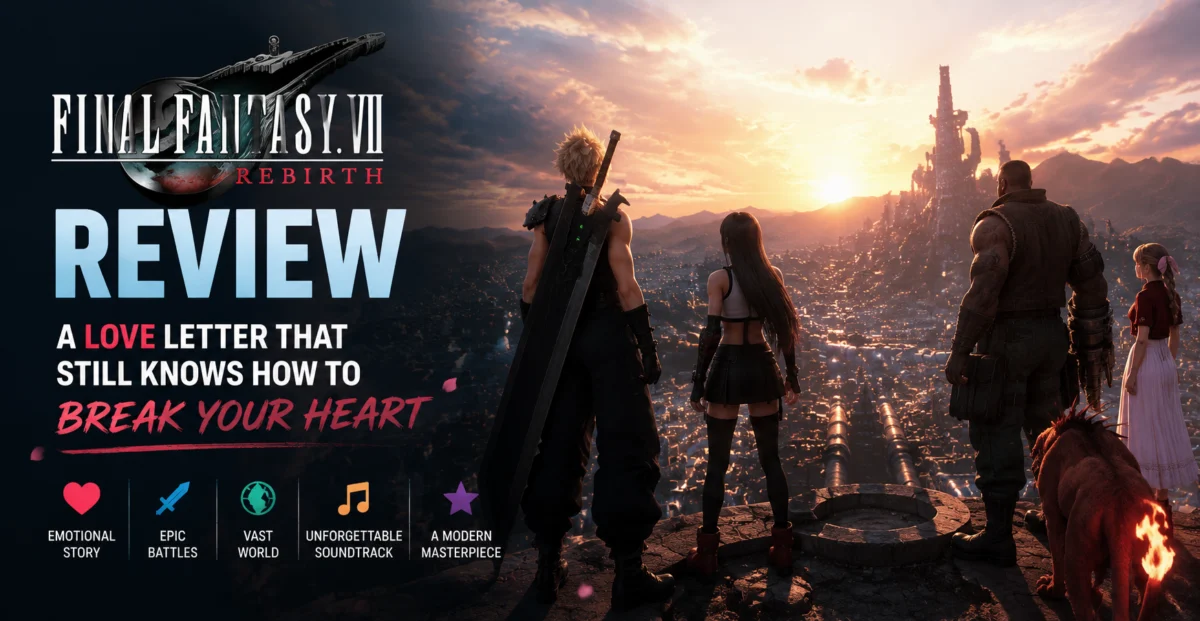
Remaking a 1997 classic across three separate games is either the boldest idea in modern gaming or the most reckless. Two entries into the project, Final Fantasy VII Rebirth makes an overwhelming case for the former. This is a game confident enough to take one linear road trip through the middle third of the original story and expand it into a sprawling, densely detailed world that somehow never once feels like padding.
Story & Premise: Familiar Roads, Unfamiliar Depths
Picking up immediately after the ending of Final Fantasy VII Remake, Cloud, Tifa, Barret, Aerith, Red XIII, and eventually Cid and Yuffie set out across the wider world in pursuit of Sephiroth, chasing him through a journey that touches on nearly every iconic location from the original 1997 release — the Gold Saucer, the Temple of the Ancients, Cosmo Canyon, and the haunting, pivotal events surrounding the Forgotten City.
What Rebirth does exceptionally well is give these once-brief moments genuine emotional runway. Character-specific side content deepens relationships that the original game only sketched — a chapter focused on Red XIII’s history with Cosmo Canyon carries real weight, and Yuffie’s introduction arc, expanded well beyond her optional status in the source material, makes her feel essential rather than bonus content. The Gold Saucer, meanwhile, becomes a genuinely enormous minigame hub, stuffed with card games, races, and a rhythm game that could function as a side product on its own.
None of this expansion comes at the cost of the story’s central emotional beats. Without spoiling specifics, the game’s handling of its most devastating moment — one that’s been discussed by players for over two decades — is treated with a seriousness and restraint that respects both longtime fans and newcomers experiencing it for the first time. It’s a difficult needle to thread, and Rebirth threads it about as well as could be hoped.
Gameplay & Mechanics: Real-Time Action With Tactical Bones
Combat builds directly on Remake’s hybrid system, blending real-time action with an ATB gauge that unlocks abilities, spells, and limit breaks once filled. Rebirth expands this considerably with a Synergy system that lets party members combo devastating joint attacks, alongside individual skill trees for each character that meaningfully differentiate their combat roles — Barret’s ranged suppression plays nothing like Tifa’s close-range combo strings, which plays nothing like Aerith’s spellcasting utility.
Boss encounters remain a series highlight, frequently multi-phase spectacles that demand you actually engage with elemental weaknesses, stagger mechanics, and character switching rather than brute-forcing through. The open-world regions between story beats add a substantial layer of exploration-driven content — towers to climb for map reveals, combat challenges, lore-rich side activities — that occasionally leans toward checklist territory but is generally elevated by strong writing and rewarding traversal.
Chocobo mechanics deserve particular praise. Each region introduces a distinct chocobo variant with unique traversal abilities — climbing, gliding, swimming — turning what could have been a simple mount system into an actual exploration mechanic worth engaging with deeply.
Graphics & Presentation
This is a genuinely stunning game, with environments ranging from the sun-bleached plains outside Junon to the jungle canopy of Gongaga rendered with an extraordinary attention to atmosphere and scale. Character models carry the same exceptional facial animation quality established in Remake, crucial given how much of the story hinges on subtle emotional beats between party members. A performance mode targeting 60 frames per second sits alongside a graphics mode prioritizing visual fidelity, and both hold up well depending on player preference.
Sound & Music
The soundtrack is, without hyperbole, one of the finest in the series’ history. Composer collaborations reimagine iconic themes from the original 1997 score with live orchestration, dynamic layering that shifts based on combat intensity or location, and new compositions that stand comfortably alongside the classics. The Gold Saucer’s musical variety alone — jazz, orchestral, upbeat arcade themes — showcases a soundtrack unwilling to settle for a single register across its enormous runtime.
- Expanded character writing gives the whole cast real depth
- Combat system meaningfully builds on Remake’s foundation
- One of the best video game soundtracks in years
- Handles its most iconic story beat with real care
- Chocobo traversal mechanics are a genuine highlight
- Open-world side content occasionally feels checklist-driven
- Runtime and pacing can sag across the middle third
- Minigame density may overwhelm story-focused players
- Some late-game systems arrive with little explanation
Materia, Folios, and Build Customization
The Materia system returns largely intact from Remake, letting players slot magic, command, and support Materia into weapons and armor to customize each character’s role in combat. Rebirth expands this with a Folio system tied to each character’s unique weapon, unlocking additional passive abilities and stat bonuses as the story progresses. The combination gives genuinely deep build customization — a Materia loadout favoring elemental magic paired with the right Folio choices can transform a character’s role in a fight entirely, and experimenting with different combinations against particularly tough optional bosses is one of the game’s most satisfying secondary loops.
Party Dynamics and the Relationship System
One of Rebirth’s most quietly effective additions is an expanded relationship system that tracks how Cloud bonds with each party member across shared activities, dialogue choices, and optional character-specific content. This isn’t a cosmetic layer — it directly informs a pivotal sequence at the Gold Saucer that changes based on which relationship has grown strongest, giving weight to choices that might otherwise feel like throwaway dialogue options.
The chemistry between the returning cast has also matured noticeably since Remake. Barret and Cloud’s dynamic carries more warmth and less friction, Tifa gets meaningfully more to do both narratively and mechanically, and the push and pull between Cloud and Aerith is handled with a lightness that makes the story’s more devastating turns land even harder in hindsight. Party banter during exploration — triggered contextually based on location and story progress — continues to be some of the best incidental writing in the series, rewarding players who take their time moving between story beats rather than rushing to the next objective marker.
Endgame and Longevity
A story-focused playthrough runs somewhere between forty and fifty hours, but the sheer volume of side content — regional activities, combat simulator challenges, an expansive card game with its own tournament circuit, chocobo racing, and character-specific side stories — pushes full completion well past the hundred-hour mark for players determined to see everything. Unlike some open-world side content that exists purely to pad a map with icons, a meaningful portion of Rebirth’s optional material ties directly into character development, meaning skipping it entirely does come at a genuine narrative cost, not just a completionist one.
Hard Mode, unlocked after completing the story, removes healing items between saves and demands much more careful use of the Synergy and ATB systems, giving veteran players a genuine mechanical challenge to chase once the main narrative concludes.
Who Should Play This
Longtime fans of the 1997 original will find an experience that treats its source material with real care, expanding beloved character moments without undercutting what made them work in the first place. Newcomers can absolutely start here with Remake as a primer, though the emotional impact of certain story beats benefits enormously from having sat with these characters since the first entry in the trilogy. Players who prefer a tighter, more linear RPG experience should know this leans heavily into open-world density during its middle stretch — but for anyone willing to embrace that scope, this is one of the most rewarding RPGs available on the platform.
One additional note worth making: while the game is fully playable as a standalone experience thanks to a recap system covering the events of the first installment, several emotional beats reference relationships and history established there directly. Players entirely new to this remake trilogy will still find a coherent, satisfying story, but the full weight of certain character arcs is meaningfully deeper for those who’ve already spent time with this cast in Midgar.
Photo Mode is similarly robust here, with an extensive suite of filters, poses, and framing tools that make capturing the game’s more painterly vistas — sunset over the Grasslands, or the neon sprawl of the Gold Saucer at night — a genuinely rewarding diversion in its own right.
Rating Breakdown
| Story | 9.6 / 10 |
| Gameplay | 9.3 / 10 |
| Graphics | 9.5 / 10 |
| Sound Design | 9.9 / 10 |
| Replayability | 8.7 / 10 |
9.4 / 10
Depplo Editor’s Choice
Final Verdict
Final Fantasy VII Rebirth takes on an almost impossible task — expanding a beloved, tightly-paced classic into a sprawling open-world epic — and succeeds far more often than it stumbles. Its cast has never felt more human, its combat has never felt more tactically rewarding, and its handling of the story’s most legendary moments proves that reverence and reinvention aren’t mutually exclusive. This is essential playing, whether you’ve walked these roads before or you’re discovering Midgar’s fallout for the very first time.
About the Author