
The Announcement Calendar
Reveals, showcases, and trailer drops seem to arrive at random, yet almost none of them are. Behind the apparent chaos sits a carefully managed announcement calendar, shaped by retail seasons, platform events, and the attention economy. This briefing maps the rhythm so you can anticipate it.
Quick Summary
- Announcement timing follows predictable cycles: showcase season, pre-launch ramps, and post-launch content beats.
- Studios choose reveal formats based on what they need: reach, depth, or conversation.
- Reading a game’s marketing phase tells you what kind of information to expect next.
- Players can use the calendar to manage hype, budgets, and backlogs.
1. The Attention Economy of Games
Every announcement competes for a finite resource: player attention. In any given week, dozens of games vie for a limited amount of conversation, coverage, and wishlist activity. A studio that announces at the wrong moment can see its news drowned out by something larger. A studio that announces at the right moment can see a modest reveal travel much farther than its budget would suggest.
This competitive reality is why the industry has developed such a strong sense of timing. Marketing teams track what rival studios are planning, what platform holders have scheduled, and what cultural events might affect attention. They plan reveals the way broadcasters plan programming: around peaks, valleys, and the habits of their audience.
For players, understanding this calendar is useful in a practical sense. It helps you recognize when information is likely to arrive, avoid being swept up in manufactured urgency, and plan your own time and spending with more confidence. It also makes news easier to interpret, because the timing of an announcement is itself a piece of information.
2. The Four Seasons of Announcement
While every game has its own schedule, the broader industry tends to move through four recognizable seasons. The names are our own shorthand, but the pattern is real.
Early in the year, studios use events and online showcases to announce new projects and establish identities. Information is broad and atmospheric.
Mid-year, a cluster of high-profile presentations draws global attention. Release dates, gameplay, and platform news dominate.
Autumn is crowded with releases. Marketing shifts from promises to proof: reviews, previews, and hands-on impressions.
Late in the year, attention turns to lists, ceremonies, and retrospectives. Studios announce roadmaps and previews for the coming year.
Because it is currently autumn, we are in the middle of what many people consider the busiest stretch of the calendar. That has real consequences for how information is released. Studios with launches approaching are focused on reviews and player impressions. Studios with titles scheduled for later are often waiting for the crowded period to pass before making noise. If you notice that a game you are following has gone quiet, this may simply be a strategic pause rather than a sign of trouble.
3. The Lifecycle of a Single Game’s Marketing
Zooming in from the industry calendar to a single title, we can see another predictable pattern. Most games pass through a sequence of marketing phases, and each phase has its own style of announcement. Recognizing which phase a game is in helps you set expectations about what comes next.
Phase One: The Teaser
The teaser is intentionally small. It may be a few seconds of footage, a logo, or an evocative piece of concept art. The goal is to plant the idea of the game in public consciousness without committing to details. At this stage, platforms, dates, and pricing are almost always absent, and that absence is normal. If you see a teaser, the most you can safely conclude is that the project exists and the studio is ready to begin talking about it.
Phase Two: The Reveal
The reveal is the first full presentation of the game. It usually includes a trailer, a description of the core concept, and a first look at the art direction. Some details may be given, such as target platforms and a general release window, but the information tends to be broad. Reveals are designed to attract wishlists and generate conversation, so they favor spectacle over specifics.
Phase Three: The Deep Dive
Once the initial excitement has settled, many studios shift to a more detailed format. Developer diaries, interviews, and gameplay breakdowns explain how the game actually works. This is the phase most valuable to players who want to evaluate whether a title suits their tastes. It is also the phase in which the studio begins to be tested: claims made in the reveal are examined, and the community begins to form opinions grounded in specifics.
Phase Four: The Pre-Launch Ramp
In the weeks before release, communication intensifies. Pre-orders open, editions are announced, system requirements are published, and previews begin to appear. This is when practical information finally becomes available: file sizes, performance targets, and launch-day plans. It is also the phase in which many players decide whether to commit, which is why studios often try to cluster their strongest material here.
Phase Five: Launch and Beyond
Release day brings a wave of reviews, impressions, and player feedback. Communication shifts again, this time toward support: patch notes, hotfixes, and roadmaps. For live games, this phase never really ends. Seasonal events, content updates, and community campaigns form a continuing cycle that keeps the game in the conversation for months or years.
“If you know which phase a game is in, you already know what kind of announcement is coming and what kind is not.”
— The Depplo Team
4. Choosing a Format: Showcase, Livestream, Post, or Drop
Studios also choose among several announcement formats, each suited to a different goal. The choice is rarely arbitrary, and understanding the logic behind it can help you interpret the news.
| Format | Best For | Trade-off |
|---|---|---|
| Industry showcase | Maximum reach and spectacle. | Crowded schedule, limited time per game, little room for nuance. |
| Dedicated livestream | In-depth demonstration and direct audience connection. | Requires an existing audience and carries the risk of live mishaps. |
| Written post and press release | Precision, clarity, and a permanent reference. | Less emotional impact than video. |
| Surprise “shadow drop” | Generating excitement through immediacy and avoiding hype fatigue. | Little time for coverage to build, so quality has to speak for itself. |
| Creator preview event | Authentic first impressions from trusted voices. | Selection of creators shapes the narrative. |
When you see a studio use a particular format, ask what it is trying to achieve. A written post suggests that precision matters more than excitement, perhaps because the news is technical or sensitive. A major showcase suggests that reach is the priority. A creator event suggests that the studio wants early impressions to feel organic and trustworthy.
5. Why Release Dates Cluster, and Why Some Studios Avoid the Crowd
It is commonly observed that games cluster around certain periods of the year. Part of the reason is commercial: players tend to spend more during particular seasons, so studios want to be present when wallets are open. But clustering also creates a problem, since the more games launch in a window, the harder it is for any one of them to stand out.
The response of many studios is to counter-program. A mid-sized title may choose to launch in a quieter month, accepting a smaller seasonal boost in exchange for greater visibility. Others avoid direct competition with a known blockbuster by moving their date by a week or two. These choices are often invisible to the public, but they explain why release dates sometimes shift in ways that appear sudden or unexplained.
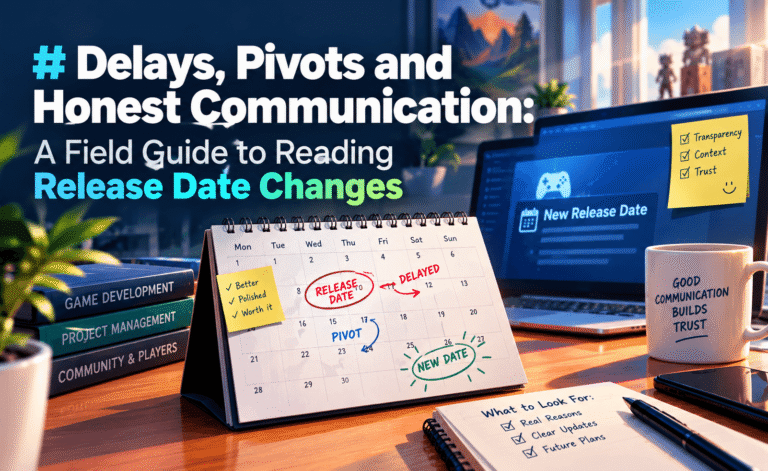
For players, the lesson is that a date change is not necessarily a sign of trouble. It can be a strategic adjustment. The more useful question is how the studio communicates the change. A clear explanation and a firm new date are a good sign. A vague postponement without further detail deserves more caution.
6. Embargoes, Review Windows, and the 48 Hours That Matter
Two moments in the announcement cycle deserve special attention: the lifting of the preview embargo and the arrival of reviews. These are the points at which independent voices enter the conversation, and studios plan carefully around them.
Preview embargoes allow journalists to share early impressions after hands-on sessions. The timing is chosen to build momentum before release. Review embargoes, which determine when full reviews may be published, are even more consequential. Studios and publishers negotiate them with an eye to when sales will be strongest, and they may be set before or after launch depending on confidence in the product.
A useful rule of thumb is that earlier review embargoes tend to suggest confidence, while embargoes that lift very close to or after launch invite questions. This is not an accusation, since there can be valid reasons such as late-stage patches or review-code logistics. But the timing is part of the story, and experienced players learn to take note of it.
Depplo Calendar Tip
Keep a simple list of the games you care about, and next to each one write its current phase: teaser, reveal, deep dive, pre-launch, or live. When a game moves to a new phase, you will know what kind of news to expect next, and you will be less likely to be caught off guard by sudden marketing pushes.
7. Managing Your Own Hype
The announcement calendar is designed to generate excitement, and that is not inherently a problem. Excitement is part of the pleasure of being a game fan. But it can also lead to impulsive decisions, such as pre-ordering based on a trailer or committing to a title before reliable information is available. A little awareness goes a long way.
Consider adopting three personal rules. First, separate wishlisting from buying: adding a title to a list costs nothing and preserves your options. Second, wait for the deep dive and review phases before making financial commitments, unless you have strong reasons to support a particular studio early. Third, notice your own reactions to marketing. If a trailer made you feel something, ask whether it also told you something concrete about the game.
These habits do not make you a skeptic. They make you a more intentional participant. You can still be delighted by a great reveal, and you can still champion a studio you admire. You are simply doing so with your eyes open.
8. Looking Ahead
The announcement calendar is evolving. Digital storefronts now run their own recurring events, giving smaller studios opportunities that were once reserved for major publishers. Creator-led showcases have grown in influence, offering alternative channels to the traditional stage. Direct-to-player communication through social platforms and community hubs has reduced dependence on intermediaries. These changes make the calendar more distributed, with more moments in which news can break and more ways for it to reach people.
At the same time, the fundamentals remain. Studios still need to capture attention, manage expectations, and time their messages to coincide with player interest. Players still benefit from understanding the patterns behind the noise. The better you can read the rhythm, the easier it becomes to enjoy the highs without being overwhelmed by them.
Final Thoughts
Announcements are not random, and they are not neutral. They are shaped by seasons, phases, formats, and strategies, and each of those choices carries meaning. By paying attention to when and how news is delivered, you gain an additional layer of insight into what a studio is thinking and what it hopes you will do next.
Depplo will continue to follow the industry’s rhythm, offering context around major announcements and highlighting the patterns that matter. Next time a reveal lands in your feed, take a moment to ask: what phase is this game in, what format was chosen, and why now? The answers are often more interesting than the trailer itself.
Published by the Depplo Team · depplo.com/ · Category: Game Press Updates
About the Author