
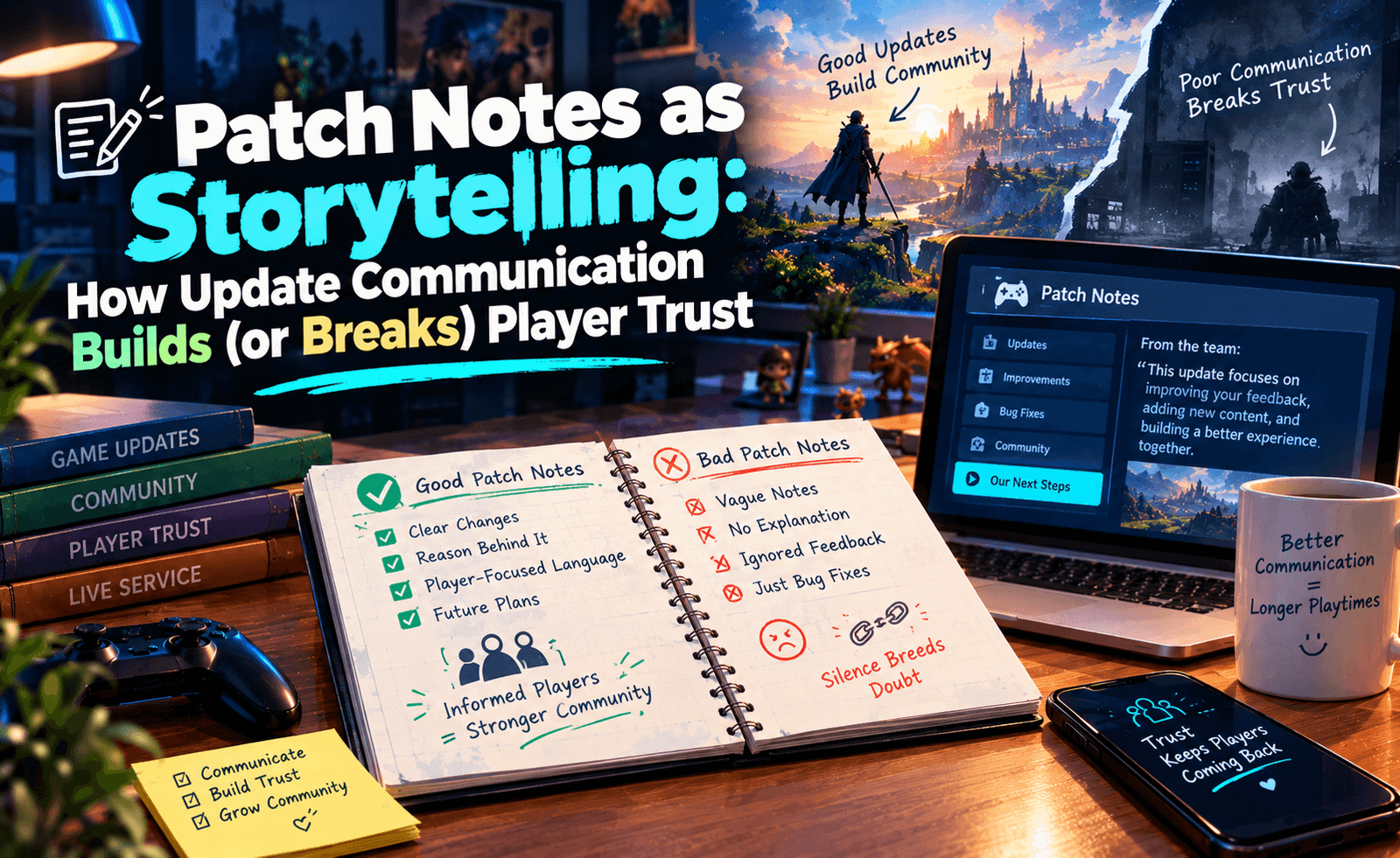
Patch Notes as Storytelling
Patch notes used to be a dry list of numbers for the most dedicated players. Today they are a public conversation between a studio and its community, and they can build or break trust faster than any trailer. Here is how update communication became storytelling, and how to read it well.
In This Briefing
- How patch notes evolved from changelogs into narrative documents.
- The four tones studios use, and what each one tells players.
- Why “developer commentary” has become a trust-building tool.
- A reader’s guide to spotting transparency, spin, and silence.
1. From Changelog to Conversation
In the early days of online games, a patch note was effectively a changelog written for engineers. It might read “Fixed crash on map load” or “Adjusted damage value from 45 to 42,” and that was the end of it. The audience was small, technical, and used to terse language. Nobody expected a patch note to be entertaining, persuasive, or emotionally intelligent.
That changed as games became long-running services with enormous communities. When a single balance change can affect millions of players, the way it is communicated becomes part of the product. A modification that feels fair when explained can feel like an insult when announced without context. Studios learned this the hard way, and the result is a new genre of writing: the update note as narrative, complete with headings, rationale, humor, and sometimes apologies.
For players, this evolution is mostly welcome. It means more information, more context, and more opportunities to understand why a game is changing. But it also means that patch notes are now a form of communication that can be skilled or clumsy, honest or evasive. Learning to read them critically is part of being an informed player.
2. The Anatomy of a Modern Update Post
Most substantial update posts today share a recognizable architecture, even though the details vary from studio to studio. Understanding the pieces helps you evaluate what you are being told.
A short paragraph setting the theme of the update, often written in a friendly first-person voice from the development team.
The two or three items the studio expects players to care about most. Their placement signals priority.
Categorized changes covering gameplay, balance, interface, performance, and fixes. This is where specifics live.
An honest list of problems the team is aware of. Its presence, length, and tone say a lot about studio culture.
The Opening Note
The opening note sets the emotional frame. A confident, brisk opening suggests the studio is pleased with the release and expects a positive reception. A more cautious opening, one that acknowledges previous frustrations, suggests the team is aware of tension and wants to approach it directly. Neither is better, but the difference can help you anticipate what follows.
Look for how the note refers to players. Phrases that treat the community as collaborators, such as “you told us” or “we heard,” indicate that the update is at least partly reactive. Phrases that emphasize the studio’s own plans suggest the roadmap is being driven internally. A healthy game generally shows a mixture of both.
The Headline Changes
Where an item appears in an update post is a form of communication. If a controversial change is buried deep in a long list, it may be there because the studio considers it minor, or because it hopes it will be overlooked. If a controversial change is placed prominently and accompanied by an explanation, the studio is signaling confidence and willingness to defend its decision.
A good habit is to read the whole list before forming an opinion. Players often react to a single line that circulates on social media, only to find later that the full context softens or reverses their first impression. Reading the entire post, and especially the explanations, is the surest way to avoid overreacting.
The Detailed List
The detailed list is where the numbers live: damage adjustments, drop rates, cooldown timings, and similar items. For competitive and progression-heavy games, this section is essential reading. Look for how changes are described. A line that says “reduced” without a figure gives you direction but not magnitude. A line that gives both the old and new values gives you everything you need to evaluate the change.
Studios that consistently publish specific figures tend to build more trust with analytical communities. Players can verify the change in-game, discuss it with confidence, and hold the team accountable if the result does not match the description. Studios that rely on vague language may be protecting flexibility, but they also invite speculation.
Known Issues
The known issues list is one of the clearest indicators of a studio’s relationship with its players. A team that publishes a candid list, including problems that are embarrassing, is demonstrating that it values transparency over image. A team that omits the list entirely, despite widely reported problems, may be prioritizing messaging control.
Pay attention to whether items on the list receive follow-up. If a known issue appears in one update and remains unresolved for several consecutive posts without comment, the list is functioning as a placeholder rather than a commitment. If issues are resolved or at least given status updates, the list is a living document and a sign of healthy process.
“The best patch notes do not just say what changed. They say what the team believed, and what they will do if they were wrong.”
— The Depplo Team
3. Four Tones, Four Messages
Studios tend to settle into a recognizable voice for their update communication. While the voices vary, most fall into four broad categories. Identifying which one you are reading helps you interpret the content.
| Tone | What It Sounds Like | What To Watch For |
|---|---|---|
| The Engineer | Terse, numeric, minimal commentary. | Clear on what changed, often silent on why. |
| The Host | Warm, humorous, personal. | Great for community feeling, but check that charm is not replacing substance. |
| The Diplomat | Careful, balanced, heavily qualified. | Safe and professional, though it can hide the real priorities behind soft language. |
| The Teacher | Explanatory, example-driven, rationale-first. | Usually the most informative, but long. Make time to read it fully. |
Many studios blend tones, and the blend can change depending on the situation. A team might use the Host voice for a seasonal event and switch to the Teacher voice for a major balance rework. That flexibility is a sign of communication maturity. What you want to avoid is a studio that uses only the Host voice when the news is good and retreats into the Diplomat voice when it is bad, because the pattern suggests that tone is being used to manage perception.
4. Developer Commentary: The Trust Multiplier
One of the most important developments in update communication is the rise of developer commentary. Instead of listing a change and moving on, the team adds a short note explaining the reasoning. Why was this ability reduced? What data suggested a problem? What outcome are we hoping for? These small paragraphs transform a list of changes into a design discussion.
Commentary is valuable for three reasons. First, it makes the decision-making process visible, which helps players understand that changes are deliberate rather than arbitrary. Second, it creates a record against which the team can be measured. If a developer says a change is intended to reduce frustration in a particular situation, players can check whether it did. Third, it invites informed disagreement. Players who understand the intent can critique the execution without resorting to accusations of bad faith.
Good commentary is specific. It names the problem, the approach, and the expected result. Weak commentary is generic. A line such as “we wanted to improve the overall experience” explains nothing. A line such as “players were finishing this challenge in under a minute, which undercut the reward structure, so we have increased the requirement” explains a great deal. When you read patch notes, treat the quality of the commentary as a signal of how seriously the team takes the community.
5. Spotting Transparency, Spin, and Silence
Not every update post is equally candid, and learning to notice the difference is a useful skill. Below are the patterns we look for.
Signs of Transparency
- Specific numbers. Old and new values, not just directions.
- Named trade-offs. Acknowledging that a change benefits some players and disadvantages others.
- Admitted mistakes. Statements such as “we got this wrong” are rare and valuable.
- Follow-through. References to earlier promises, with updates on progress.
Signs of Spin
- Passive voice around problems. “Mistakes were made” or “issues were experienced” distances the studio from responsibility.
- Disproportionate emphasis. Cosmetic additions take up half the post while core complaints receive a single line.
- Reframing removals as improvements. A feature disappears, but the note describes it as “streamlining.”
- Selective comparison. Statistics presented without baselines, so you cannot judge their significance.
Signs of Silence
- Unaddressed community concerns. A widely discussed problem is simply absent from the notes.
- Stealth changes. Players discover differences that were not listed in the post.
- Disappearing roadmaps. Previously shared plans vanish without comment.
Silence is the most difficult category to interpret, because there are often legitimate reasons for it. A team may be investigating a problem and not want to make promises before it understands the cause. But when silence is combined with unlisted changes, it deserves skepticism. Trust is built on the expectation that what players experience matches what they have been told.
Reader’s Rule of Three
When you read any update post, find three things: one change you can verify in the game, one explanation you find convincing, and one question the post did not answer. If you cannot find all three, the post may be telling you less than it seems to.
6. The Role of Community Managers
Behind most thoughtful update communication is a community manager, a professional whose job is to translate between development teams and players. Their role is sometimes underestimated, but they carry a significant share of responsibility for how a game is perceived. They gather feedback, summarize themes, advocate for players internally, and shape the language that goes public.
A strong community manager does more than post. They help developers understand which concerns are widespread, which are loud but narrow, and which reflect real design problems. They also help the community understand the constraints under which the team operates, such as technical limitations, platform requirements, and the unpredictability of development schedules.
If you want to know how healthy a studio’s relationship with its players is, look at how its community team behaves during difficult moments. Do they respond to criticism calmly and specifically? Do they correct mistakes publicly? Do they acknowledge when a decision has been poorly received? Consistent, respectful engagement during tension is one of the best predictors of long-term goodwill.
7. What Players Can Do
Readers are not passive in this relationship. How players respond to update communication influences how studios write it. When constructive, specific feedback is rewarded with engagement, teams are encouraged to be more transparent. When every post is met with outrage regardless of content, teams learn that candor is risky and retreat into cautious language.
A few habits make a difference. Read the full post before reacting. Quote the specific line you are responding to, so your feedback is concrete. Distinguish between disagreeing with a decision and accusing the team of dishonesty. Acknowledge when a studio explains itself well, even if you still disagree with the outcome. Over time, these small behaviors help create the conditions in which better communication is possible.
It is also worth remembering that behind every update is a team of people who have worked long hours, often under pressure. That does not mean their decisions are immune from criticism, but it does mean that criticism lands better when it is specific, respectful, and aimed at the work rather than the individuals.
Final Thoughts
Patch notes began as a technical footnote and have become one of the most important documents in a game’s life. They shape expectations, define the relationship between studio and community, and provide the raw material for countless discussions. A studio that communicates clearly can survive a controversial change. A studio that communicates poorly can turn a minor adjustment into a crisis.
As readers, our task is to engage with these documents thoughtfully: to look for specifics, notice tone, recognize patterns, and extend trust where it has been earned. As part of the games community, Depplo will continue to track update communication across the industry, highlighting examples of clarity and offering context when announcements raise questions. If you take one lesson from this briefing, let it be this: the most revealing part of an update is often not the change itself, but how the studio chooses to explain it.
Published by the Depplo Team · depplo.com/ · Category: Game Press Updates
About the Author