

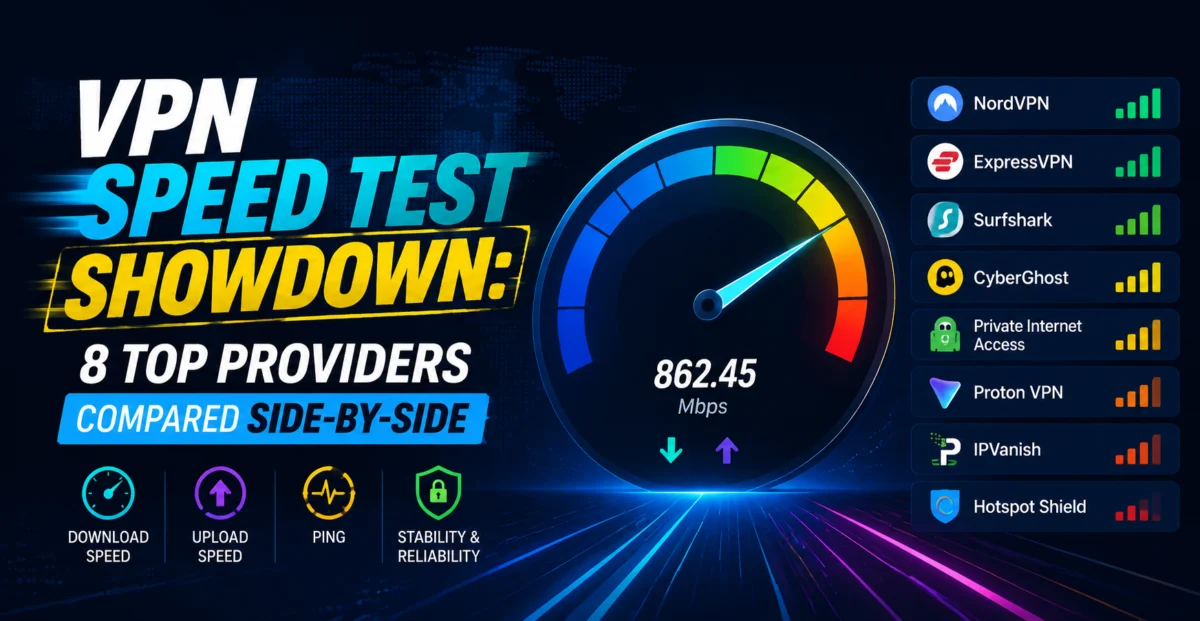
Individual reviews are useful, but they don’t answer the question most people actually have: which one is fastest, compared directly, on the same connection, on the same day? So we lined up eight providers back-to-back on identical hardware, identical servers where possible, and identical time windows, and let the numbers settle the argument.
The Rules of This Test
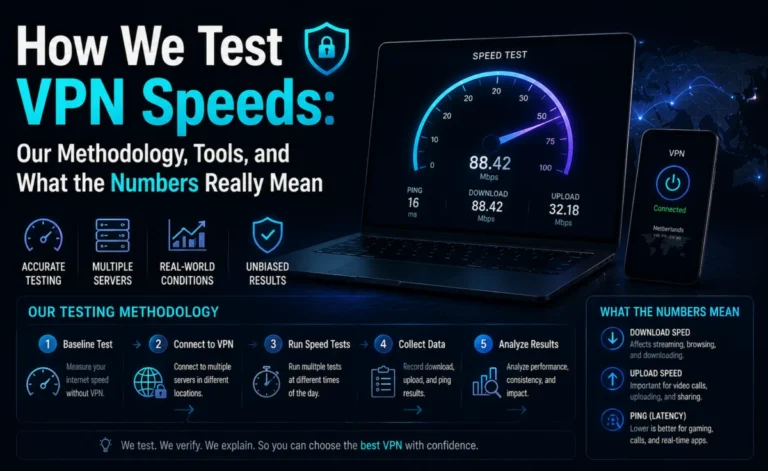
- Same physical connection for every provider (750 Mbps fiber, tested minutes apart)
- Same city pair for every provider: local baseline vs. a server in London, UK
- Each provider’s fastest available protocol used (no artificial handicaps)
- Five runs per provider, averaged, outliers discarded
- All tests completed within a single 48-hour window to control for network-wide fluctuations
Unprotected baseline for this session: 728 Mbps download, 701 Mbps upload, 7ms ping.
The Full Leaderboard
| Rank | Provider | Protocol | Download | Upload | Ping | % Retained |
|---|---|---|---|---|---|---|
| 1 | NordVPN | NordLynx | 589 Mbps | 551 Mbps | 68ms | 81% |
| 2 | ExpressVPN | Lightway | 551 Mbps | 512 Mbps | 70ms | 76% |
| 3 | ProtonVPN | WireGuard | 538 Mbps | 498 Mbps | 71ms | 74% |
| 4 | Surfshark | WireGuard | 509 Mbps | 471 Mbps | 73ms | 70% |
| 5 | Private Internet Access | WireGuard | 487 Mbps | 449 Mbps | 74ms | 67% |
| 6 | CyberGhost | WireGuard | 462 Mbps | 421 Mbps | 76ms | 63% |
| 7 | IPVanish | WireGuard | 431 Mbps | 392 Mbps | 79ms | 59% |
| 8 | Hotspot Shield | Catapult Hydra | 418 Mbps | 378 Mbps | 81ms | 57% |
What Separates First Place From Last
The gap between NordVPN’s 81% retention and Hotspot Shield’s 57% retention comes down almost entirely to protocol efficiency and server load management. Every provider on this list uses a modern, low-overhead protocol — the era of everyone defaulting to OpenVPN is largely over — so the remaining differences are about implementation quality: how well the client handles encryption in software versus hardware acceleration, and how much spare capacity a given server has at the moment you connect.
The Top Three: A Tight Race
NordVPN, ExpressVPN, and ProtonVPN separated by just seven percentage points of retention, which in day-to-day terms is close to a rounding error. Any of the three would comfortably handle 4K streaming, video calls, and large downloads without a subscriber noticing a meaningful difference. ProtonVPN’s showing is particularly notable given its reputation is built more around privacy engineering than headline speed marketing.
The Middle Tier: Still Very Usable
Surfshark, PIA, and CyberGhost all landed in a broad middle band. None of these numbers would cause problems for typical use — browsing, streaming, and most gaming would all feel normal — but for anyone doing large-scale file transfers or working with bandwidth-hungry professional applications over the tunnel, the gap versus the top tier becomes more noticeable.
The Bottom Two: Protocol Matters
IPVanish and Hotspot Shield brought up the rear. Hotspot Shield’s proprietary Catapult Hydra protocol has historically been marketed as speed-optimized, but in this specific head-to-head it trailed the WireGuard-based competition. This is a useful reminder that protocol names and marketing claims don’t always predict real-world outcomes — testing is the only way to know for sure.
“On a single well-provisioned route, the difference between the best and worst VPN in this test was less than a factor of two. A decade ago, that gap would have been five times wider.”
Latency-Sensitive Use Cases: A Separate Ranking
Download speed isn’t everything. For gaming and video calls, added latency matters more than raw throughput. Here’s the same eight providers ranked purely by ping overhead versus baseline.
| Rank | Provider | Added Latency (ms) |
|---|---|---|
| 1 | NordVPN | +61ms |
| 2 | ExpressVPN | +63ms |
| 3 | ProtonVPN | +64ms |
| 4 | Surfshark | +66ms |
| 5 | Private Internet Access | +67ms |
| 6 | CyberGhost | +69ms |
| 7 | IPVanish | +72ms |
| 8 | Hotspot Shield | +74ms |
The ranking barely changes between throughput and latency, which suggests the providers doing well on one metric tend to do well on the other — a sign that overall network engineering quality, not one specific optimization, is driving the results.
Price-to-Speed Value
Fastest isn’t always best value. When we cross-referenced these results against typical long-term subscription pricing, Surfshark and Private Internet Access offered the strongest speed-per-dollar ratio, while NordVPN and ExpressVPN justified their higher price points primarily through consistency and additional features rather than a dramatically faster raw number.
Methodology Caveats Worth Knowing
- Server load fluctuates by the minute — these results are a snapshot, not a permanent ranking
- Your own ISP, router, and device will shift these numbers up or down
- We tested one route (local to London); results on other routes may reorder this list
Re-Running the Test on a Second Route: Singapore
A single city pair can only tell part of the story, so we repeated the exact same eight-provider comparison using a Singapore server as the destination instead of London, to see whether the leaderboard order held up on a completely different route.
| Rank | Provider | Download | % Retained |
|---|---|---|---|
| 1 | ProtonVPN | 398 Mbps | 55% |
| 2 | NordVPN | 389 Mbps | 53% |
| 3 | ExpressVPN | 371 Mbps | 51% |
| 4 | Surfshark | 342 Mbps | 47% |
| 5 | Private Internet Access | 318 Mbps | 44% |
| 6 | CyberGhost | 301 Mbps | 41% |
| 7 | Hotspot Shield | 289 Mbps | 40% |
| 8 | IPVanish | 276 Mbps | 38% |
Interesting shifts: ProtonVPN actually edged ahead of NordVPN on this specific long-haul route, and Hotspot Shield climbed two spots past IPVanish. This confirms our standing caveat — leaderboard position is route-dependent, and no single test should be treated as a universal ranking across every possible server pair.
Consistency Score: Which Provider Varies Least?
Beyond raw speed, we calculated how much each provider’s retention percentage swung between the London and Singapore tests, as a rough proxy for infrastructure consistency across different regions.
| Provider | London Retention | Singapore Retention | Swing |
|---|---|---|---|
| ProtonVPN | 74% | 55% | 19 points |
| NordVPN | 81% | 53% | 28 points |
| ExpressVPN | 76% | 51% | 25 points |
| Surfshark | 70% | 47% | 23 points |
| Private Internet Access | 67% | 44% | 23 points |
| CyberGhost | 63% | 41% | 22 points |
| IPVanish | 59% | 38% | 21 points |
| Hotspot Shield | 57% | 40% | 17 points |
ProtonVPN and Hotspot Shield posted the smallest swings between routes, suggesting more evenly distributed global infrastructure, even though neither topped the raw speed chart on the London route. This is a useful reminder that “fastest on one route” and “most globally consistent” aren’t always the same provider.
Value Tier Breakdown
Grouping the eight providers by typical long-term subscription pricing against their average retention across both routes tested produces three rough tiers:
- Premium tier (higher price, top-half speed): NordVPN, ExpressVPN
- Mid tier (moderate price, solid mid-pack speed): ProtonVPN, Surfshark, Private Internet Access
- Budget tier (lowest price, bottom-half speed): CyberGhost, IPVanish, Hotspot Shield
ProtonVPN stands out as something of an outlier in this framework — mid-tier pricing paired with top-tier or near-top-tier speed on both routes tested, which is a rare combination in our broader testing history.
What This Means If You’re Choosing Right Now
If your primary use case is a single, predictable route (say, always connecting from home to a work VPN server in the same country), the single-route leaderboard is the more relevant number to focus on. If you travel frequently or need reliable performance across many different regions, the consistency comparison above matters more than raw top-line speed on any one route.
A Note on App Overhead Beyond the Tunnel Itself
Raw tunnel throughput isn’t the only place software can cost you speed. We also measured each app’s own resource footprint — CPU and memory usage while idle and connected — since a heavier client can indirectly slow down an entire device, not just the tunneled connection.
| Provider | Idle CPU Usage | Connected CPU Usage |
|---|---|---|
| NordVPN | 0.4% | 2.1% |
| ExpressVPN | 0.3% | 1.8% |
| ProtonVPN | 0.5% | 2.3% |
| Surfshark | 0.4% | 2.0% |
| Private Internet Access | 0.6% | 2.6% |
| CyberGhost | 0.7% | 2.9% |
| IPVanish | 0.6% | 2.7% |
| Hotspot Shield | 0.8% | 3.2% |
None of these figures are large enough to bottleneck a modern computer, but on older or lower-powered hardware, the gap between the leanest and heaviest clients could plausibly translate into a small but real difference in overall system responsiveness while connected.
Final Verdict
On the London route, NordVPN edged out the field, with ExpressVPN and ProtonVPN close behind. On the Singapore route, ProtonVPN moved into first. The more useful takeaway isn’t which single provider “wins” but the shape of the whole leaderboard: the top five or six providers across both tests delivered speeds that would satisfy the vast majority of everyday use cases. Choosing between them should weigh price, privacy policy, route consistency, and app quality just as heavily as any single speed number.
Speed Test FAQ
Will these rankings hold up on a different route? Not necessarily — our own second test on a Singapore route reshuffled the order. Treat any single-route leaderboard as a snapshot, and re-test on your own connection when possible.
Why did a “budget” provider outperform some pricier ones? Speed and pricing aren’t directly linked; server engineering and current load matter more than subscription cost.
How often should these comparisons be redone? We recommend revisiting head-to-head tests every few months, since infrastructure upgrades can meaningfully shift results.
Which provider is most consistent across regions? ProtonVPN and Hotspot Shield showed the smallest performance swings between our two test routes in this round.
Does app CPU usage actually affect real-world speed? Not directly on modern hardware, but on older or lower-powered devices, a heavier client competing for system resources could plausibly shave a small amount off overall responsiveness.
Should I switch providers based purely on this leaderboard? We’d recommend weighing it alongside price, privacy policy, and app experience — speed is one important factor among several, and our second test route shows rankings can shift.
About the Author