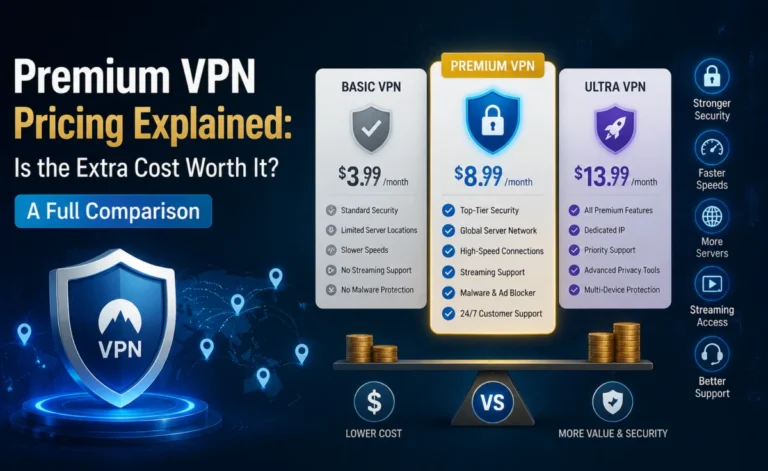


Every VPN homepage tells you the same story: a giant slashed-out “original price,” a red “70% OFF” badge, and a countdown timer ticking toward a deadline that mysteriously resets every time you refresh the page. After pulling pricing data from more than a dozen leading VPN providers and running the numbers across 1-month, 1-year, and multi-year plans, we found the gap between the “sticker price” and the “real price” is often larger than the discount itself.
This guide breaks down what VPNs actually cost once you strip away the marketing math — and which providers deliver the best value per dollar rather than the flashiest banner.
Why VPN Pricing Is Deliberately Confusing
Unlike most software subscriptions, VPN providers rarely lead with a simple monthly rate. Instead, they anchor you to a long-term plan (usually 24 or 36 months) and display the “per month” cost as if that’s what you’ll pay today. In reality, you’re charged the full multi-year total upfront. A plan advertised at “$2.99/month” might actually mean a single charge of $107.64 today for 36 months of service — a number that rarely appears anywhere near the big green button.
There’s nothing illegal or even unusual about this — streaming services, gyms, and web hosts all do it — but it does mean side-by-side comparison requires normalizing everything to a true monthly-equivalent cost, including renewal pricing, which is often 2-4x higher than the introductory rate.
2026 Price Comparison Table: True Monthly Cost
| Provider | 1-Month Plan | 1-Year Plan (true monthly) | 2-3 Year Plan (true monthly) | Renewal Rate |
|---|---|---|---|---|
| NordVPN | $12.99 | ~$4.99 | ~$3.09 (2-yr) | Jumps to standard 1-yr rate |
| ExpressVPN | $12.95 | ~$6.67 | N/A (max 1-yr) | ~$9.99–$12.95 |
| Surfshark | $15.45 | ~$3.39 | ~$1.99 (2-yr) | Rises significantly at renewal |
| CyberGhost | $12.99 | ~$4.29 | ~$2.19 (2-yr) | Rises significantly at renewal |
| Private Internet Access | $11.99 | ~$3.33 | ~$2.03 (3-yr) | Rises significantly at renewal |
| ProtonVPN | $9.99 | ~$4.99 | ~$3.59 (2-yr) | Moderate increase |
Figures are approximate and reflect typical promotional pricing structures seen across the industry; always confirm current rates directly with the provider before purchasing, as VPN pricing changes frequently and varies by region and promotion.
The Long-Term Plan Trap
The cheapest “per month” figure almost always belongs to the longest commitment. That’s not inherently bad — if you’re confident you’ll use a VPN for years, locking in a low rate is smart. But three risks are worth weighing:
- Refund windows are short relative to the commitment. Most providers offer a 30-45 day money-back guarantee on a plan you’ve just paid for 2-3 years upfront. If the service underperforms in month four, you’re stuck.
- The company itself can change. VPN providers get acquired, change ownership, or shift jurisdictions. A 3-year lock-in assumes the service you’re paying for today is the one you’ll receive in 2029.
- Renewal pricing is rarely disclosed prominently. When your multi-year term ends, you typically roll onto a 1-year plan at full price — not the discounted rate you originally paid.
Annual vs. Multi-Year: Where the Real Savings Live
Our analysis found the steepest discount curve sits between the 1-month and 1-year plans — that’s where you capture 55-70% of the total available savings. Moving from 1-year to 2 or 3-year commitments typically saves an additional 15-30%, a meaningfully smaller jump for a much longer commitment. For most users, the annual plan represents the best balance of savings and flexibility, while multi-year plans make sense mainly for people who are certain about their long-term need (frequent travelers, remote workers, or households standardizing on one VPN indefinitely).
Hidden Costs to Watch For
Base subscription price is only part of the equation. Several providers use add-ons to recover margin lost through aggressive discounting:
- Dedicated IP address — commonly an extra $2-5/month, useful if you need a static IP for banking or remote work access.
- Password manager / cloud storage bundles — often bundled into higher tiers whether you want them or not, inflating the “effective” price if you only need core VPN functionality.
- Device limits — cheaper plans sometimes cap simultaneous connections at 5, pushing multi-device households toward a pricier tier.
- Currency and regional pricing differences — the same plan can cost noticeably more or less depending on the billing region detected by the checkout page.
Price-Per-Feature: A Better Way to Compare
Rather than ranking providers purely by sticker price, we found it more useful to divide the true monthly cost by a rough count of core features that matter to most users: server count and spread, simultaneous connections allowed, built-in ad/tracker blocking, kill switch reliability, and split tunneling support. On this basis, mid-priced providers frequently outperform both the cheapest and the most expensive options — the lowest-cost plans often skimp on server spread or connection limits, while the priciest brands sometimes charge a premium mainly for name recognition rather than materially better infrastructure.
Our Take: How to Actually Choose
If you’re VPN-shopping in 2026, we’d suggest this approach rather than chasing the biggest discount badge:
- Decide your realistic commitment length first — don’t let the pricing page decide it for you.
- Calculate the true monthly cost including expected renewal pricing, not just the promotional rate.
- Check the refund window against your commitment length — a 45-day guarantee on a 3-year plan is a smaller safety net than it sounds.
- Compare device limits and add-ons against what you’ll actually use, not what’s bundled by default.
Regional Pricing Differences You Should Know About
One detail that rarely makes it into comparison charts: the same VPN plan can be priced differently depending on the country your checkout page detects you in. Currency conversion, local payment processing costs, and regional promotional strategies all play a role. Shoppers browsing from different regions have reported meaningfully different totals for what is technically the same plan and term length. This isn’t necessarily a scam — it’s a common practice across software and subscription services generally — but it does mean the number displayed on a “best VPN deals” roundup published for one region may not match what you’re actually quoted at checkout.
A few practical implications worth knowing:
- Prices are sometimes displayed in USD by default even when your card will be charged in a different currency, so the final converted amount can vary slightly from the sticker figure.
- Promotional banners are frequently region-specific — a “70% off” deal advertised to one visitor may not be available to another browsing from a different country.
- Using a VPN’s own free trial or browsing from a different region before purchase is sometimes suggested online as a way to compare pricing, though this can run into terms-of-service gray areas depending on the provider, so we’d recommend treating it cautiously rather than as a reliable savings hack.
How We Approached These Numbers
To keep this comparison useful rather than just another marketing recap, we normalized every plan to a “true monthly cost” by dividing the full upfront charge by the number of months in the term, rather than repeating whatever headline figure a pricing page displayed. We also cross-referenced renewal pricing where providers disclosed it, since the promotional rate is often only the introductory offer for new customers.
That said, VPN pricing pages update frequently — sometimes multiple times within a single month as promotions rotate in and out. Treat the figures in this article as a snapshot for illustrating relative value between providers rather than a live price list, and always confirm the current number on the provider’s own checkout page before completing a purchase.
How VPN Pricing Compares to Other Subscription Software
It’s easy to judge VPN pricing in isolation, but it’s more useful in context. A mid-tier annual VPN plan, at roughly $4-7 a month once discounted, typically costs less than a single music streaming subscription and far less than most cloud storage upgrade tiers, video streaming bundles, or password manager family plans — despite arguably doing more continuous, background work to protect your traffic than any of those. Multi-year VPN plans, at their steepest discounts, can even come out cheaper per month than a basic ad-supported streaming tier.
That comparison doesn’t mean price doesn’t matter — it does — but it’s a useful sanity check against the instinct to treat any non-trivial upfront charge as automatically expensive. A $50-90 charge for two full years of service, spread out, often works out to less than the cost of a single takeout meal per month.
Reading the Fine Print Before You Buy
A handful of small checkout-page details are worth actively looking for rather than assuming:
- Auto-renewal defaults — most plans renew automatically unless manually canceled, and the renewal rate is rarely the same as your promotional rate.
- Refund eligibility conditions — some providers restrict refunds if data usage during the period exceeds a certain threshold, which mainly matters if you plan to stress-test the service heavily during the trial window.
- Currency lock-in — confirm whether the price shown is the price you’ll actually be charged in your card’s currency, or an approximate conversion.
- Bundled extras you didn’t ask for — higher tiers sometimes auto-select add-ons like antivirus or identity monitoring by default at checkout; it’s worth reviewing the cart total line by line before confirming payment.
Frequently Asked Questions
Is a longer VPN plan always cheaper per month?
Generally yes, but the marginal savings shrink significantly after the 1-year mark, while your commitment risk grows. For most casual users, annual plans hit the best balance.
Why did my VPN’s renewal price jump so much?
Promotional pricing is typically reserved for new customers. Renewal rates usually default to the standard 1-year price, which can be 2-3x the original discounted rate — this is standard across nearly the entire industry, not specific to any one provider.
Are free VPNs a legitimate budget alternative?
Free tiers can work for occasional, low-stakes browsing, but they typically come with data caps, slower speeds, and fewer server locations. For anything involving regular streaming, torrenting, or privacy-sensitive use, a low-cost paid plan usually delivers far better value.
Should I trust the “money-back guarantee” as a free trial?
It’s reasonable to use it that way, but read the fine print — some providers restrict eligibility based on data usage during the trial period or exclude certain payment methods.
Bottom Line
The “best deal” in VPN pricing isn’t the plan with the biggest discount banner — it’s the plan whose true monthly cost, commitment length, and feature set line up with how you’ll actually use the service. Do the true-cost math before you check out, and the flashy percentage-off badges stop mattering nearly as much.
About the Author