

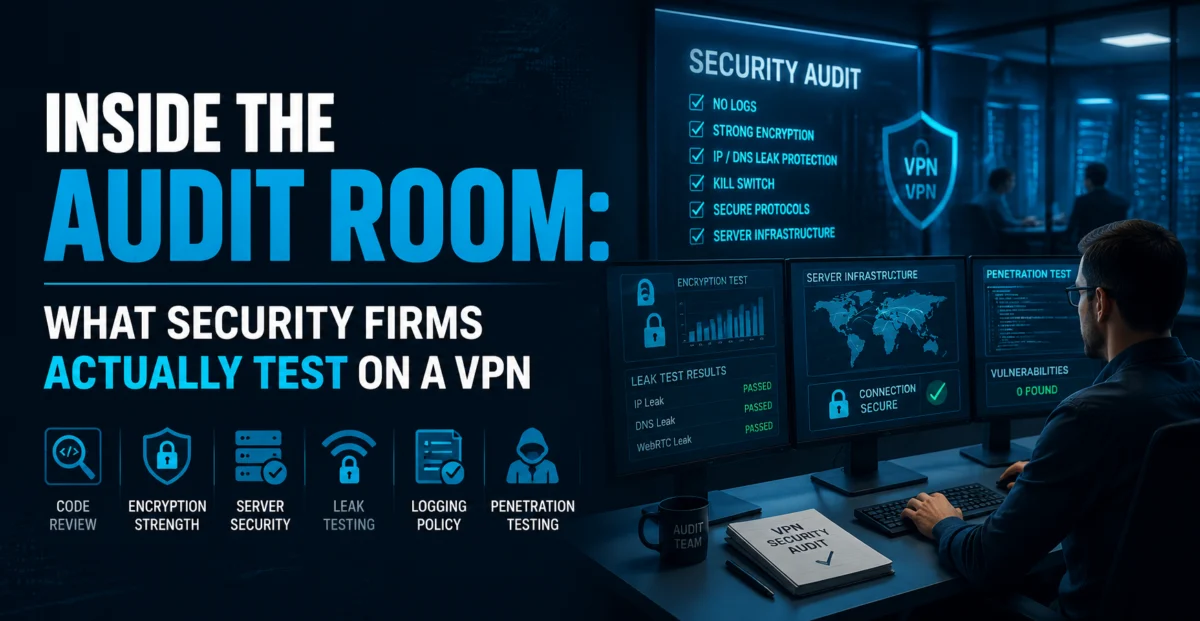
When a VPN provider announces it “passed a security audit,” it’s tempting to picture a single dramatic hacking attempt against the whole company at once. The reality is more methodical and, frankly, more interesting: a structured engagement broken into distinct phases, each aimed at a different layer of the product, run by specialists who spend their careers doing exactly this. Understanding the actual workflow makes it much easier to judge whether a given audit was thorough or superficial.
Phase One: Scoping and Threat Modeling
Before any testing begins, the auditing firm and the provider agree on boundaries. What’s in scope: the Windows client, the Android app, the browser extension, the backend infrastructure, the update mechanism? What’s the threat model: a remote attacker with no access, a malicious insider, a nation-state adversary with legal subpoena power? This phase rarely makes it into marketing copy, but it determines everything that follows. A narrow scope with a weak threat model produces a thin report even if the testing itself is skillfully executed.
Phase Two: The Testing Itself
This is where the actual technical work happens, and it typically spans several distinct disciplines.
Application Penetration Testing
Auditors install the VPN’s desktop, mobile, and browser-extension clients and try to break them from the outside: intercepting local traffic, tampering with update mechanisms, checking whether the app fails safely when the connection drops, and probing for privilege-escalation bugs on the local machine.
Protocol and Cryptography Review
This checks whether the encryption is implemented correctly, not just whether a strong algorithm is named on the marketing page. A provider can advertise industry-standard encryption while still implementing key exchange or session handling incorrectly — the kind of subtle bug that only shows up under expert review of the actual code paths.
Infrastructure and Network Testing
Here, auditors examine the servers themselves: firewall rules, exposed ports, patch levels, access controls, and whether an attacker who compromised one server could pivot to others. This phase is also where no-logs verification typically happens, since it requires direct inspection of what the servers are actually configured to store.
Leak and Failure-State Testing
A dedicated pass checks what happens under imperfect conditions: does the DNS resolver leak your real location when the VPN reconnects? Does IPv6 traffic bypass the tunnel entirely if it isn’t explicitly blocked? Does the kill switch actually cut all traffic, or does it leave a brief window open during reconnection?
Common Vulnerability Classes Found in VPN Audits
| Category | What It Looks Like in Practice |
|---|---|
| DNS leaks | Real DNS queries escape the encrypted tunnel under specific network conditions |
| Kill-switch gaps | A brief window during reconnection where unencrypted traffic can pass |
| Insecure update mechanisms | App updates not properly signed or verified, opening a path for tampering |
| Local privilege escalation | A bug in the desktop client that lets a low-privilege process gain elevated access |
| Improper certificate validation | The app doesn’t correctly verify it’s talking to a genuine server, enabling interception |
| Excess metadata retention | Logging systems capturing more than the stated policy allows, even unintentionally |
None of these findings are unusual or uniquely damning on their own — modern software of any kind accumulates bugs like this routinely. What matters is whether the provider fixes them promptly and whether the auditors confirm the fix in a follow-up test.
Phase Three: Reporting and Remediation
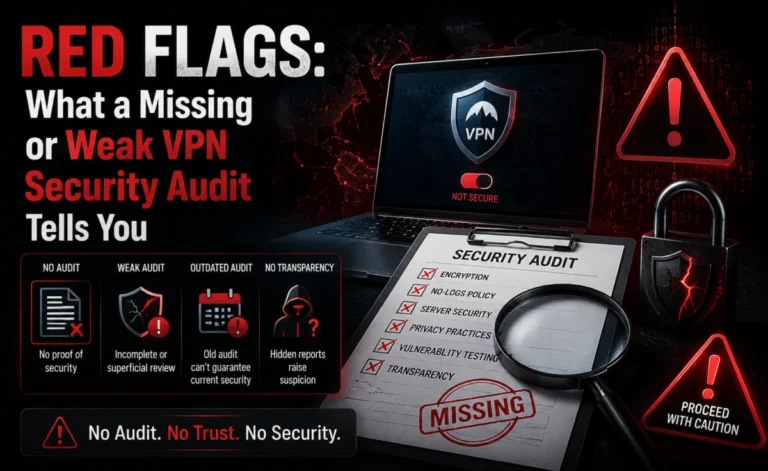
Findings get written up with severity ratings, reproduction steps, and recommended fixes. A credible engagement doesn’t end here — it includes a remediation window where the provider patches what it can, followed by a re-test to confirm the fixes actually worked. Reports that skip straight from “here are the findings” to “audit complete” without documenting remediation are giving you half the picture.
Key takeaway: The value of an audit isn’t that a company had zero bugs. It’s that a company had bugs, an outside party caught them, and they got fixed before you were the one who found out the hard way.
Why Scope Quietly Decides the Whole Story
Two providers can both say “independently audited” while one paid for a two-week review of a single server cluster and the other commissioned a comprehensive multi-app, multi-infrastructure engagement spanning months. The published report’s scope section is the only place this distinction becomes visible. A narrow, cheap audit isn’t dishonest — but treating it as equivalent proof to a comprehensive one is a mismatch between the marketing claim and the underlying evidence.
What This Means for Evaluating a Provider
- Look for evidence of multiple testing disciplines, not just one narrow check.
- Check whether the report documents a remediation and re-test cycle.
- Note how many applications and infrastructure components were actually in scope.
- Favor providers where this process repeats on a defined cadence rather than happening once for a press release.
Security audits are, at their core, a structured way of paying strangers to be adversarial toward your own product before real adversaries get the chance. Providers that embrace that process thoroughly — across apps, protocols, infrastructure, and failure states — are giving you meaningfully more than providers that treat the audit as a single box to check.
How Long a Real Engagement Actually Takes
Public perception often compresses a security audit into something that happens over a long weekend. In practice, a thorough multi-discipline engagement — covering several client applications, backend infrastructure, and a cryptography review — typically runs anywhere from three to eight weeks of active testing, followed by a remediation window that can extend the total timeline to several months before a final report is signed off. Firms that advertise a “same-week” comprehensive audit are usually describing a narrow-scope engagement, not a full-stack one, regardless of how the result gets marketed afterward.
The Role of Automated Tooling vs. Human Testers
Modern audits blend both. Automated static and dynamic analysis tools scan source code and running applications for known vulnerability patterns quickly and at scale — useful for catching common mistakes like outdated dependencies or insecure default configurations. But automated tools are structurally bad at finding logic flaws: a kill switch that technically activates but leaves a five-second gap, or a token-refresh mechanism that’s secure in isolation but exploitable when combined with a specific app state. That category of finding almost always comes from a skilled human tester manually exploring the product the way a motivated attacker would, which is exactly why the composition of a testing team — not just the tools they run — belongs in a credible report’s methodology section.
What Happens When Auditors and Providers Disagree
Not every finding gets accepted at face value. Providers sometimes push back on a severity rating, arguing a theoretical vulnerability requires conditions unlikely to occur in practice. A transparent report handles this by documenting the disagreement explicitly — the auditor’s original rating, the provider’s counter-argument, and, where applicable, an adjusted rating with the reasoning shown. This kind of visible back-and-forth is a good sign, not a bad one: it means the report wasn’t simply rubber-stamped, and readers get to evaluate the reasoning themselves rather than trusting a flattened final verdict.
Why the Best Providers Treat This as a Continuous Cycle
The strongest security postures in the industry don’t come from a single landmark audit; they come from folding this entire process — scoping, testing, remediation, re-testing, publication — into a recurring annual or semi-annual cadence, sometimes across rotating auditing firms to avoid blind spots that any one firm might develop over repeated engagements with the same client. When that cadence is visible in a provider’s public audit history, it’s one of the clearest available signs that security testing is a standing operational discipline rather than a one-time response to competitive pressure.
A Look at Severity Distribution Across a Typical Engagement
Readers sometimes assume a “good” audit should return nothing but a clean bill of health. In practice, a healthy, well-scoped engagement against any moderately complex product usually surfaces a handful of low-to-medium findings and, occasionally, one high-severity issue that gets flagged for priority remediation. A useful mental model looks something like this:
| Typical Outcome | What It Suggests About the Engagement |
|---|---|
| Zero findings, any severity | Testing was likely shallow or narrowly scoped |
| Several low/informational findings, all addressed | Healthy, expected outcome for a real product under real scrutiny |
| One or two medium/high findings, documented and remediated | Strong signal — the process caught something that mattered and fixed it |
| Critical findings left unresolved at publication | Serious concern regardless of how the rest of the report reads |
Why Retesting Is the Step Most Often Skipped — and Most Important
Of every phase in the audit lifecycle, the follow-up re-test is the one most likely to be quietly dropped when budgets or timelines tighten, and it’s also the phase that actually confirms whether the whole exercise accomplished anything. A report that lists a critical finding and simply states it was “addressed by the development team,” with no independent confirmation, is asking you to trust the provider’s own account of its own fix. A report that includes a dated re-test entry confirming the same finding no longer reproduces is offering something categorically stronger: independent verification that the fix actually worked, not just that it was attempted.
What This Means the Next Time You See an “Audited” Badge
Understanding this full lifecycle — scoping, multi-discipline testing, severity-rated findings, remediation, and independent re-test — changes how a simple badge on a pricing page should be read. The badge is a claim that this entire process happened somewhere behind it. Whether that claim holds up is a matter of finding the report and checking each of these phases actually shows up in it, rather than taking the logo’s word for it.
About the Author