

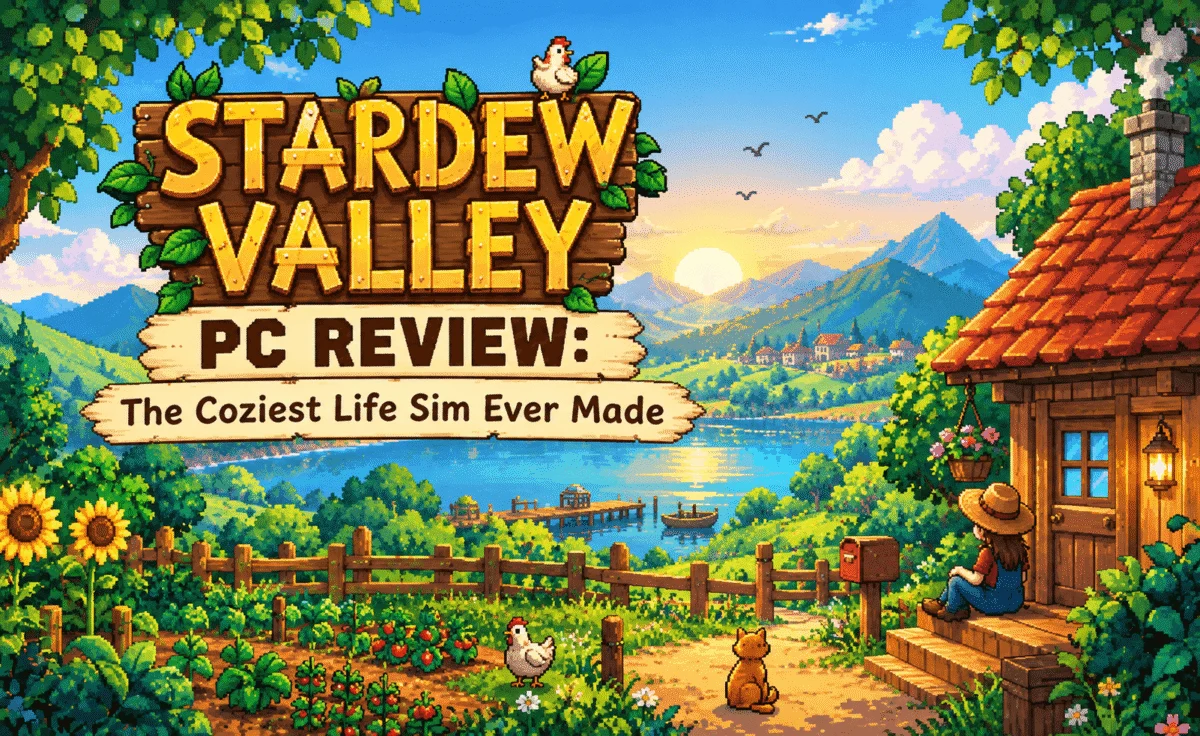
Some games are about winning. Some are about surviving. Stardew Valley is about something far rarer: it is about building a life you actually want to live, one turnip at a time. Created almost entirely by a single developer, ConcernedApe, it has grown from a humble farming sim into one of the most beloved and enduring PC games ever made. Years after its release, it remains the gold standard for cozy gaming, and a masterclass in how small details can add up to an unforgettable experience.
A Gentle Premise With Surprising Depth
The setup is simple. You are an office worker, worn down by city life, who inherits your late grandfather’s rundown farm in a small rural town called Pelican Town. You arrive with a few tools, a handful of seeds, and a plot of land overgrown with weeds, boulders, and fallen branches. From there, the game steps back and lets you decide what happens next.
That freedom is the heart of the experience. There is no timer demanding that you hurry, no rival farm racing you to the finish line. You can spend your days growing crops, raising animals, fishing in the river, exploring caves, befriending the townspeople, or doing a little of everything. The game offers just enough structure to keep you moving, in the form of seasonal festivals, community goals, and personal milestones, but it never forces you down a single path.
What surprises newcomers is how much there is to do. Beneath the cozy surface lies a remarkably deep set of interlocking systems: farming, foraging, fishing, mining, combat, cooking, crafting, and relationships all feed into one another. A fish you catch becomes a dish you cook, which fuels a trip into the mines, which yields ore for tools that make your farm more productive. Every activity supports the others, and the loop is endlessly satisfying.
“Stardew Valley does not ask you to be productive. It makes you want to be, and then lets you stop whenever you like.”
The Rhythm of the Seasons
Time in Stardew Valley is organized into four seasons, each lasting a fixed number of days, and each with its own crops, fish, festivals, and moods. Spring is a season of fresh beginnings, with green fields and the first tentative harvests. Summer brings heat, long days, and richer yields. Autumn is a golden, bittersweet season of abundance, and winter forces you to slow down, turn indoors, and prepare for the year ahead.
This cycle gives the game a natural rhythm. Planning your crops around the seasons is a puzzle in itself, and the satisfaction of a well-timed harvest is immense. The festivals, from flower dances to fishing contests, add a delightful social dimension, giving you reasons to look up from your fields and spend time with your neighbors. They are small, charming, and often surprisingly funny.
The in-game clock moves quickly, and a typical day is just a handful of minutes in real time. This is a clever design choice. Each day feels like a short, satisfying chapter, and the constant tension between everything you want to do and the limited hours available creates gentle, productive pressure. Sleeping at the end of a long day, as the farm settles into silence, is one of the great small pleasures in gaming.
The People of Pelican Town
If the farm is the body of the game, the townspeople are its soul. Each villager has a distinct personality, a daily schedule, and a story that unfolds over time. Getting to know them is a slow, rewarding process, with gifts, conversations, and shared events building trust. Some are cheerful and welcoming, others are guarded and prickly, and many carry quiet burdens that become clear only after you have spent time with them.
The writing is warm, funny, and surprisingly poignant. Without ever being heavy-handed, the game touches on loneliness, ambition, grief, and the strange comfort of community. Several storylines are genuinely moving, and the heart events that mark the deepening of a friendship can be unexpectedly emotional.
You can also build romantic relationships, and eventually marry and start a family. These systems are charming and sincere, though they are intentionally simple, and they do not demand the complexity of a full dating sim. The game treats relationships with warmth and respect, and it lets you shape your own story without judgment.
Beyond the Farm: Mines, Fishing, and Secrets
The farm is only the beginning. Beneath the town lie the mines, a multi-level dungeon filled with ore, gems, and monsters. Combat here is simple but satisfying, built around a few weapons and a handful of enemy types, and the descent offers a pleasant sense of escalating challenge. It provides a break from the quiet of the farm, and the resources you gather feed directly into your progress.
Fishing, meanwhile, is a mini-game with surprising depth. Different fish appear at different times, in different places, and under different weather conditions. The mini-game itself requires a steady hand, and landing a rare catch is a genuine thrill. Many players find it relaxing, while others find it frustrating until they master it, and both reactions are valid.
The world is also full of secrets. Hidden areas, strange characters, and mysterious events reward curiosity, and the game rarely explains everything. Part of its charm is the sense that there is always something you have not yet discovered, even after dozens of hours. Updates over the years have added new areas, new content, and refinements to existing systems, and the developer has continued to support the game with remarkable generosity.
“The best moments in Stardew Valley are the ones you stumble into, not the ones you plan for.”
Cooperative Play and Mods
On PC, Stardew Valley supports cooperative multiplayer, letting you share a farm with friends. This transforms the game in delightful ways. Tasks can be divided, strategies shared, and the quiet pleasure of a shared home becomes even sweeter. Coordinating a farm with a friend is like running a small family business, and the chaos that sometimes results is part of the fun.
The modding community is another highlight of the PC experience. Players have created everything from small quality-of-life improvements to large-scale expansions that add new regions, characters, and storylines. The tools for installing and managing mods are well developed, and the community is welcoming and creative. If you finish the base game and want more, the modding scene offers nearly limitless possibilities.
The game’s technical requirements are modest, and it runs well on almost any machine. It is also an excellent fit for portable PCs, thanks to its simple controls and low demands. Controller support is solid, though the mouse and keyboard remain an efficient way to manage inventory and crafting.
Presentation: Pixels With Personality
Visually, the game embraces a charming pixel-art style that evokes classic 16-bit adventures while adding a modern sense of warmth and detail. Colors are rich, animations are expressive, and the seasonal changes give the world a constantly shifting beauty. A rainy day, with raindrops on the fields and a gentle melody in the background, is a surprisingly affecting sight.
The music is a quiet triumph. Each season has its own set of tracks, from lively spring tunes to melancholy winter melodies, and the soundtrack perfectly complements the mood of the game. Many players find themselves humming the themes long after they have stopped playing, and the music is often cited as one of the game’s defining strengths.
A Few Caveats
No game is perfect, and Stardew Valley has its share of quirks. The early hours can feel slow, and the sheer number of systems can overwhelm new players who are used to being guided. The game does not always explain itself clearly, and some mechanics are best discovered with the help of a community guide. Inventory management can become a chore in the later game, and players who prefer a strong narrative drive may find the gentle pace unsatisfying.
It is also a game that rewards moderation. Because there is always something to do, it is easy to fall into the trap of trying to optimize every hour, and the experience is much more pleasant if you allow yourself to relax and wander. The best way to play is at your own pace, without worrying about efficiency.
Tips for Your First Year
New players often worry about doing everything correctly, but the best advice is to relax. Your first year is for learning, and mistakes are cheap. Plant a variety of crops, talk to everyone in town, and pay attention to the bundles at the community center, which quietly guide your goals across the seasons. Keep an eye on the calendar so that you do not miss a festival or a birthday, since small gifts can go a long way in building friendships.
Invest in your tools early, because upgraded equipment saves precious hours. Do not neglect your energy, either. Eating well and sleeping on time keeps you productive, and a well-stocked kitchen is one of the most underrated advantages. Most importantly, resist the urge to chase a perfect farm layout from day one. The valley is more fun when it grows organically, and the best farms are the ones that reflect the player who built them, quirks and all.
If you ever feel stuck, take a walk through town. A quiet stroll, a chat with a neighbor, and a pause by the river is often all it takes to remember why you came here in the first place.
The Depplo Verdict
Stardew Valley is a modern classic, a warm, generous, and endlessly charming game that proves that small ideas, executed with love, can have an enormous impact. It is a game about patience, community, and the quiet joy of building something meaningful, and it delivers that experience with extraordinary polish and heart.
Whether you are a longtime fan of farming sims or someone who has never planted a virtual seed, this is an easy recommendation. It is affordable, accessible, and deeply rewarding, and it is the kind of game you will return to again and again. Pick up your hoe, plant your first parsnip, and let the valley work its magic.
Score Breakdown
- Relaxing, deeply rewarding gameplay loop
- Charming characters and warm writing
- Co-op and a vibrant mod scene
- Runs on almost anything
- Slow, under-explained early hours
- Inventory management can become a chore
- Little narrative drive for story-first players
Reviewed by the Depplo Team. Scores reflect our editorial opinion. Browse more in Game Verdicts → PC Games.
About the Author