
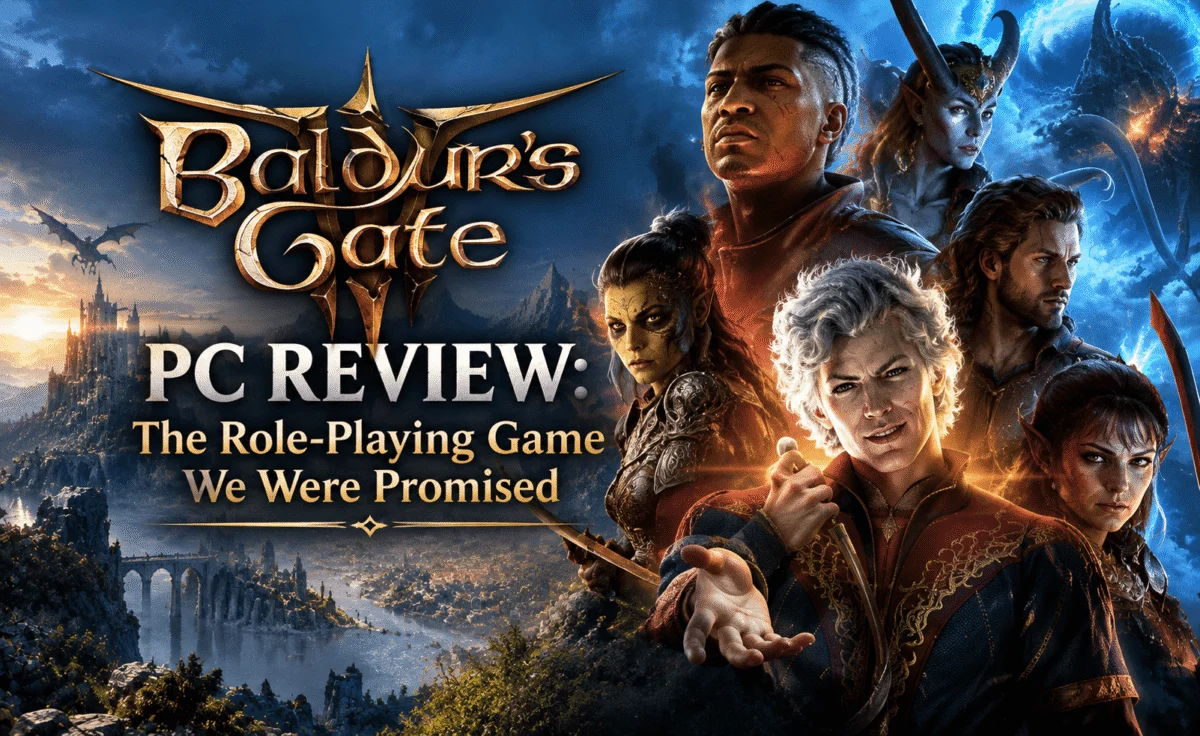
Some games ask for your attention. Baldur’s Gate 3 asks for your autobiography. Within the first hour you are choosing who your character was before the story began, and within the first ten you are lying to a goblin, adopting a very questionable bear, and wondering why a conversation about breakfast has become a moral crisis. Larian Studios did not simply adapt Dungeons & Dragons for the PC. It built the version of the tabletop experience that most of us always imagined was possible, then wrapped it in a production that still feels startling years after release.
A Role-Playing Game That Actually Respects the Word “Role”
The great promise of any tabletop-inspired RPG is that your decisions matter, and the great disappointment is how often that promise turns out to be a decorative menu. Baldur’s Gate 3 is the rare exception. Reactivity here is not limited to big binary choices at the end of a chapter. It lives in the small things: the way a companion remembers a throwaway comment, the way a locked door can be opened by a spell, a stolen key, a shove, or a persuasive lie, and the way an NPC you ignored in the first act can return in the third with opinions about it.
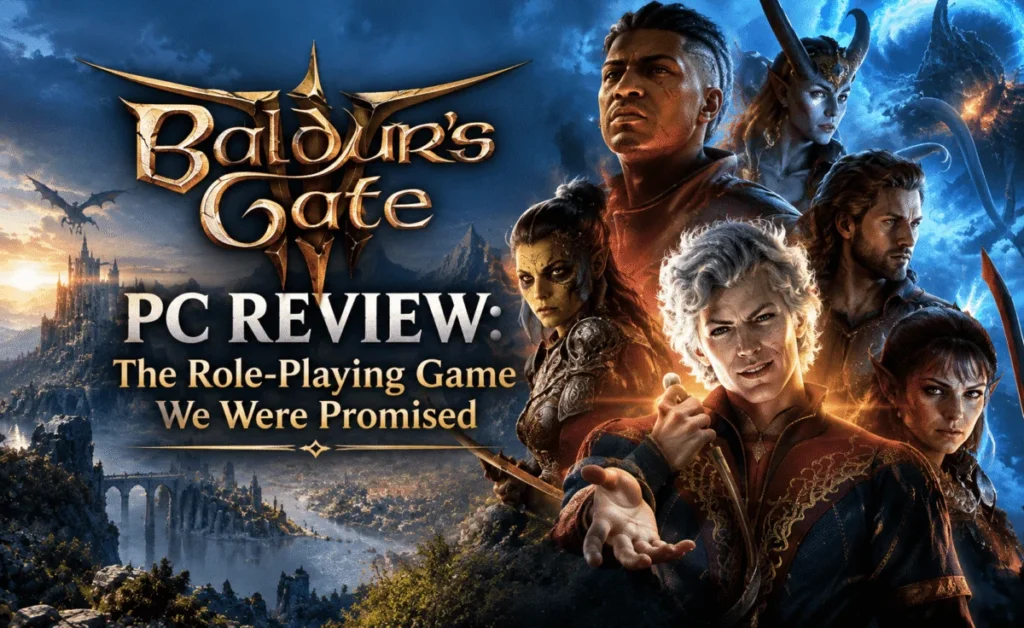
The origin-character system is the clearest expression of this philosophy. You can build your own hero from the official races and classes of the fifth edition ruleset, or you can step into the shoes of one of the pre-written companions, each with a personal storyline that unfolds whether or not they are the “main” character. Playing as a custom character feels like directing a film in which you are also the lead actor. Playing as an origin character feels like reading a novel where you occasionally get to overrule the author. Both approaches are valid, and both are richly supported.
What makes the writing land is its tonal range. The game is genuinely funny, then genuinely frightening, then quietly tender, sometimes inside the same scene. The villains are not cartoonish; the three central antagonists are written with enough conviction that you can understand, if never excuse, what they believe. The companions are even better. Shadowheart, Astarion, Gale, Wyll, Lae’zel, Karlach, and the rest are not quest dispensers with personalities stapled on. They argue with each other, they disapprove of you, they have bad days, and they change in response to how you treat them.
“This is a game where the most memorable moments are rarely the ones the marketing showed you. They are the ones you caused yourself.”
Combat: Chess With Dice and a Sense of Humor
Baldur’s Gate 3 uses turn-based combat built on the rules of the fifth edition tabletop game, and Larian layers its own talent for systemic chaos on top. If you have played a Divinity game before, you will recognize the philosophy: the environment is a weapon, surfaces interact, and the most elegant solution to a fight is often the one the designers did not explicitly plan.
A typical encounter is a puzzle with several valid answers. You can ambush a group from high ground, set a patch of oil alight beneath them, and watch the fire spread to a barrel you had forgotten about. You can shove an enemy off a ledge for a satisfying instant of physics. You can skip the fight entirely with a well-placed persuasion check, or you can lose it spectacularly because the dice betrayed you at the worst possible moment. That last part matters. The tension of a roll is real, and the game has the confidence to let bad luck produce interesting problems instead of smoothing them away.
The class system gives you a great deal of room to experiment. A wizard who relies on utility spells plays nothing like a barbarian who treats every encounter as a personal insult. Multiclassing, introduced after the early releases, widens the possibilities even further, and the respec option means that a failed experiment is an inconvenience rather than a disaster. Early fights can feel punishing for newcomers who are not used to tabletop rules, but a handful of hours in, the rhythm clicks, and the combat becomes one of the most satisfying tactical loops in the genre.
There are blemishes. Some encounters, particularly in the later chapters, drag because of sheer enemy count, and the action economy of larger fights can slow the pace to a crawl. Honor Mode, the harder, one-save challenge, is a fantastic addition for veterans, but it is a very different game from the standard experience and should be approached with humility.
The World: Dense, Dangerous, and Worth Poking
The game is structured in three acts, and each one feels like a different kind of RPG. The opening act is an open, wild landscape that rewards curiosity with hidden caves, side quests that cross-pollinate, and loot that actually changes how you play. The second act moves into a twisted, hostile region where the atmosphere shifts from adventure to dread. The final act drops you into the sprawling city of Baldur’s Gate itself, a dense urban environment packed with factions, secrets, and consequences.
Exploration is the quiet star of the package. Vertical level design means that you are constantly looking up for another route, another rooftop, another cache of treasure. The map is full of environmental storytelling: a room that tells you how its occupant died without a single line of dialogue, a note that rewrites your understanding of a questline you thought you had finished. Almost every location has a reason to exist, which is a rarer achievement than it sounds in a game this large.
The first act is widely regarded as the strongest, and it is easy to see why. Its structure is looser and more open, and the sense of discovery is at its peak. The third act, by contrast, is where the seams show. The city is a magnificent setting, but the sheer density of quests and characters can overwhelm, and a few storylines resolve more abruptly than the buildup deserves. That said, even the weaker moments of the finale are stronger than the high points of many competitors.
Performance and Technical Notes on PC
On PC, Baldur’s Gate 3 is a generally well-behaved game with a few well-known caveats. The first act typically runs smoothly on a broad range of hardware, while the busy city of the third act is the stress test that exposes weaker CPUs and older systems. If your machine is on the lower end of the recommended specification, expect the final chapter to be the place where you start trimming settings.
The game supports modern upscaling options, and the interface scales sensibly for different monitor sizes. Mod support has become a significant part of the PC experience, with the community producing quality-of-life tweaks, new cosmetic options, and even entirely new content. We recommend finishing a first playthrough as close to the vanilla experience as possible, then exploring mods on a second run, when you will appreciate the difference.
The game’s size and its long runtime make saving discipline a good habit. Keep several manual saves, particularly before major story decisions, because the temptation to see “what happens if” is strong and the game rewards it handsomely. Controller support exists and is surprisingly competent for a game with this many spells and inventory interactions, though keyboard and mouse remain the most precise way to manage a complicated party.
Cooperative Play: Chaos With Friends
One of the game’s most underrated features is its cooperative mode. Up to four players can share a campaign, each controlling their own character, and the result is something that comes surprisingly close to a real tabletop night. Conversations become negotiations between actual people. Players can disagree on a decision, and the game happily lets them pursue different goals in the same scene. A friend who decides to pickpocket a quest-giver at the worst possible moment is a feature, not a bug.
Cooperative play does demand patience. Sessions run long, and coordinating schedules across a campaign of this scale is its own quest. But if you have a group that enjoys storytelling, this is one of the most memorable ways to play, and it adds enormous replay value to a game that already has plenty.
“A campaign here is not a product you consume. It is a story you and your friends will still be arguing about next year.”
Audio, Visuals, and Presentation
The production values are simply exceptional. The voice cast delivers performances that elevate even minor characters, and the motion-captured cinematics give conversations a weight and intimacy that static dialogue boxes could never achieve. The score ranges from sweeping orchestral themes to delicate, melancholic moments that fit the tone of the story without ever overpowering it.
Visually, the game balances fidelity and style with confidence. Character models are expressive, environments are lush or oppressive as required, and spell effects are legible even in the middle of chaotic fights. Lighting does a great deal of work, particularly in the more atmospheric sections, and the camera system makes the most of the game’s cinematic ambitions. A small number of animation quirks and the occasional clipping issue remind you that the game is enormous, but they rarely break the spell.
Who Should Play It, and Who Should Wait
If you enjoy narrative-driven RPGs, tactical combat, or the simple pleasure of making choices that ripple outward, Baldur’s Gate 3 is close to essential. It is a game that rewards patience, curiosity, and a willingness to be surprised by your own decisions. Players who prefer faster, action-oriented experiences may find the pace slow, and those who dislike reading or dialogue-heavy storytelling will probably bounce off it. The time commitment is real, and the first few hours demand a little effort before the whole machine starts to hum.
Newcomers to the tabletop rules should not be intimidated. The game explains its systems patiently, and its difficulty options are flexible enough that you can focus on the story if tactics are not your priority. Veterans will find enough depth to keep them engaged for several playthroughs, with different classes, companions, and approaches producing meaningfully different experiences.
The Depplo Verdict
Baldur’s Gate 3 is not a perfect game. Its third act is overstuffed, some encounters outstay their welcome, and a handful of technical wrinkles linger. But perfection is not what makes a game last. What matters is ambition, execution, and heart, and few games in recent memory have shown as much of all three. It treats your choices with respect, writes characters you actually care about, and offers a sandbox of tactical possibilities that remains fresh deep into the journey.
It is a landmark for the PC platform and for the genre it belongs to, and it sets a standard that other studios will be chasing for years. If you have not yet stepped into Faerûn, now is an excellent time. Bring a notebook, a healthy appetite for consequences, and a willingness to let the dice fall where they may.
Score Breakdown
- Choices and consequences that truly matter
- Brilliantly written companions
- Deep, flexible turn-based combat
- Excellent co-op and mod support
- Act 3 is overstuffed and demanding on CPUs
- Large fights can drag
- Long time commitment
Reviewed by the Depplo Team. Scores reflect our editorial opinion. Browse more in Game Verdicts → PC Games.
About the Author