

The Quiet Shift Nobody Saw Coming
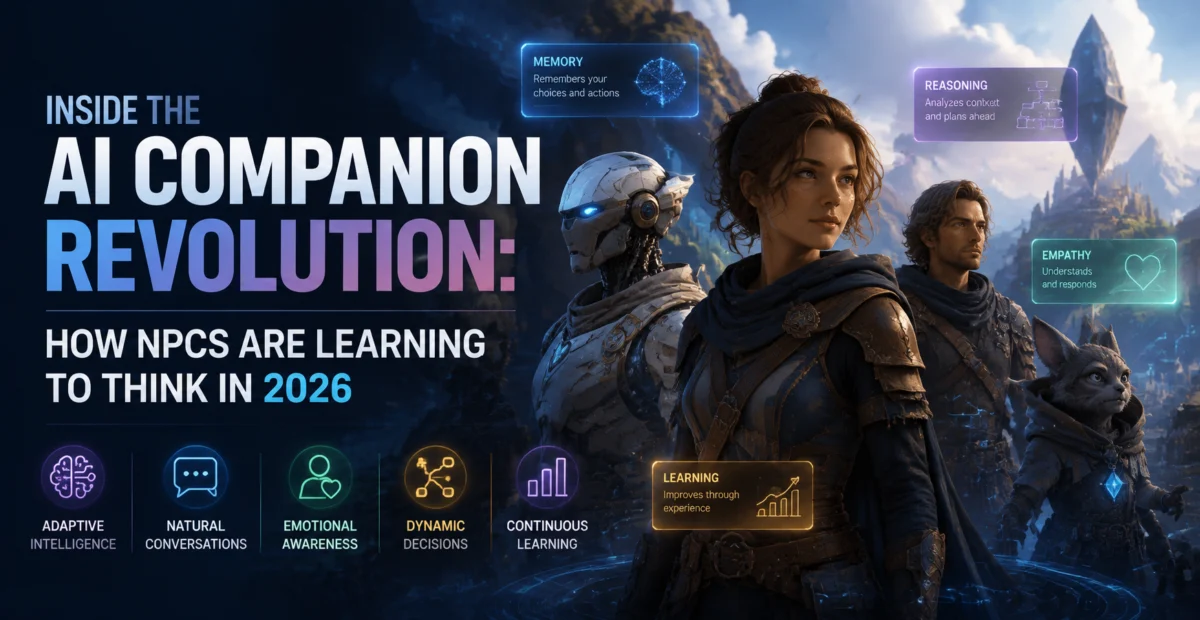
For the better part of three decades, non-player characters existed inside a narrow box. They walked pre-set patrol routes, repeated the same four lines of dialogue, and reacted to the player’s presence with all the emotional nuance of a vending machine. That box has been cracking open for a few years now, but 2026 is shaping up to be the year it finally shatters. Across studios large and small, the phrase “AI companion” has quietly replaced “NPC” in design documents, and the shift is not just cosmetic branding — it reflects a genuine change in how characters are built, tested, and shipped.
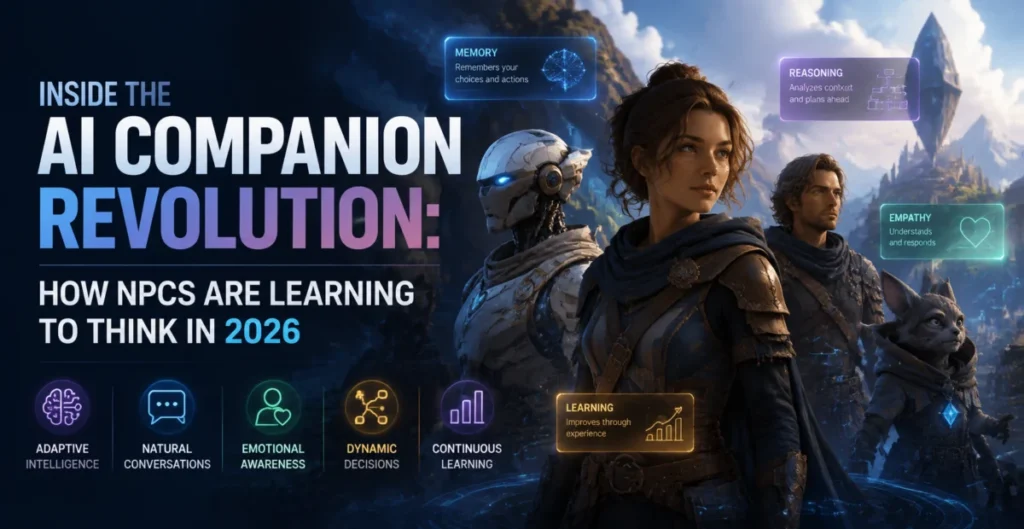
The catalyst is a convergence of three technologies that used to live in separate departments: large language models capable of real-time dialogue generation, procedural animation systems that translate emotional state into believable body language, and lightweight on-device inference that no longer requires a constant round-trip to a data center. Individually, none of these are new. Together, they are producing characters who remember what the player did an hour ago, who can be genuinely surprised, annoyed, or grateful, and who no longer break immersion the moment a conversation strays outside a scripted tree.
From Barks to Conversations
Ask any veteran game writer about the old workflow and they will describe something close to industrial manufacturing. A character’s entire vocabulary was authored months in advance, recorded in a studio, and locked into the build. If a player asked a guard a question the writers hadn’t anticipated, the guard would simply repeat a generic “bark” — a single canned line meant to plug the gap. It worked because players were trained not to expect more.
That training is now being undone. Several mid-size studios have begun shipping companion characters whose dialogue is generated live, constrained by a persona document rather than a fixed script. The persona document defines the character’s history, values, speech patterns, and boundaries, and the model improvises within those guardrails. The result, according to several developers who spoke about their production pipelines this month, is a companion who can discuss a plot twist from an hour ago, comment on the player’s specific inventory, or push back when asked to do something that conflicts with their established personality.
“We stopped writing dialogue trees and started writing character bibles,” said one narrative director at a studio currently finishing a mid-budget RPG. “The job changed from scripting every possible sentence to defining who this person is clearly enough that the model can’t get them wrong.”
This does not mean writers are disappearing from the credits. If anything, the opposite is happening: studios report needing more narrative staff, not fewer, because someone still has to author the underlying persona, define hard limits, and catch the moments when a generated line drifts out of character. The job has shifted from writing every word to writing the rules a character lives by.
Bodies That Match the Mind
Dialogue is only half the equation. A character who says something surprising but keeps standing in a neutral idle pose feels uncanny rather than alive. This is where procedural animation systems have made some of the least publicized but most important progress of the last eighteen months.
Rather than blending between a fixed library of animation clips, newer systems generate motion from a small set of parameters — tension, openness, urgency, warmth — that are updated continuously based on the character’s simulated emotional state. A companion who has just been complimented might loosen their shoulders and hold eye contact a beat longer. One who feels betrayed might cross their arms without a designer ever hand-placing that specific pose. The animation becomes a downstream expression of the character’s internal state rather than a separately authored layer that has to be manually synced to dialogue.
- State-driven posture: body language responds to a rolling emotional score instead of a fixed animation trigger.
- Micro-expression layering: facial rigs blend subtle involuntary tells — a flicker of the eyes, a delayed smile — on top of the primary expression.
- Gaze and attention systems: characters track what the player is doing, not just where they are standing, which fixes the long-standing problem of companions staring blankly into space during a tense conversation.
The combined effect is subtle but cumulative. Individually, none of these systems would convince anyone they were talking to a real person. Together, over the course of a ten-hour campaign, they add up to companions that players describe, almost universally, as “the first NPC I’ve felt bad about disappointing.”
The Hardware Question
None of this matters if it cannot run on the hardware players actually own. This has historically been the biggest obstacle to AI-driven characters: language models are expensive to run, and console and handheld hardware budgets are tight. The breakthrough this year has been less about raw model size and more about distillation — training smaller, specialized models that only need to be good at one thing, namely staying in character and responding quickly, rather than general-purpose intelligence.
A specialized dialogue model tuned for a single game can be an order of magnitude smaller than a general chatbot while performing better at the specific job of staying consistent with a character’s established voice. Several engine middleware providers have released toolkits this year specifically aimed at helping small teams fine-tune compact models on their own narrative data, which has done more to democratize the technology than any single flagship AAA release.
Latency remains the other constraint. Players notice a half-second delay before a character responds, and that delay breaks the illusion faster than a slightly generic line would. Studios have responded with hybrid approaches: a fast, local model handles immediate reactions and short exchanges, while longer, more complex conversations can lean on a cloud-assisted model when the player is in a less time-sensitive context, such as a quiet dialogue scene rather than mid-combat banter.
What This Means for Players
For the people actually holding the controller, the practical upshot is a companion who feels less like a quest dispenser and more like a character with continuity. Early feedback from playtests suggests players are adjusting their own behavior in response — choosing dialogue options more carefully, avoiding actions they know a specific companion would disapprove of, and in some documented cases, apologizing to a virtual character after making a choice the character reacted badly to.
There is a risk of overcorrection here. Several designers have cautioned against chasing realism for its own sake, pointing out that some of gaming’s most beloved companions were beloved precisely because of tight, deliberate authorial control rather than open-ended generation. A companion who can say almost anything is not automatically a better companion than one who says exactly the right thing at exactly the right moment, because a human writer crafted that moment on purpose.
The emerging consensus among studios experimenting seriously with this technology is that the sweet spot lies somewhere in between: authored major story beats stay fully scripted and voice-acted, while incidental conversation, banter, and reactive commentary are handed over to generative systems. This hybrid model preserves the emotional peaks that require precision while filling in the vast, previously lifeless space between them with something that finally feels responsive.
Looking Ahead
The next twelve months will likely bring the first wave of games built around this technology from the ground up, rather than retrofitted onto existing systems. Expect to see companion characters marketed as a headline feature rather than a technical footnote, along with a growing conversation about how much memory a character should retain across a full playthrough, and what happens to that memory in a sequel.
There are also open questions the industry has not fully answered: how to handle players who try to break a character’s persona through adversarial prompting, how to localize generative dialogue across dozens of languages without losing personality, and how to ensure a companion’s improvised lines never contradict the fixed, voice-acted story beats around them. None of these are trivial, and studios that get them wrong risk turning a beloved companion into an uncanny liability.
What is clear is that the era of the disposable NPC is ending. Whether players end up remembering 2026 as the year companions became characters, or as an interesting but flawed first draft, the direction of travel is no longer in doubt. The box non-player characters have lived in for thirty years finally has the lid off.
The Testing Problem
Quality assurance teams have quietly become one of the most important stakeholders in this shift, and one of the least discussed. Testing a scripted dialogue tree is a bounded problem: every branch can, in theory, be walked and verified before launch. Testing a generative companion is fundamentally different, because the space of things a player might say or do is effectively unbounded. Several studios have responded by building automated adversarial testing pipelines that throw thousands of synthetic player inputs at a character overnight, flagging any response that breaks tone, reveals information too early, or drifts outside the character’s defined boundaries.
Even with this kind of automated coverage, human testers remain essential, in part because some of the most damaging failures are not technical bugs but tonal ones — a companion who stays perfectly in character while saying something that simply feels wrong for the moment, a joke landing flat during a scene meant to be somber, or a callback to an earlier event delivered with the wrong emotional weight. Catching these requires a human ear tuned to the specific story being told, which is part of why several studios describe QA headcount on these projects growing rather than shrinking, even as the technology promises to automate large parts of content creation.
Localization Enters Uncharted Territory
Perhaps the least glamorous but most consequential open question is what this technology means for localization. A scripted line can be translated once, reviewed by a native speaker, and locked into the build with confidence. A generated line, by definition, does not exist until the moment a specific player triggers it, which means traditional translation workflows do not map cleanly onto this new kind of content at all.
The emerging approach involves training or fine-tuning separate models for each target language, rather than generating in one language and machine-translating the output, since translated generative dialogue has tended to lose the subtle personality cues that make a character feel distinct in the first place. This is expensive, and it means smaller studios experimenting with AI-driven companions may, at least for now, be forced to launch in a limited number of languages rather than the wide simultaneous release schedules players have come to expect, a tradeoff several teams have already acknowledged publicly while promising broader language support in future updates.
About the Author