

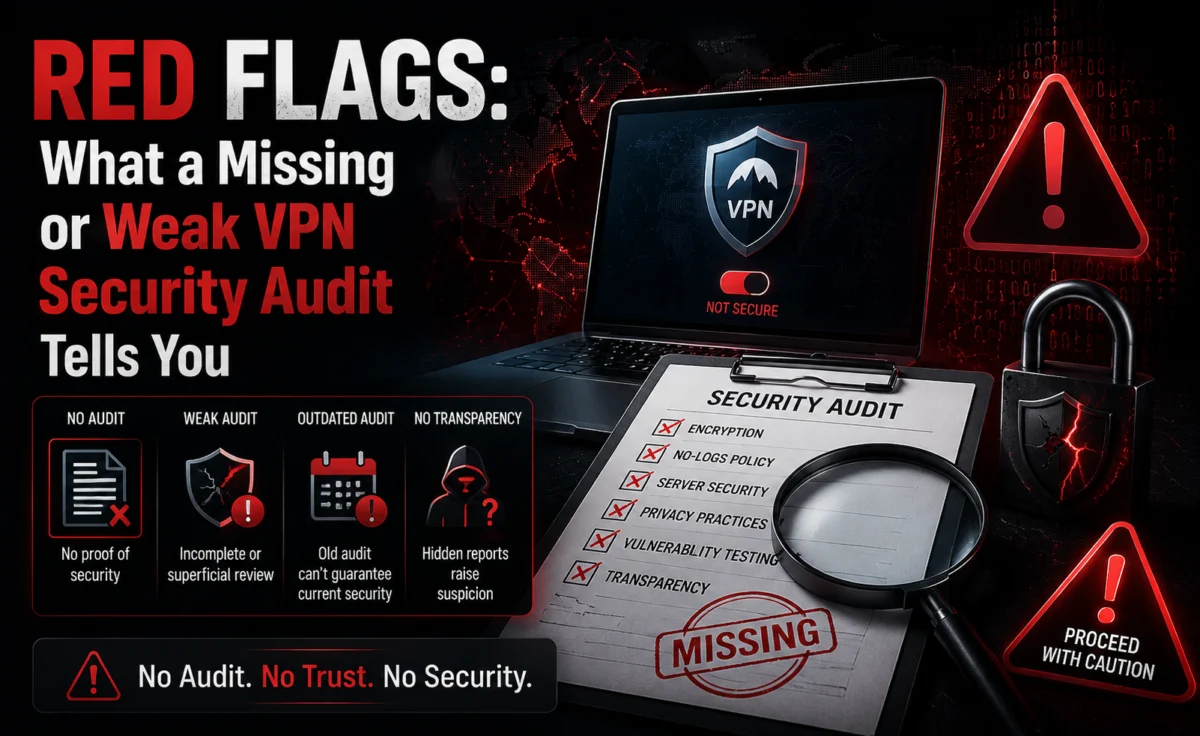
Absence of evidence isn’t automatically evidence of wrongdoing — that principle holds for VPN providers too. Plenty of smaller, honest providers simply haven’t budgeted for a full independent audit yet. But absence of evidence is a gap, and how a provider responds when you point at that gap tells you almost as much as the audit itself would have. This piece is about reading the negative space: what a missing audit means, and what a weak one is quietly signaling.
Not All “No Audit” Situations Are Equal
| Situation | What It Suggests |
|---|---|
| New, small provider, transparent about not yet being audited, roadmap mentioned | Reasonable — cost and maturity constraints, not necessarily a trust problem |
| Established, well-funded provider, no audit, no explanation offered | Concerning — the resources exist; the choice not to seek scrutiny is the signal |
| Provider claims to be “audit-ready” indefinitely without ever completing one | Red flag — a phrase used to imply confidence while avoiding commitment |
| Provider had an audit years ago, references it constantly, never repeated it | Aging evidence being used as if it were current |
The Weak-Audit Playbook: Patterns Worth Recognizing
A provider doesn’t need to fabricate an audit to mislead you with one. It’s far more common — and much harder to spot — for a real audit to be quietly stretched past what it actually supports.
1. The Logo Without the Report
An auditor’s logo displayed prominently, with no link to a downloadable report, no date, and no way to verify the engagement actually happened as described. If you can’t find the underlying document, the logo is doing marketing work, not evidentiary work.
2. The Scope-Laundering Headline
“Independently audited for security” sounds comprehensive. If the underlying report shows the audit covered a single component — say, just the no-logs claim on backend infrastructure — the headline is technically true and substantively misleading. This is the single most common gap between claim and evidence in the industry.
3. The One-and-Done Audit
A single audit from three or four years ago, never repeated, still being cited as current proof. Infrastructure and codebases change constantly; an audit that old describes a system that likely no longer exists in its audited form.
4. The Self-Written “Summary”
Instead of publishing the auditor’s actual report, the provider publishes its own two-paragraph summary of what the audit supposedly found. This removes the auditor’s independent voice from the process entirely — you’re trusting the company’s retelling of its own results.
5. Findings Without Remediation
A published report that lists vulnerabilities but includes no remediation section and no re-test. Bugs were found; whether they were fixed is left an open question the provider hopes you won’t ask.
Key takeaway: A weak audit is often more misleading than no audit at all, because it borrows the credibility of “we got audited” without delivering the substance.
Questions That Cut Through the Ambiguity
When a provider’s audit situation is unclear, a short, direct set of questions — asked via support chat or email — tends to surface the real answer quickly:
- “Can you send me the full PDF report, not just the summary?”
- “What exact systems or applications were in scope?”
- “When was this conducted, and is a newer audit planned?”
- “Were any findings unresolved at the time of publication?”
How a support team responds is itself informative. A provider confident in its audit history will usually produce the document promptly. A provider that stalls, deflects, or offers only the marketing summary again is telling you something, even if it never says so directly.
Other Warning Signs Worth Cross-Checking
- Vague jurisdiction claims — “we operate under strong privacy laws” without naming the specific jurisdiction or legal framework.
- No transparency report — no public record of government data requests received or how they were handled.
- Ownership opacity — a parent company structure that’s difficult to trace, especially after a merger or acquisition.
- Marketing that outpaces the evidence — claims of being “the most audited VPN” without a public, comparable body of reports to back the superlative.
None of these are automatically disqualifying on their own. Combined, though, a pattern of vagueness across audits, jurisdiction, ownership, and transparency reporting adds up to a provider that has consistently chosen ambiguity over verifiability — and that choice, repeated across every category where scrutiny is possible, is the real red flag.
The Bottom Line
A missing audit from a small, honest, transparent provider is a reasonable and often temporary state of affairs. A weak, stale, or scope-laundered audit from a large provider that could easily afford better is a choice, not a limitation. Learning to tell the two apart — by asking for the actual document, checking the date, and reading the scope section before believing the headline — is the single most useful habit you can build as a VPN user who wants proof instead of promises.
Why Providers Sometimes Resist Deeper Scrutiny
It’s worth understanding the incentives on the other side of this equation. A full, comprehensive, recurring audit program is expensive, and a published report with real findings — even remediated ones — can be seized on by competitors or misread by casual readers as evidence of insecurity rather than evidence of a working process. Some providers respond to that risk by investing more in the audit and being confident enough in their process to publish everything. Others respond by narrowing scope, delaying publication, or leaning on a single favorable engagement indefinitely. Neither response is irrational from a pure business standpoint, but only one of them actually serves the reader trying to make an informed decision.
A Short Case for Skepticism in Both Directions
It’s tempting to treat “has an audit” as a simple pass/fail signal, but overcorrecting into blanket skepticism of the entire practice is its own mistake. Independent audits, done well, are genuinely one of the best tools available for verifying claims that would otherwise be unverifiable. The goal of this piece isn’t to suggest audits are meaningless theater — it’s to equip readers to tell a rigorous, current, fully published audit apart from a stale or narrow one wearing the same badge. Most of the work of doing that is just reading the document instead of the headline.
A Compact Checklist Before You Commit
- Does a full report exist, and is it downloadable without a request or paywall?
- Is the auditing firm named, identifiable, and reputable in the security industry?
- Was the audit conducted within roughly the last twelve to eighteen months?
- Does the report cover the specific claim you care about — no-logs, app security, encryption — rather than something adjacent?
- Is there evidence that findings were remediated and re-tested, not just listed?
- Has the provider done this more than once, suggesting an ongoing practice rather than a one-time event?
If a provider clears most of these questions with documentation rather than reassurance, that’s about as strong a signal as this category of evidence can offer. If it clears none of them, the marketing claim of being “audited” is doing far more work than the underlying evidence supports.
A Brief Note on Giving Newer Providers a Fair Read
It’s easy for this kind of checklist to unintentionally punish small, newer providers who simply haven’t had the runway to commission a full audit program yet, while rewarding large incumbents purely for having deeper pockets. A fairer reading looks at trajectory as much as current state: has a smaller provider published a roadmap toward independent verification, engaged with security researchers informally, or been transparent about the limitation when asked directly? A young provider that says plainly “we haven’t been audited yet, here’s why, and here’s our timeline” is behaving more trustworthily than a much larger provider that dodges the same question indefinitely. Evidence quality matters more than company size.
How to Escalate If a Provider Won’t Engage
If direct questions to support don’t produce a straight answer, a few additional steps can round out the picture before you commit: search independent security research and disclosure databases for the provider’s name, check whether any security researchers have published findings outside of a paid audit relationship, and look for community discussion in security-focused forums where technically literate users tend to surface exactly this kind of gap. None of these replace a real audit, but together they can tell you whether a provider’s silence reflects genuine early-stage limitations or a pattern of avoiding scrutiny across every channel available.
Closing Thought
The goal of all of this isn’t cynicism toward the VPN industry as a whole — plenty of providers are doing real, careful, well-documented security work. The goal is calibration: knowing which claims deserve full confidence, which deserve a follow-up question, and which are quietly asking you to take a leap of faith you don’t actually need to take. In a category built entirely on trust, that calibration is the most useful skill a reader can bring to the decision, and it’s exactly the lens we try to apply every time a provider lands in this hub’s Security Audits coverage.
About the Author