
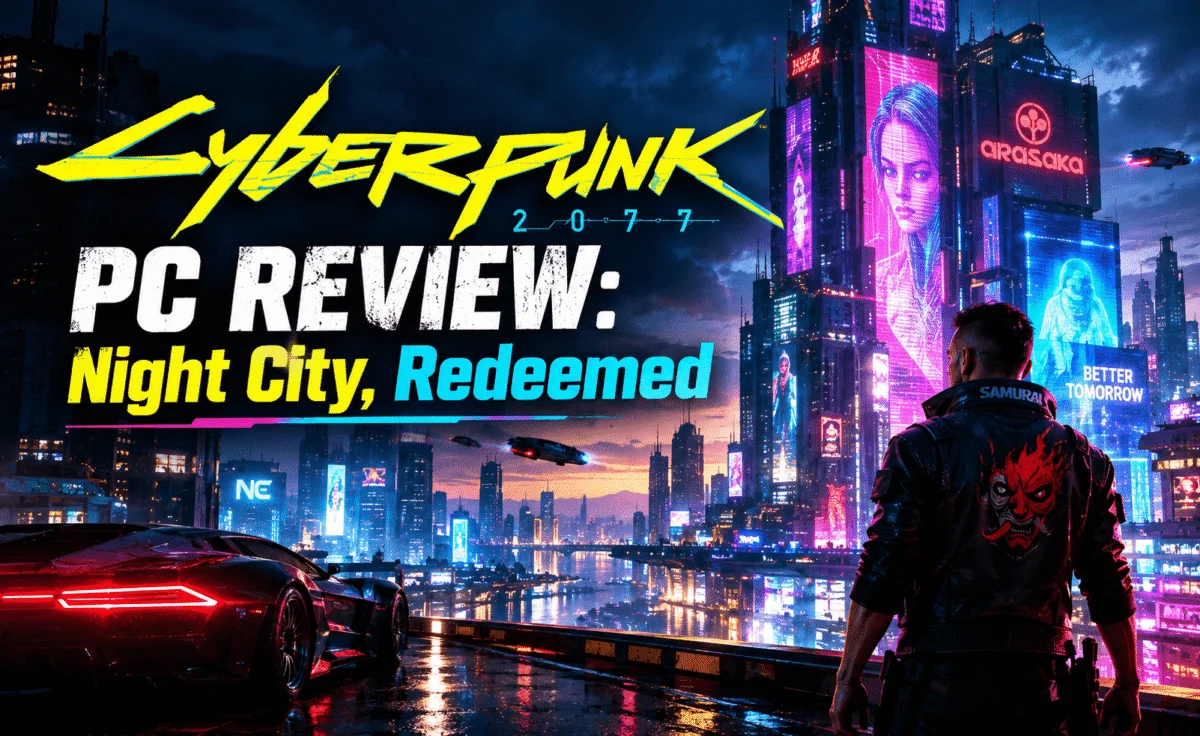
Few games in history have had a story as dramatic as the one that unfolded around Cyberpunk 2077. It launched in December 2020 to enormous expectations, stumbled badly on many platforms, and spent the following years being rebuilt, patched, and reimagined until it became something its first reviewers would barely recognize. Today, on a capable PC, it is a confident, stylish, and often brilliant open-world RPG. This review is about the game as it stands now, and about whether Night City has finally earned the neon halo it was promised.
Night City: A Setting With Its Own Pulse
Every great open-world game has a place that feels alive, and Night City is one of the most striking environments ever put on a monitor. It is dense, vertical, and overwhelming by design: towering corporate spires, cramped neon-soaked alleys, sprawling markets, and desolate wastelands on the edge of the city, each district with its own personality and its own relationship to power.
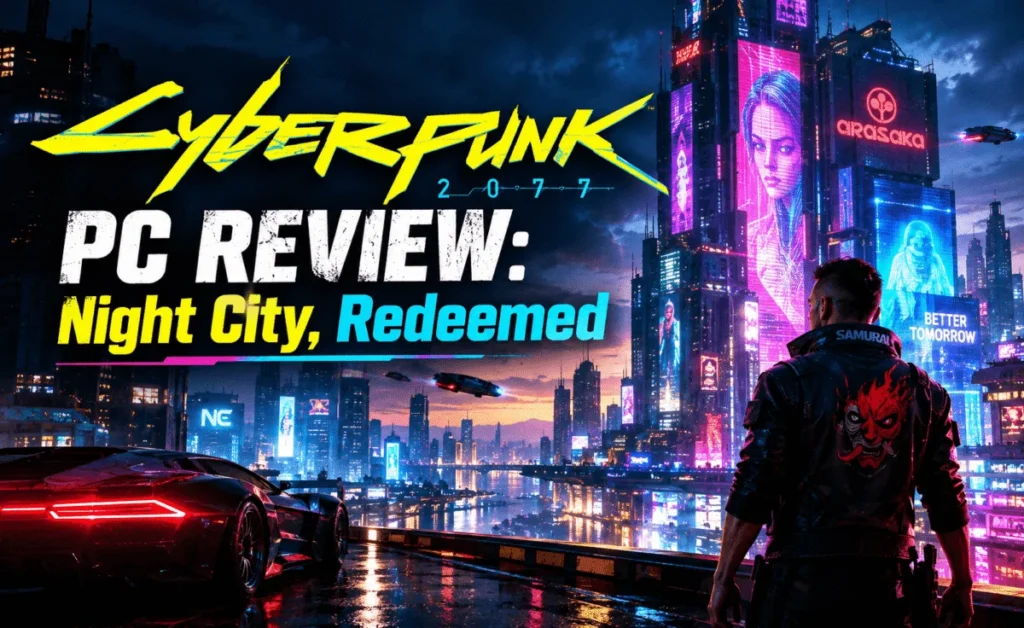
What makes the city work is its sense of texture. Billboards advertise absurd products, street vendors hawk strange wares, and the background chatter of passersby paints a picture of a society that has been pushed to its limits by corporate greed and technological excess. The art direction commits fully to a retro-futurist aesthetic, with a palette of hot pink, electric blue, and sickly yellow that gives every scene a distinctive glow. After dark, when rain slicks the streets and reflections shimmer on every surface, the city is breathtaking.
Exploration is rewarded with a steady stream of small stories: a crime in progress, a strange vending machine, a rooftop with a secret, a message on a terminal that reveals a personal tragedy. These details are the lifeblood of the setting, and they give the world a sense of lived history that goes beyond its main storyline. Not every district is equally detailed, and some of the background systems remain thinner than the marketing once suggested, but the cumulative effect is still immersive.
“Night City is not just a backdrop. It is the main character, and it has opinions about you.”
The Story: Chrome, Ghosts, and Hard Choices
You play as V, a mercenary trying to make a name in the underworld of Night City. A job goes catastrophically wrong, leaving V with a dangerous piece of technology implanted in their head and a digital ghost of a rock-and-roll terrorist rattling around inside their mind. That ghost, played with magnetic charisma, becomes the emotional spine of the whole experience.
The central relationship works because the writing resists easy answers. V and their unwanted passenger are both flawed, both desperate, and both capable of surprising tenderness. The game uses their shifting dynamic to explore themes of identity, mortality, and the cost of fame, and it does so with a confidence that lifts it above the standard action-RPG storyline.
The main questline is strong, but the real gems are often the side stories. Companion missions are standouts, giving you the chance to build real relationships with a memorable cast of characters. Several of these arcs are genuinely moving, and a few of the optional quests deliver emotional punches that rival anything in the main plot. Choices matter, though not always in the sweeping way some players might expect. The game tends to favor meaningful consequences within quests rather than world-altering branching, and the ending paths are distinct and satisfying.
The expansion, Phantom Liberty, deserves special praise. It is a tight, tense spy-thriller that introduces a new district, a compelling cast, and some of the best writing in the entire game. If you are going to buy into the world, the expansion is a highly recommended part of the package.
Combat, Builds, and the Many Ways to Be a Menace
The combat in Cyberpunk 2077 has been substantially improved since launch. Gunplay is punchy and satisfying, with a wide range of weapons that feel distinct: precise sniper rifles, hard-hitting shotguns, smart weapons that track targets, and melee tools such as katanas and mantis blades that turn V into a whirlwind of steel.
Your build defines how you play. You can be a stealthy hacker who disables enemies from the shadows, a heavily armored brawler who rushes into every fight, a sharpshooter who picks off targets from a distance, or a hybrid of everything. The skill and perk systems were overhauled in a major update, and the changes made progression feel clearer and more rewarding. Cyberware, the chrome implants that augment your body, offers a rich set of options for customization, giving you tools like double jumps, arm-mounted weapons, and enhanced reflexes.
The result is a combat system with real flexibility. A fight can be approached quietly, loudly, or somewhere in between, and the game rewards experimentation. Enemy AI is serviceable rather than spectacular: foes will flank, take cover, and call for backup, but they can still behave predictably. Police behavior and some open-world systems remain areas where the game feels less polished than the rest of its design.
Driving is the other pillar of the moment-to-moment experience. Vehicles have improved considerably, with a range of cars and motorcycles that feel distinct, and the addition of vehicle combat gives road chases a satisfying kick. Traffic is dense, and the city’s design makes travel a pleasure, though some players may still find the handling a matter of taste.
The Technical Picture on PC
The PC version is where Cyberpunk 2077 can be seen at its absolute best, and also where it can demand the most from your hardware. The game has long been a showcase for advanced graphical features, including ray-traced lighting, reflections, and path tracing. On a powerful system with a modern graphics card, these features can produce some of the most beautiful imagery in the medium. Neon signs bleed color onto wet pavement, light bounces through smoky interiors, and the whole city seems to shimmer.
These features are demanding, however, and players with more modest hardware will want to use upscaling technologies and carefully adjusted settings to find a balance between visuals and smoothness. The game supports multiple upscalers and frame-generation options, and tuning them can make a significant difference. It is worth spending a few minutes in the settings menu before you start your first mission.
The launch-day horror stories are largely a thing of the past. On a modern system, the game is stable, responsive, and a pleasure to play, though occasional bugs and quirks still appear, as they do in nearly every game of this scale. Mod support is an important part of the PC experience, with the community producing everything from cosmetic tweaks to gameplay overhauls, and the modding scene has given the game a second life.
“The game that launched in 2020 and the game you can play today are two very different experiences. The second one is far better.”
Sound and Music: A City You Can Hear
The audio design deserves its own praise. The radio stations are packed with a diverse mix of genres, from aggressive electronic tracks to gritty rock, giving every drive its own soundtrack. The original score blends synth-heavy melodies with moody, atmospheric textures that suit the setting perfectly.
The voice acting is strong throughout, with performances that convey the emotional depth of the story and the personality of its characters. Ambient sound design adds to the immersion, with distant sirens, humming machinery, and the muffled thump of nightclub bass making the city feel like a place that never sleeps. Playing with a good pair of headphones is highly recommended.
What Still Holds It Back
It would be dishonest to suggest the game has no weaknesses. Some of the open-world activities are repetitive, and the game’s systems for crime, police, and city simulation do not match the depth of the narrative content. A few quest markers can be confusing, and occasional visual glitches can break immersion. The ambition of the original pitch, a hyper-reactive, living city, has not been fully realized, and players who expected that vision may still feel a pang of disappointment.
Still, these issues are small compared to what the game gets right. The core experience, a deeply written, atmospheric, and flexible RPG with a world that rewards curiosity, is strong enough to overcome its flaws. The studio’s long-term commitment to fixing and improving the game is an inspiring example of how to make amends.
Tips for Your First Night in the City
If you are diving in for the first time, a little preparation goes a long way. Spend your early attribute points on a clear idea rather than spreading them thinly, because the game rewards builds with a strong identity. Do not rush the main questline; the side jobs and gigs are where the city reveals its character, and they hand out useful gear, cyberware, and context that make the story land harder.
Take your time with conversations, too. Dialogue options are shaped by your background and your attributes, and some of the best moments only appear if you have the right skill or have paid attention to earlier details. Save often, especially before major story missions, and do not be shy about reloading to see how a different choice plays out. The game is long enough to reward a second playthrough with a completely different build, and the differences between a stealthy netrunner and a chrome-plated brawler are larger than you might expect.
Finally, drive slowly now and then. The best way to appreciate the city is not at full speed but at a crawl, with the radio on and the rain on the windshield.
The Depplo Verdict
Cyberpunk 2077 is a redemption story, and a good one. It is not the revolution that its marketing once promised, but it is an excellent, immersive RPG with some of the best writing, characters, and atmosphere on PC. Its setting is unforgettable, its story is affecting, and its build flexibility offers plenty of reasons to return for a second playthrough.
If you skipped the game after its troubled debut, now is the time to give it another look. Bring a capable PC, an open mind, and a willingness to get lost in the neon, and Night City will reward you generously. Wake up, samurai. There is a city to burn.
Score Breakdown
- Night City is a stunning, dense setting
- Strong writing and unforgettable companions
- Flexible builds and cyberware
- Phantom Liberty is a standout thriller
- Open-world systems still feel thin
- Ray tracing and path tracing demand strong hardware
- Occasional bugs and odd AI
Reviewed by the Depplo Team. Scores reflect our editorial opinion. Browse more in Game Verdicts → PC Games.
About the Author