
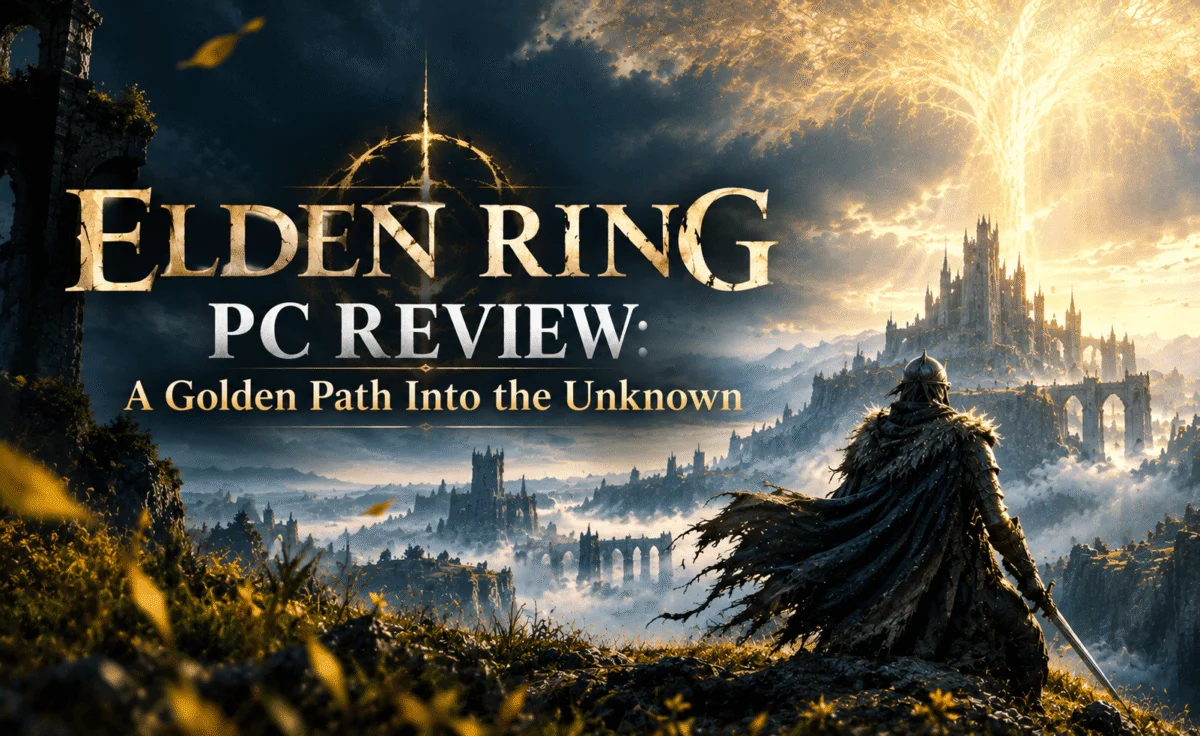
There is a moment, shortly after you leave the tutorial cave and ride out into the Lands Between, when Elden Ring quietly tells you what kind of game it is. A golden path stretches toward a distant tree, a castle looms on the horizon, and not a single marker, quest log, or tutorial arrow tells you where to go. You are being trusted. That trust, and the extraordinary world it unlocks, is the foundation of one of the most influential action RPGs ever released on PC.
Freedom as a Design Philosophy
From Software built its reputation on tightly constructed, interconnected worlds, and the studio’s earlier games were often described as corridors with attitude. Elden Ring takes the same design sensibility and blows the walls off. The result is an open world that feels less like a theme park and more like a place with its own geography, history, and indifference to your presence.
The key is how the game handles discovery. Instead of filling the map with icons, it fills the landscape with curiosities. A distant ruin might hide a boss, a puzzle, or a dead end with a single useful item. A cave could contain a punishing dungeon or a quiet secret. A suspicious-looking cliff can reveal a path to a region you were not expecting to reach for another ten hours. Because nothing is guaranteed, everything feels like a genuine find.
This structure also solves a problem that has long plagued the series: difficulty walls. In earlier games, being stuck on a boss meant being stuck on the game. Here, you can simply turn around and explore somewhere else, level up, find better equipment, or discover a different way to approach the challenge. Difficulty has not been diluted. It has been given an exit, and that exit makes the experience more welcoming without making it softer.
“The game does not hold your hand. It does something better. It leaves a door open and trusts you to find it.”
Combat That Rewards Patience and Experimentation
At its core, Elden Ring is a game about timing, positioning, and respect for your enemies. Dodge rolls, parries, shield blocks, and stamina management form the backbone of every encounter. Stamina is the great equalizer: every swing, every roll, every block costs something, and greed is punished swiftly.
What sets this game apart from its predecessors is the sheer breadth of options. Weapons come in dozens of categories, from nimble daggers to enormous greatswords and strange hybrids that defy easy description. Ashes of War allow you to swap the special abilities attached to a weapon, which means that a favorite blade can be reshaped to fit your evolving playstyle. Magic comes in two major schools, sorceries and incantations, each with its own stat requirements and tactical personality.
Perhaps the most significant addition is the spirit summon system. Spirit Ashes let you bring AI-controlled allies into difficult fights, and while some purists scoffed at the idea, it is a smart design choice. Summons can distract a boss, soak up damage, or simply make a tough fight more approachable for players who need it. They do not trivialize the game, because the strongest bosses still demand skill. They simply widen the doorway.
The jump button deserves its own mention. Mounted combat on Torrent, your spectral steed, transforms the way you travel and fight in open areas, and the ability to jump opens up verticality and secrets that earlier games could only hint at. Stealth, too, plays a larger role than before, rewarding players who prefer to scout, sneak, and strike from the shadows.
Bosses: Spectacle, Frustration, and Triumph
No review of a FromSoftware game would be complete without talking about its bosses, and Elden Ring has some of the best the studio has ever made. The big set-piece encounters, the demigods who rule each region, are spectacles of design: dramatic arenas, multi-phase fights, and attack patterns that feel intimidating and legible at the same time. The thrill of learning a boss, dying, adapting, and finally winning is as potent here as it has ever been.
That said, the game is not without its inconsistencies. Some late-game bosses lean on rapid-fire attack chains, delayed swings, and area effects that can feel overtuned, particularly in the final stretch. A handful of encounters cross the line from challenging to exhausting, and a few optional fights recycle bosses more often than they should. These are real criticisms, but they sit alongside genuine highlights that more than compensate.
The open world also introduces a pacing quirk. Because you can approach the game in so many orders, the difficulty curve can wobble. You may stumble into a region that is far more dangerous than your level suggests, or breeze through an area that was meant to be a significant obstacle. For many players this is part of the appeal, but if you prefer a carefully controlled escalation, the structure may take some getting used to.
Lore, Atmosphere, and the Art of Saying Less
Elden Ring’s storytelling is deliberately oblique. Rather than delivering its history through lengthy cutscenes, it scatters fragments through item descriptions, environmental details, and brief, cryptic conversations. The world was shaped with input from a famed fantasy author, and it shows in the mythic scale of the setting: shattered gods, fallen kingdoms, and rulers who have been broken by their own ambitions.
This approach will not suit everyone. If you want a clearly explained plot, you may find yourself frustrated by how much the game leaves to interpretation. If, however, you enjoy piecing together a mystery, reading the world like an archaeologist, and arguing with other fans about what everything means, the experience is deeply rewarding. The community around the game has produced a staggering amount of analysis, and much of the fun comes from joining that conversation.
The art direction is a masterclass. From the glowing, tragic beauty of its early regions to the sinister, decaying grandeur of its later ones, the game uses color, light, and architecture to build mood. A distant silhouette against a burning sky, a vast underground lake dotted with stars, a crumbling cathedral wrapped in vines: these are images that linger long after the console, or in this case the monitor, has been switched off.
“Elden Ring does not explain its world. It lets you fall in love with it, and then lets you realize you barely scratched the surface.”
The PC Experience
On PC, Elden Ring has had a mixed technical history, and it is worth being honest about it. Since launch, the game has been associated with occasional frame-time stutter, and shader compilation hitches were a common complaint in the early period. Patches have improved matters, but players with less powerful hardware may still encounter inconsistencies, particularly in dense or effect-heavy areas.
The positives are significant, however. The game supports widescreen setups, offers a wide range of graphical options, and is very friendly to remapped controls. Mod support exists for the single-player offline experience, but it is important to remember that the game’s online features use anti-cheat protection, and launching modded versions online can put your account at risk. Play it safe: keep modded sessions offline, and follow the official guidance for the build you are running.
The online systems themselves are a delight when they work. Summoning a friend, or a stranger, to help with a boss is simple, and the messages players leave on the ground, offering hints, jokes, or deliberate misinformation, add a human texture to the world. A small warning: beware of the message that says “try jumping.” It is often a lie.
The Expansion Question
The major expansion, Shadow of the Erdtree, deserves a mention for how much it adds. It introduces a large new region, fresh weapons, fresh enemies, and a difficulty level aimed squarely at players who have mastered the base game. It is a confident, ambitious piece of content that reaffirms the studio’s willingness to push its own formula. If you finish the main game and want more, it is well worth the investment, though it is intentionally tough and best tackled with a developed character.
Who Should Play It
If you enjoy action RPGs, exploration, and the satisfaction of overcoming real challenges, Elden Ring is essential. It is also arguably the most accessible entry point to the studio’s catalogue, thanks to its flexible structure and the safety valve of spirit summons. Players who dislike difficulty spikes, vague storytelling, or trial-and-error learning may bounce off, and that is fine. This is not a game that tries to please everyone. It is a game that tries to leave a mark.
Before you start, a few tips. Explore broadly in the early hours. Upgrade a weapon you enjoy rather than hopping between every new find. Do not be afraid to leave a hard boss and return later. And above all, talk to the strange characters you meet. They rarely say what they mean, but they almost always matter.
The Depplo Verdict
Elden Ring is a landmark in open-world design and a high point of FromSoftware’s craft. It has flaws, including technical bumps on PC, an occasionally overtuned late game, and a storytelling style that will frustrate players who want clarity. But those flaws sit inside a world so confident, so strange, and so full of discovery that the whole experience transcends them.
It is a game about courage, curiosity, and the stubborn joy of getting back up after you fall. On PC, with a little patience for its technical quirks, it is one of the most rewarding adventures you can undertake. Step into the Lands Between, follow the grace, and make your own path.
Score Breakdown
- Open world built on genuine discovery
- Huge variety of builds, weapons and spells
- Spirit summons widen the difficulty doorway
- Shadow of the Erdtree is a superb expansion
- Occasional stutter on PC
- Some late-game bosses feel overtuned
- Lore is deliberately cryptic
Reviewed by the Depplo Team. Scores reflect our editorial opinion. Browse more in Game Verdicts → PC Games.
About the Author